


10 Sep From Crosses to Sequences: How LaLiga Evolved (and What Coaches Should Train Next)
“What really changed in LaLiga? Not the speed of legs—but the grammar of the ball.”
A real sideline dilemma
Friday, pre‑match. One assistant argues for more direct play and early crosses. Another wants a higher press and longer spells on the ball. Which way does modern LaLiga actually tilt?
To move beyond opinion, the Football Intelligence & Performance Department at LALIGA consolidated multi‑season, longitudinal evidence across nine peer‑reviewed studies on team structure, playing style, offensive sequences and contextual factors. The aim: translate stable patterns into training and match‑prep decisions for elite staffs.
What we studied (without the lab coat)
Across 8–13 seasons of the Spanish top division (and comparisons with LaLiga 2 when relevant), the research quantified:
- Playing style & sequences: start zone, passes/sequence, duration, direct speed (ball progression speed), and how often sequences reach the final third or a shot.
- Technical events: passes, successful passes, shots, goals, crosses, corners, fouls.
- Collective structure: Width, Length, Height and GkDef (distance GK‑último defensor).
- Tactical templates: the distribution of formations (2012–2021).
All of it tracked season‑over‑season and by ranking groups, so the patterns are robust for applied use.
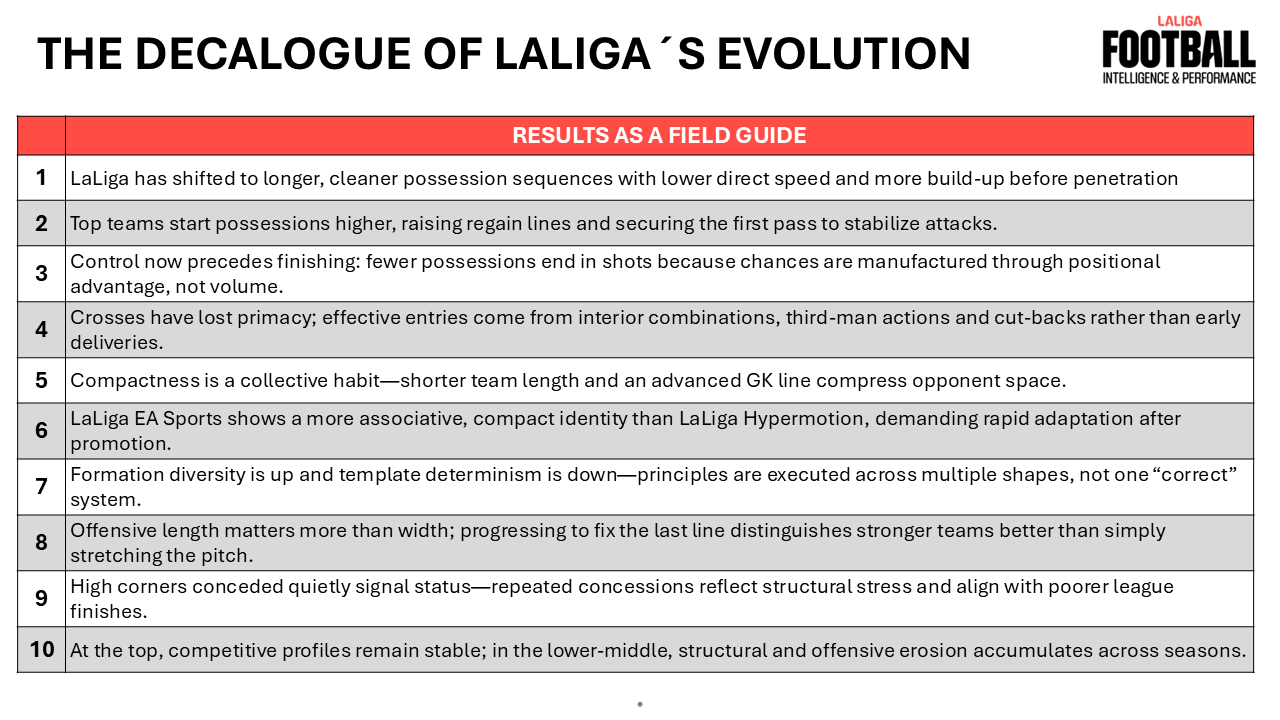
Results as a field guide: The Decalogue of LaLiga’s Evolution
1) Longer sequences, slower direct speed
LaLiga shifted toward more associative possession: +33% passes/sequence and longer duration, with a ~25% drop in direct speed of progression. The league builds more—and rushes less. Coaching cue: prize stabilisation passes after regain before verticality.
2) Higher starting positions for top teams
Champions and UCL teams start sequences higher upfield than the rest. As ranking drops, start zones retreat; direct speed rises. Coaching cue: lift your regain/start line 5–10 m in training games; protect first pass after recovery.
3) Control before finish: fewer sequences end in shots
Across 2008–2021, sequences ending in shots decreased, even as possession became tidier. Implication: shots are more manufactured than chanced. Coaching cue: train possession→penetration links (third‑man, wall pass, underlap) rather than volume crossing.
4) Crosses are not the shortcut to status
Over 13 seasons, higher‑ranked teams show more ball possession, passing accuracy and through balls—and do not rely on high crossing volume; in some comparisons, lower teams cross more. Coaching cue: prioritise entries via half‑spaces and cut‑backs over early, contested deliveries.
5) Compactness as a collective habit
From 2014/15–2018/19, Europe‑level teams played with shorter Length and GK lines closer to the last defender (lower GkDef) versus others; Upper‑Middle followed a similar Length trend. Coaching cue: rehearse 20–25 m team Length in mid‑block and coordinate the GK’s step‑up on circulation passes.
6) LaLiga vs LaLiga 2: identity shows in structure
Across eight seasons, LaLiga EA Sports teams displayed shorter Length and lower GkDef than LaLiga 2, alongside more passes and goals. This underlines an elite‑tier identity of tighter spacing and more associative play. Coaching cue: when promoted, compress vertical distances early; the league punishes stretched lines.
7) Formation diversity ↑, template determinism ↓
2012–2021 saw a significant shift in formation distribution. The lesson isn’t “pick the right system,” but “express the same principles through multiple shells.” Coaching cue: build weekly “same roles, different shell” rehearsals (e.g., carry your plan in 4‑3‑3, 4‑4‑2 and 3‑4‑2‑1).
8) Offensive length matters more than width
Champions achieve longer offensive sequences than middle/relegation teams; differences in offensive width are less consistent. Coaching cue: teach length by fixing the last line (pinning runs) and arriving with a free man, not by stretching width for its own sake.
9) Corners conceded: a quiet separator of status
A longitudinal top‑3 vs bottom‑3 comparison shows unsuccessful teams concede more corners, a repeatable defensive stress signal. Coaching cue: audit why your block yields corners (late blocks? poor rest‑defence? clearances under pressure?) and fix the source, not only set‑piece routines.
10) Stability at the top, erosion in the lower‑middle
Over eight seasons, Europe and Upper‑Middle profiles are relatively stable; Lower‑Middle teams show a worsening in key outputs (e.g., fewer shots; structural compaction lag). Coaching cue: if you sit 12th–17th, set quarterly targets on sequence start, passes/sequence and Length—these are levers that move status.
So what do we train on Monday? Four levers to operationalise
- Where sequences start: raise average start zone; design regain‑to‑retain games (first two passes must stick).
- How long they last: set passing floors per attack and reward stability actions before the vertical hit.
- How compact you stay: coach team Length windows and GK line behaviour as part of build‑up.
- How you finish: replace “more crosses” with structured entries (third‑man, underlaps, cut‑backs).
Methodological note (honest, not weakening)
The studies aggregate thousands of matches over multiple seasons and control for context (e.g., location, opponent quality) where modelled, but some analyses rely on predefined provider variables and do not split phases (attack vs defence) in all designs. Tracking tech upgrades across years can add noise. Use relative benchmarks and track within‑team deltas, not absolutes.
Selected publications (DOI)
- An eight-season analysis of the teams’ performance in the Spanish LaLiga according to the final league ranking (https://doi.org/10.1371/journal.pone.0299242).
- Evolution of physical and technical parameters in the Spanish LaLiga 2012-2019 (https://doi.org/10.1080/24733938.2022.2049980)
- Evolution of Tactics in Professional Soccer: An Analysis of Team Formations from 2012 to 2021 in the Spanish LaLiga (https://doi.org/10.5114/jhk/167468)
- No sport for old players. A longitudinal study of aging effects on match performance in elite soccer (https://doi.org/10.1016/j.jsams.2022.03.004)
- Performance analysis of the teams that remained in the top-tier division of the Spanish LaLiga during eight consecutive seasons (https://doi.org/10.1177/17543371241232034)
- A longitudinal analysis of technical-tactical and physical performance of the teams in the Spanish LaLiga Santander: An eight-season study (https://doi.org/10.5114/biolsport.2022.105331)
- An Extensive Comparative Analysis of Successful and Unsuccessful Football Teams in LaLiga (https://doi.org/10.3389/fpsyg.2019.02566)
- Differences in playing style and technical performance according to the team ranking in the Spanish football LaLiga. A thirteen seasons study (https://doi.org/10.1371/journal.pone.0293095)
- Technical and tactical evolution of the offensive team sequences in LaLiga between 2008 and 2021. Is Spanish football now a more associative game? (https://doi.org/10.5114/biolsport.2024.131818)