


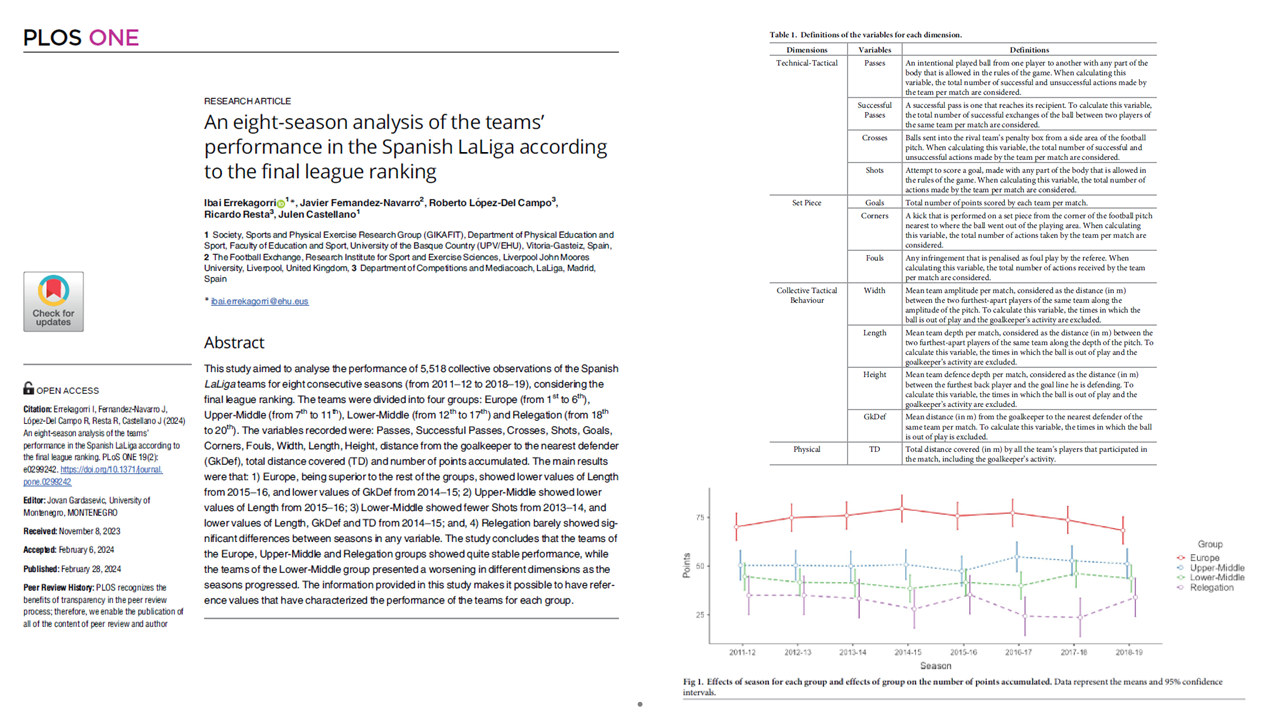
28 Feb An eight-season analysis of the teams’ performance in the Spanish LaLiga according to the final league ranking
This study looks at how teams in LaLiga really perform over time. Not just in one season. Across eight full seasons. From 2011–12 to 2018–19. More than 5,500 team performances were analysed. The teams were grouped by where they finished in the table. Champions League level. Upper-middle. Lower-middle. Relegation level.
The first key message is simple. The best teams are not chaotic. They are stable. Teams that qualify for Europe show very similar performance profiles year after year. Their numbers barely fluctuate. Passes. Successful passes. Shots. Collective spacing. Everything stays under control. Success in elite football is built on consistency.
Top teams dominate the ball. They pass more. They pass better. And they shoot more than the rest. This is not about aesthetics. It is about probability. More passes lead to more control. More control leads to more shots. More shots increase the chance of winning matches. Training environments should reflect this. Sessions must allow players to accumulate many high-quality passes under pressure. Not just rondos. Game-like situations. With intention.
Another important finding is how space is managed. Over the years, top teams reduced their team length. They play more compact. Shorter distances between lines. Less space between the goalkeeper and defenders. This means higher collective density. More support around the ball. Faster reactions after loss. This is not random. It reflects a tactical evolution. Training should replicate these distances. Pitch sizes matter. Task constraints matter.
The goalkeeper also becomes more involved. The reduced distance between goalkeeper and defenders shows a clear trend. The goalkeeper is part of the build-up. A real outfield player in possession. This has direct implications for training design. Goalkeepers must be integrated daily. Not isolated. Especially when working on build-up and pressing resistance.
Upper-middle teams follow a similar path. But with less quality. They also reduce team length over time. They try to play more compact. But they cannot always sustain it with the same efficiency. This often results in higher physical demands without the same tactical payoff. Coaches working with these teams should be careful. Compactness without coordination leads to fatigue. Not performance.
The most worrying profile appears in lower-middle teams. These teams progressively lose shots. They cover less total distance. They become less aggressive in attack. This is a dangerous combination. Fewer shots mean fewer goals. Less running often reflects passive behaviour, not efficiency. These teams slowly drift toward survival mode. Training must fight this tendency. Attacking intent must be protected. Even under pressure.
Relegation teams show something different. Almost no evolution. Their performance profile barely changes across eight seasons. This suggests a structural limitation. Not a seasonal one. These teams often repeat the same behaviours. Same distances. Same spatial use. Same attacking output. Without intervention, outcomes remain the same. Data confirms it.
From a physical perspective, total distance covered is not what separates winners from losers. Upper-middle teams actually run more than top teams. But they win less. Running more is not the solution. Running better is. The best teams manage space and ball. Physical output serves the game model. Not the other way around.
For performance staff, this study provides reference values. Clear benchmarks by league level. It helps answer practical questions. Are we compact enough? Are we generating enough shots for our ranking objective? Are we running because we want to, or because we are chasing?
This paper reinforces a key idea. Football success is not about extremes. It is about stability. Control. And intelligent use of space. Training, match preparation, and recruitment should all align with this reality.