


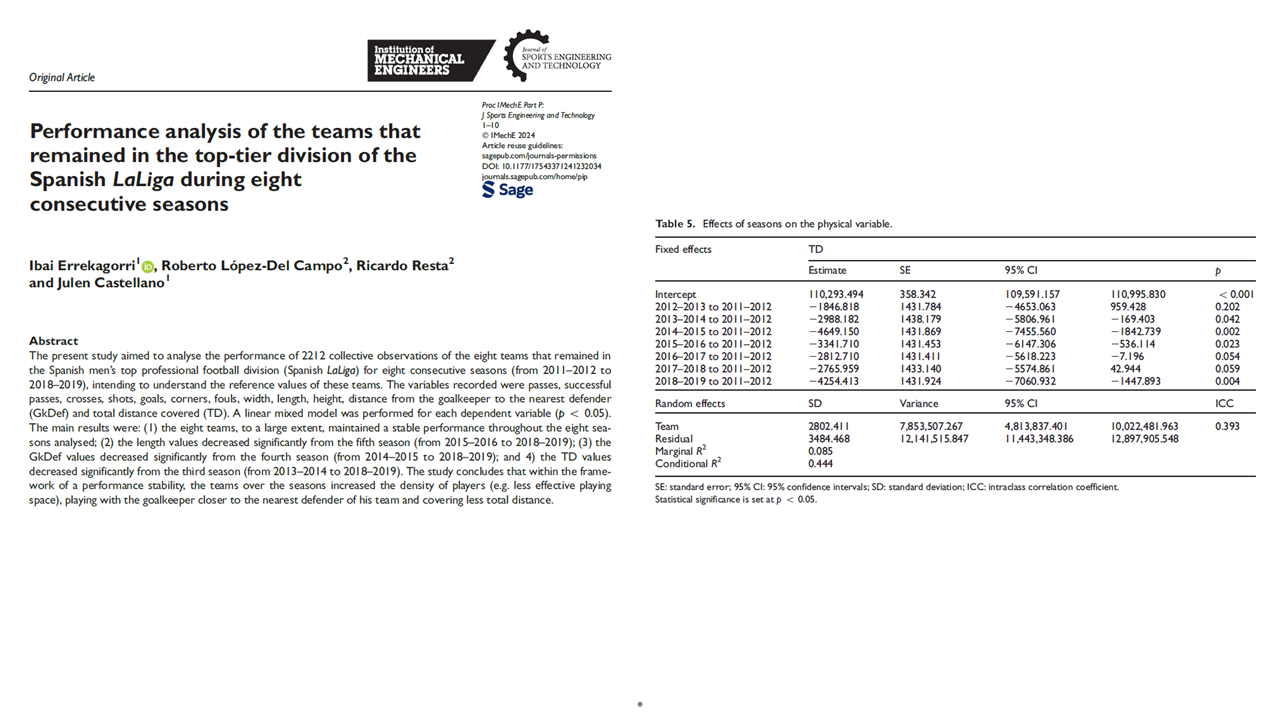
08 Feb Performance analysis of the teams that remained in the top-tier division of the Spanish LaLiga during eight consecutive seasons
Staying in LaLiga year after year is not about chasing trends. It is about building a stable, repeatable way of competing. This study looked at eight teams that managed exactly that. Eight seasons in a row at the highest level. No relegation. No shortcuts. Just consistency.
More than 2,200 team performances were analysed across eight full seasons. From 2011–2012 to 2018–2019. The goal was simple. Identify what does not change when teams survive at the top. And understand what subtly evolves over time.
The first key message is clear. These teams were remarkably stable. Passes. Successful passes. Shots. Goals. Fouls. All stayed within very similar ranges across eight seasons. This matters. It shows that long-term success in LaLiga is not about constant reinvention. It is about protecting a solid performance base.
For coaches, this is a powerful reference. If your weekly outputs fluctuate wildly, something is wrong. The teams that survive do not swing from extreme to extreme. They stay predictable in the right way. Their baseline performance is reliable.
One of the few attacking actions that did change was crossing. In the last two seasons analysed, these teams crossed less. This suggests a shift towards more central, controlled attacking structures. Fewer hopeful balls. More patience. More positional play. For analysts, this reinforces the idea that volume of actions is not the goal. Quality and context matter more.
Set pieces showed a similar pattern. Corners slightly decreased over time. Goals stayed stable. Fouls stayed stable. The message is not that set pieces lost importance. It is that successful teams do not rely on chaotic game states to survive. They reduce randomness.
The most interesting insights come from collective team behaviour. Over the seasons, teams played in less space. Width stayed the same. Length decreased. Players were closer together. The effective playing area became denser.
This has direct implications for training. Compactness is not just a defensive concept. It is a game model. Training tasks that stretch the team too much vertically may look attractive, but they do not reflect how top teams actually compete over time. Small vertical distances. Short connections. Faster support.
The goalkeeper’s role also changed. The distance between the goalkeeper and the nearest defender became shorter from season four onwards. This points to a more integrated goalkeeper. A goalkeeper who is part of the team structure. Both in build-up and in defensive organisation.
For coaches, this reinforces the importance of training the goalkeeper with the team. Not in isolation. Decision-making. Positioning. Timing. The goalkeeper is no longer a last resort. He is part of the system.
From a physical perspective, total distance covered decreased over time. This is critical. The teams that stayed in LaLiga did not run more. They ran better. Total metres went down, while performance remained stable.
This challenges outdated beliefs. High total distance is not a success marker. Efficient positioning, better spacing, and smarter collective movement reduce unnecessary running. Conditioning staff should not chase volume for its own sake. The goal is functional load.
The big takeaway is simple. Stability wins leagues. Not peak values. Not extremes. Consistent technical output. Compact team structures. Integrated goalkeepers. And controlled physical demands.
This study provides real reference values for elite football. Not from one season. From eight. If your team wants to survive at the top, these are the behaviours that matter.