


02 Sep “Does Being Faster Really Make You Win More?”
A scenario from the pitch
Picture this: you’re preparing your team for a decisive match. In your analysis session, someone highlights the top speed of your star forward—“He hit 35 km/h last week.” The question lingers: does that raw maximum sprint speed really matter for winning games across a long season? Or is it just a number that looks good in a report?
This is exactly the kind of assumption we wanted to test at LALIGA’s Football Intelligence & Performance Department. We set out to investigate whether the maximum running speed of players truly influences a team’s success in a full professional league season.
Introduction: A popular belief put to the test
Modern football is obsessed with speed. Broadcasters highlight the fastest sprints, scouts use it as a metric of talent, and fans share clips of players hitting top gear. But the game is more complex: most decisive actions involve positioning, decision-making, and execution rather than hitting maximum velocity.
Previous studies have shown that high-intensity running differentiates elite players from lower levels and that sprints often precede goal-scoring situations. But no one had asked the most direct question: do teams with faster players finish higher in the league?
Methods: Measuring speed across an entire season
To answer, we analysed 475 players in LALIGA EA Sports during the 2017/18 season, using the Mediacoach® multicamera tracking system. Every sprint across 38 fixtures was recorded.
- Peak speed per match was identified for each player.
- Maximum seasonal speed was defined as the fastest value reached by that player across the season.
- Players were grouped by position (defenders, midfielders, forwards).
- Teams were compared by their squad’s maximum speed and their final ranking.
The research was conducted under strict scientific protocols and reviewed in a peer-reviewed journal.
Results: Surprising stability, limited influence
The findings challenge conventional wisdom:
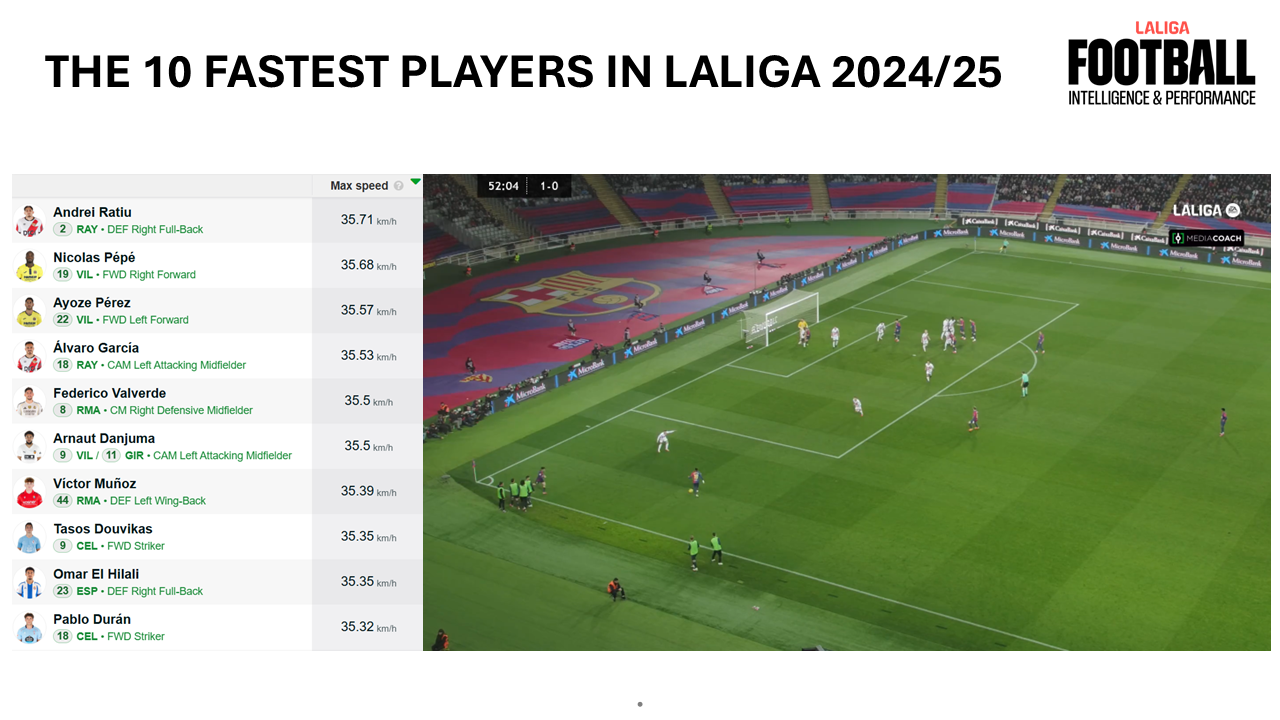
- Most players (over 94%) reached at least 30 km/h during the season. Only three surpassed 35 km/h.
- Forwards were the fastest, followed by defenders, then midfielders.
- Maximum running speed did not explain league success. The statistical association between a team’s fastest players and its final ranking was weak, explaining only 7.5% of the variance.
- Speed values were stable throughout the season. Players could reach maximum speed from the very first fixture, even before accumulating full match fitness.
Discussion: What coaches and analysts should take away
This study confirms something many practitioners intuitively sense: raw maximum sprint speed is not a reliable marker of team success across a season.
Why does this matter?
- Training priorities: Instead of investing heavily in marginal gains for maximum speed, coaches may obtain more impact by focusing on repeated sprint ability, acceleration/deceleration in small spaces, and tactical uses of speed.
- Match analysis: When evaluating opponents, maximum top speed is a less meaningful differentiator than context-specific actions: sprints with the ball, recovery runs, or pressing distances.
- Player development: Ensuring players reach at least 30–32 km/h is useful, but beyond that threshold, the advantage is minimal unless combined with decision-making and timing.
Broader context from the literature
- Chmura et al. (2022) showed that in the Bundesliga, sprinting distance with ball possession predicted team points, not just sprinting without context.
- Faude et al. (2012) highlighted that straight sprints often precede goals, but it is the timing and context that matter most.
- Andrzejewski et al. (2022) reinforced that technical metrics (shots, goals, possession) are stronger predictors of success than raw running speed.
Together, these findings refine our understanding: speed matters, but only when integrated into tactical and technical execution.
Limitations and honest reflections
This research was limited to one full LALIGA season and focused solely on maximum velocity. It did not consider contextual variables such as tactical systems, match location, or pressing styles, which may influence how speed is expressed. Future studies should integrate these factors.
Still, the message for coaches is clear: treat maximum sprint speed as one data point, not a performance compass.
Conclusion: From assumption to evidence
Football often celebrates speed as a symbol of superiority. But our data show that being faster does not necessarily mean finishing higher in the table. Success comes from integrating physical qualities into the team’s tactical identity.
For coaches, analysts, and physical trainers, the pitch should be seen as a living laboratory. Use data not to confirm assumptions, but to test them. Ask: Does this metric really make us win more? If not, shift focus to what does.
Learn more
- 📄 Full article: https://doi.org/10.3390/ijerph17238815