


09 Mar How to Measure Defensive Blocks in Football Using Tracking Data
Concepts like low block, mid block, or high block are deeply embedded in the language of football.
Coaches use them when preparing matches.
Analysts rely on them when describing defensive strategies.
Commentators frequently mention them during broadcasts.
Despite their widespread use, these concepts are rarely measured objectively.
In practice, the classification of defensive blocks often depends on subjective interpretation. Two analysts may watch the same defensive sequence and describe the structure differently. One may see a mid block, while another may argue that the team was defending deeper.
This raises an important question for modern football analysis:
Can defensive blocks be measured objectively using tracking data?
With the increasing availability of positional data, it is now possible to analyse the spatial organisation of teams in unprecedented detail. But turning that data into meaningful tactical insight requires more than simply tracking player positions.
It requires models that capture how teams actually behave on the pitch.
Why Defensive Blocks Are Difficult to Measure
At first glance, detecting a defensive block might seem straightforward. A simple approach would be to calculate the average position of the defending team and classify the block based on its distance from goal.
However, football is far more complex than that.
Consider a situation where the two forwards press high up the pitch while the rest of the team remains deeper. A centroid-based approach might suggest that the team is defending in a mid block, even though the defensive line is positioned much closer to its own goal.
Similarly, teams often become stretched during long attacking sequences. In these situations, the distance between the first pressing line and the defensive line can increase significantly, creating structures that are difficult to classify with a single metric.
This is why measuring defensive blocks requires understanding not only where the team is located, but also how the defensive structure is organised internally.
Two teams may defend in similar areas of the pitch but behave very differently depending on their compactness, line stability, and spatial coverage.
Capturing these differences is essential for meaningful tactical analysis.
A Model for Detecting Defensive Blocks
To address these challenges, the proposed model analyses defensive structures using player tracking data and classifies them along two key dimensions.
These dimensions capture both the location of the defensive structure and its internal organisation.
The first dimension describes where the defensive structure is positioned on the pitch.
The model classifies defensive structures into three categories:
- Low block
- Mid block
- High block
Rather than relying on a simple average position, the model evaluates the spatial distribution of players across the defensive structure.
Robust statistical measures are used to reduce the influence of outliers. This is particularly important in situations where one or two players temporarily move far from the rest of the team, for example when pressing aggressively or attempting to intercept a pass.
By analysing the distribution of player positions, the model estimates a stable representation of the block’s height while maintaining sensitivity to collective movements of the team.
This approach provides a more reliable description of defensive organisation than traditional centroid-based methods.
Dimension 2: Length of the Defensive Block
While block height indicates where the team is defending, it does not describe how coordinated the defensive structure is.
For this reason, the second dimension measures the vertical length of the defensive block.
In practical terms, this corresponds to the distance between the highest and lowest segments of the defensive structure.
Defensive blocks are therefore classified as either:
- Compact
- Long
A compact block indicates that the different lines of the team move together, maintaining relatively small distances between players.
A long block, on the other hand, often emerges when the first line presses higher while the defensive line remains deeper. This situation can lead to structural disconnections that opponents may exploit.
Understanding whether a team defends with a compact or stretched structure provides important context when analysing defensive effectiveness.
Why Defensive Sequences Matter
Another key feature of the model is the level of analysis.
Many spatial metrics in football are calculated across an entire match or within fixed time windows.
However, defensive behaviour in football evolves dynamically throughout each attacking phase.
For this reason, the model analyses defensive organisation at the level of defensive sequences.
Each attacking phase faced by the defending team is evaluated individually, allowing the model to capture how defensive structures change over time.
This approach makes it possible to move beyond static descriptions and analyse patterns such as:
- which defensive blocks appear most frequently
- which structures lead to higher defensive vulnerability
- how teams adjust their defensive organisation during prolonged attacking sequences.
Analysing defensive behaviour sequence by sequence provides a far more realistic representation of how teams defend during matches.
Example: Analysing a Defensive Sequence
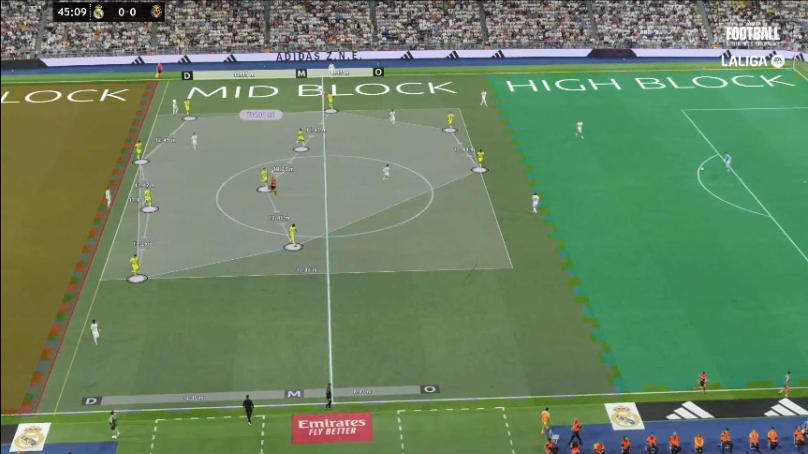
To illustrate how the model works in practice, consider a sequence from a match between Real Madrid and Villarreal.
During a sustained attacking phase by Real Madrid, Villarreal defends primarily in a mid block structure.
The model detects that the defensive shape remains relatively compact throughout most of the sequence, indicating a coordinated zonal defensive organisation.
The visualization of the sequence highlights several elements:
- the height of the defensive block
- the width and depth of the team structure
- the stability of the defensive, midfield and attacking lines
- the spatial coverage of the defensive unit.
Although the sequence eventually ends in a goal for Real Madrid, analysing the defensive structure throughout the attacking phase reveals how Villarreal attempted to control space and limit progression.
This type of analysis allows analysts to move beyond describing outcomes and instead examine the defensive processes that led to those outcomes.
Practical Applications for Tactical Analysis
Automatically detecting defensive blocks opens the door to several practical applications in football analysis.
For analysts and coaches, this type of model makes it possible to answer questions such as:
- In which defensive structures does a team concede the most dangerous attacks?
- How often does a team become stretched defensively?
- Which defensive blocks are most effective at preventing progression into dangerous areas?
- How does defensive organisation vary depending on the opponent or match context?
By combining positional data with tactical modelling, analysts can transform tracking data into insights that directly support match preparation and post-match analysis.
Beyond Defensive Blocks
While this model focuses on detecting defensive blocks, the same framework can be extended to analyse other aspects of defensive organisation.
Future developments may include:
- identifying man-oriented defensive structures
- detecting pressing behaviours and triggers
- analysing line stability and defensive synchronisation
- measuring dynamic compactness during attacking phases.
These extensions would allow analysts to capture an even richer representation of collective defensive behaviour.
From Positional Data to Tactical Insight
Tracking data has dramatically expanded the possibilities for football analysis.
However, raw positional data alone does not automatically translate into meaningful tactical understanding.
The real value emerges when spatial data is interpreted through models that reflect how teams actually organise themselves on the pitch.
Defensive blocks are one of the most fundamental concepts in football tactics.
The challenge today is not defining them — coaches have been doing that for decades.
The challenge is measuring them objectively.
Because in modern football analysis, the goal is not simply to collect data.
It is to transform positional data into actionable tactical insight.