


14 Dic A multilayer network framework for soccer analysis
Modern football is complex. It is not just about passes completed or possession percentage. It is about where the ball moves, how it is lost, and how it is recovered. And always in relation to the opponent.
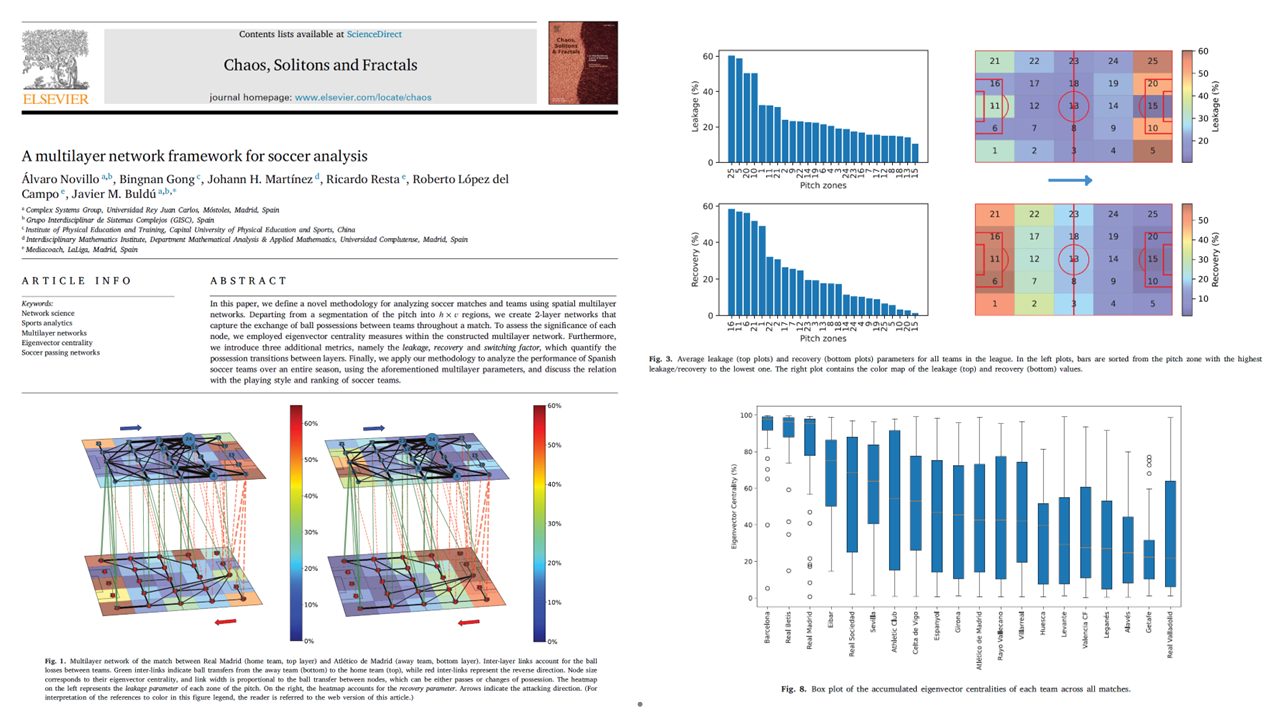
This paper introduces a new way to read the game. A multilayer network approach that connects both teams in the same analytical framework. One layer represents your team. The other represents the opponent. The link between them is possession change. In simple terms, this model allows coaches and analysts to see football as it really happens. As a continuous interaction between two competing systems.
The pitch is divided into zones. Every pass connects zones. Every ball loss and recovery connects teams. Over a full season of LaLiga matches, this approach reveals patterns that traditional statistics cannot show.
One key concept is eigenvector centrality. This metric identifies the most influential zones of the pitch, not by volume alone, but by their importance within the whole passing structure. The results are clear. Central areas of the pitch dominate the game. Not because they are used more, but because they connect everything else. Control the center, and you control the rhythm.
Then come three new metrics with direct practical value.
Leakage shows where teams tend to lose the ball. High leakage zones are risky zones. Corners and wide areas near the opponent’s box stand out. These are places where possession is fragile and decision-making must be fast and precise.
Recovery shows where teams regain possession. Defensive zones close to the box are critical. High recovery values reflect compact defending, numerical superiority, and good positioning. This directly links defensive structure with transition success.
Switching factor measures how often possession changes between teams. Teams with high pressing and direct play show high switching values. Teams that dominate possession show low values. Neither is good or bad by default. It depends on the game model.
Across the season, different playing styles emerge clearly. Possession-based teams show strong centrality and low switching. Direct and high-pressure teams lose the ball more often but recover it quickly. The model does not judge styles. It explains them.
For coaches and performance staff, the application is immediate.
You can identify where your team is most vulnerable when building up. You can see if your pressing recovers the ball where you want it. You can adapt training tasks to reinforce key zones. You can compare your style objectively against opponents. And you can understand transitions not as moments, but as spatial patterns.
This framework helps move from isolated metrics to connected thinking. From single-team analysis to true game interaction. It does not replace tactical insight. It enhances it.
This is football seen as a living system. Dynamic. Competitive. Spatial. And measurable.