


15 Ene Why do teams in numerical superiority reduce their physical intensity instead of exploiting the advantage?
Introduction: a familiar scenario in elite football
A red card changes everything.
As a coach or performance staff member, you have seen it countless times. The opponent goes down to ten players. Instinct says: now is the moment. Push higher. Increase tempo. Make the pitch bigger. Break resistance.
But when we looked at the data, that is not what consistently happens.
In our latest peer-reviewed research, led by J. C. Ponce-Bordón as Principal Investigator and conducted by the Football Intelligence and Performance Department at LALIGA, we found a pattern that challenges a deeply rooted assumption in football: teams playing with numerical superiority tend to reduce their physical intensity instead of increasing it.
Not in total distance alone. But in distance per minute. In sprint frequency. In the very indicators that reflect how aggressively a team imposes itself physically.
This article translates that research into applied insights. No equations. No academic jargon. Just evidence, logic, and questions worth asking.
The assumption we decided to test
Football culture carries a powerful belief:
With one more player, you should dominate physically.
It sounds logical. More players. More options. Less space to cover per individual. Greater control.
But logic is not evidence.
Our goal was simple: to test whether numerical superiority actually leads to higher physical intensity at elite level, once time, position, and context are properly accounted for.
How we studied it (without the academic noise)
This research was conducted on LaLiga matches from the 2021/22 season, using tracking data from the Mediacoach® system.
Key methodological points matter here:
- We analysed individual running performance, not team totals
- All metrics were normalised per minute (m/min, sprints/min)
- We excluded short appearances to avoid inflation effects
- We modelled data using linear mixed models, accounting for player, team, position, match context, and game state
In short: we compared intensity, not volume.
This distinction is crucial. Without it, the conclusions would be trivial.
What the data clearly shows
1. Numerical superiority does not increase physical intensity
Across the sample, teams playing 11 vs 10 showed:
- Lower total distance per minute
- Fewer sprints per minute
This pattern appeared consistently, even after controlling for playing position, match location, and competitive level.
In other words:
With one more player, teams do not run harder. They run less.
This is not an interpretation. It is a measurable result.
2. The effect is even stronger in specific contexts
Two situations deserve special attention.
Playing at home
Home teams with numerical superiority reduced their physical intensity more clearly than away teams.
When the team in inferiority improves the scoreline
In matches where the team with ten players ended up improving the score, the team with eleven showed an even greater reduction in running intensity.
We are not saying this causes the score change.
We are saying the pattern exists.
And patterns raise questions.
Is this inefficiency, or strategic efficiency?
Here is where interpretation must remain disciplined.
The data does not tell us that teams are wrong.
It tells us that teams choose control over intensification.
With numerical superiority, teams appear to:
- Slow the game
- Increase positional security
- Reduce unnecessary high-intensity actions
This can be understood as a principle of efficiency, not as a mistake.
But it also opens a legitimate performance question:
Is the physical advantage of numerical superiority being fully exploited, or partially left unused?
That is not criticism. That is inquiry.
Why this matters for practitioners
This is not about running more for the sake of running more.
It is about understanding what your data is really telling you.
If a player or team shows lower running metrics in 11v10 situations, this does not automatically indicate:
- Lower effort
- Poor physical condition
- Reduced competitiveness
It may reflect:
- Tactical control
- Reduced need for high-intensity actions
- A deliberate pacing strategy
Misreading this can lead to poor decisions in:
- Player assessment
- Match preparation
- Load interpretation
- Readiness evaluation
A scientific mindset applied to football reality
One of the most dangerous traps in performance analysis is assuming that “higher level” always means “more”.
More distance.
More sprints.
More intensity.
Our research does not deny differences between competitive contexts.
It nuances them.
Football is not a laboratory where intensity must always increase with advantage. It is a complex system where context reshapes physical behaviour.
That is why we insist on this point:
Data does not replace judgement. But it sharpens it.
Limitations worth acknowledging
To remain fully transparent:
- We did not account for effective playing time, which may influence intensity metrics
- Tactical adjustments after red cards were not directly measured
- Psychological states were not directly assessed
These limitations do not invalidate the findings.
They simply define their scope.
Final thought: a better question to ask
Instead of asking:
“Why didn’t we run more with one extra player?”
A better question might be:
“What problem were we trying to solve by running less?”
That question leads to better conversations.
And better football.
A note on timing: when the red card happens also matters
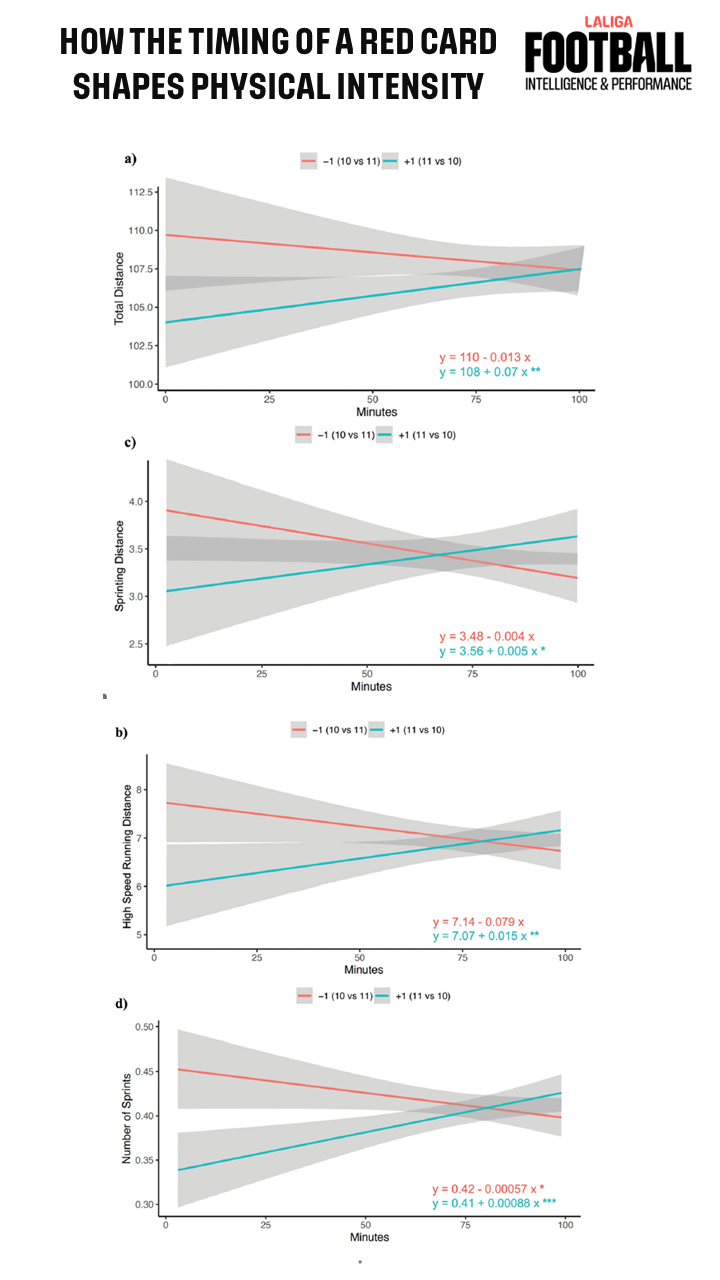
The figure accompanying this article adds an important layer of nuance. It does not compare effort between teams in absolute terms. Instead, it shows how the timing of a red card modifies physical behaviour in each numerical scenario.
Although the team in numerical superiority appears higher in absolute adjusted values — which is expected when one team keeps eleven players on the pitch — the key information lies in the direction of the trends. When the red card occurs later in the match, teams in inferiority show a progressive reduction in their ability to sustain physical intensity. At the same time, teams in superiority tend to increase their intensity only when the dismissal happens in advanced phases of the game.
This reinforces a central idea of the study: numerical superiority is not exploited physically in a uniform way throughout the match. The advantage exists, but how and when it is expressed depends strongly on context. For practitioners, the takeaway is clear. Interpreting physical data without considering when a red card occurs can easily lead to misleading conclusions.
Research reference
This study was conducted by the Football Intelligence and Performance Department at LALIGA, with J. C. Ponce-Bordón as Principal Investigator, and published in a peer-reviewed journal.
DOI: https://doi.org/10.1080/24748668.2025.2610880