


29 Abr Offside Control: A pitch control parameter to evaluate the offside performance of soccer teams
Offside is usually judged in black and white. Onside or offside. Correct or incorrect.
This study shows that reality is far more nuanced.
The paper introduces a new concept called Offside Control. It measures how much real attacking threat a team creates behind the defensive line, not just whether players cross it illegally. It uses tracking data to quantify space, timing, speed, and positioning around the offside line. The result is a much clearer picture of how teams and forwards actually exploit defensive depth.
The key idea is simple. Not all space behind the defensive line is equal. And not all offside actions are bad. Offside Control measures how much pitch control the attacking team generates beyond the last defender. It then separates this into effective and ineffective control.
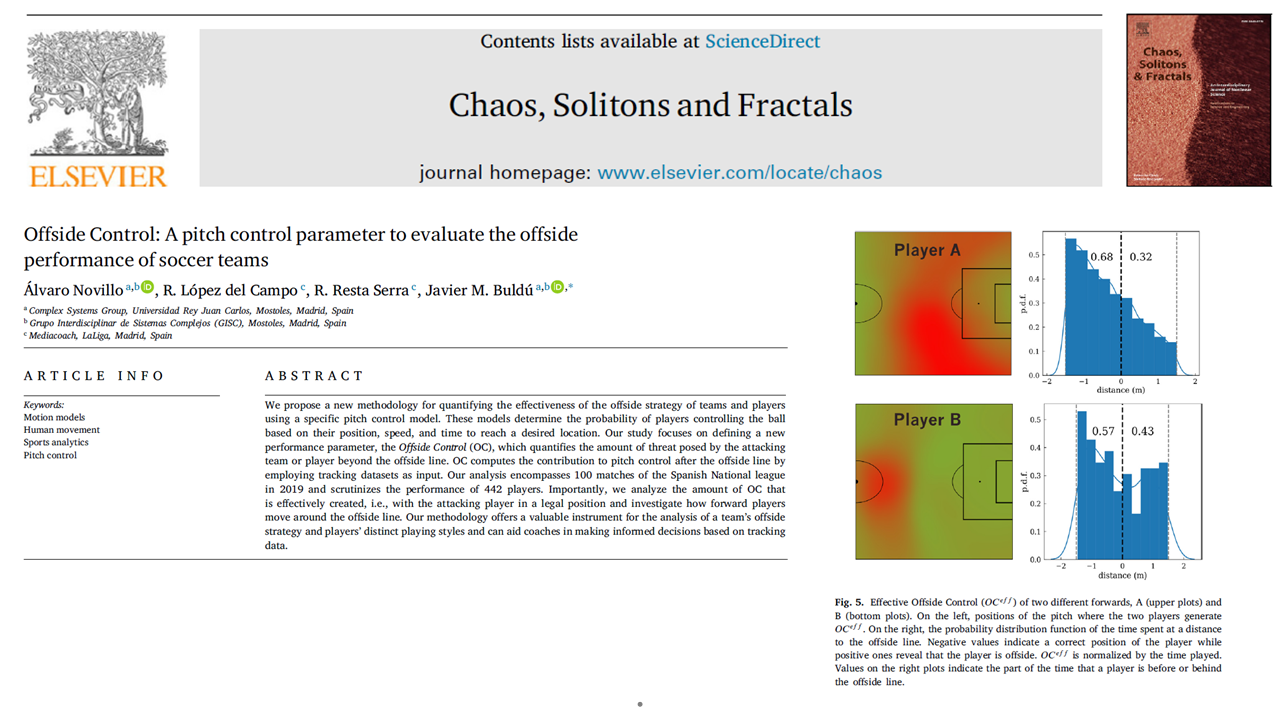
Effective Offside Control happens when a player stays onside but still threatens the space behind the defence. Ineffective Offside Control happens when that threat is generated from an offside position. Both exist constantly during a match. Both influence how defenders behave.
From a coaching perspective, this changes how offside behaviour should be interpreted. A forward standing half a metre offside may still be manipulating the defensive line. That movement can stretch defenders, delay their advance, or open space for teammates. The metric does not judge intention. It describes what is happening on the pitch.
At team level, Offside Control allows staff to see where danger is created and where it is conceded. Heatmaps show whether a team threatens centrally, through half-spaces, or wide channels. They also reveal how deep that threat is. Creating control close to the box is not the same as creating it near the halfway line.
Teams that generated more effective Offside Control than they conceded tended to finish higher in the table. This does not mean Offside Control causes success. It means it describes a behaviour commonly present in successful teams. It captures how often a team pins the opponent back without being caught offside.
This has clear implications for match preparation. Against high lines, coaches can assess whether their team truly threatens the space behind or only occupies it without control. Against deep blocks, they can detect when Offside Control drops, often before chances disappear.
The study also shows how Offside Control evolves during a match. When teams go ahead, Offside Control often decreases. The threat behind the line reduces as the team protects the score. This drop can be detected minutes before goals are conceded or phases of dominance change. For analysts, this offers an early warning signal.
At player level, the model is especially powerful for forwards. It identifies where each striker generates effective threat behind the line. Some forwards create danger centrally and close to goal. Others do it wider or at greater depth. These patterns are stable across matches.
Crucially, the study shows that the best forwards spend most of their time close to the offside line but on the correct side of it. The more time a player operates near the line while staying onside, the higher the proportion of effective Offside Control they generate. Timing, not speed alone, becomes the key performance skill.
This has direct implications for training. Finishing drills, positional games, and pattern work should not only reward runs in behind. They should reward runs that create control without crossing the line too early. Video feedback supported by Offside Control data can help players understand this balance far better than offside flags alone.
For defensive units, Offside Control provides a way to evaluate line height and coordination. A defence may catch many offsides but still concede large amounts of effective Offside Control. That usually means poor pressure on the ball or inconsistent stepping. The metric highlights those weaknesses.
The study also warns against simplistic interpretation. Ineffective Offside Control is not always bad. Sometimes it is used deliberately to fix defenders and free teammates. This metric should never be used to punish players. It should be used to understand collective behaviour.
Overall, Offside Control bridges the gap between tactical intention and spatial reality. It moves the conversation beyond offsides called by referees. It quantifies how teams and players actually interact with the defensive line over time.
For elite football environments, this provides a powerful tool. It supports recruitment, player development, opposition analysis, and in-game monitoring. Most importantly, it turns a rule into a performance variable.