


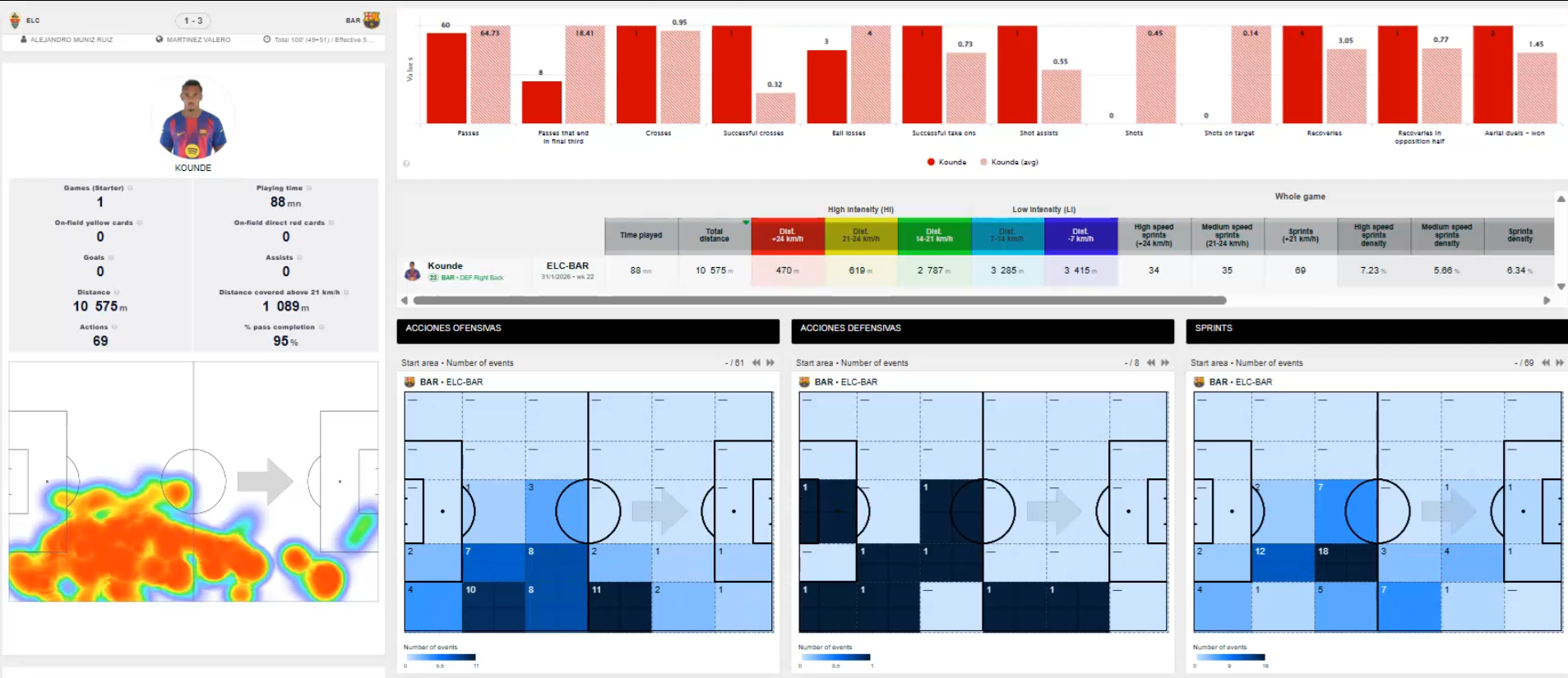
17 Feb Performance is not individual. It is relational.
We compare players every week.
Total distance. High-speed running. Duels. Passes. Defensive actions.
We assume those numbers describe the player.
But do they?
In professional football, performance does not emerge in isolation. It emerges in interaction. And that interaction has a name: the opponent.
The uncomfortable question
If the same player produces different outputs depending on who he faces, are we really measuring quality? Or are we measuring context?
Research using four full seasons of LaLiga data showed that the strongest predictor of a team’s total distance was not match location, not possession time, not team level. It was the opponent’s total distance. For every additional kilometre run by the rival, the team ran approximately 0.71 km more on average (https://doi.org/10.5114/biolsport.2024.132984).
That finding alone should change how we interpret match data.
Your physical output partly mirrors the rival’s behaviour.
Another large-scale study analysing match movement profiles according to opponent ranking confirmed that total distance, high-intensity running, and work with and without possession all vary depending on rival quality (https://doi.org/10.3390/app122412635). Teams do not express the same locomotor profile against top-ranked opponents as they do against lower-ranked ones. The problem changes. The response changes.
From a tactical-structural perspective, network science analysis has shown that some teams consistently impose their passing patterns on rivals, while others adapt (https://doi.org/10.1038/s41598-020-76835-3). In some matches, you dictate the game. In others, you react. The numbers will reflect that dynamic.
What this means for practice
When we compare players across matches without adjusting for opponent strength, tempo, or style, we introduce bias.
A midfielder facing a high press will accumulate different physical and technical actions than the same midfielder facing a deep defensive block. Not because he is better or worse. Because the task constraints differ.
This has direct consequences for:
– Scouting. Are we contextualising outputs by opponent quality?
– Load management. Are we anticipating higher external demands when facing certain rivals?
– Training design. Are we simulating the interaction we expect next weekend?
– Post-match analysis. Are we separating individual execution from contextual imposition?
Football is a complex adaptive system. Performance is co-created. It is shaped by what your opponent allows, denies, or forces.
Ignoring the rival does not simplify analysis. It distorts it.
So before ranking players, before benchmarking outputs, before drawing conclusions from a dashboard, ask a more fundamental question:
Who did they face, and what kind of game emerged from that interaction?
Because performance is not an individual property.
It is a relationship.
Scientific articles:
https://doi.org/10.5114/biolsport.2024.132984
https://doi.org/10.3390/app122412635
https://doi.org/10.1038/s41598-020-76835-3