


03 Jul Optimal Acceleration Profile: It Does Not Mean Maximum, It Means Matched to the Demand
Two wingers can cover the same sprint distance.
Two centre-backs can perform the same number of accelerations.
Two forwards can reach similar peak speeds.
And yet, their acceleration profiles may be completely different.
That difference matters. Because in football, acceleration is not only about how often a player accelerates. It is also about where the acceleration starts from: from a standing position, from a low running speed, or when the player is already moving fast.
A centre-back reacting from a nearly static position to correct his defensive line is solving a different physical problem from a winger who is already running at high speed and still needs to accelerate into space. Both actions may appear in the data as accelerations. But they do not represent the same mechanical demand, and they do not have the same tactical meaning.
This is the central idea behind a recent study developed by the Football Intelligence & Performance Department at LALIGA, in collaboration with the Autonomous University of Madrid and the Miguel de Cervantes European University. The study analysed acceleration profiles in 222 professional LALIGA players across the 2021/22 and 2022/23 seasons, using match tracking data from official competition.
The objective was not simply to count accelerations. It was to understand how players accelerate depending on their initial running speed, and how those profiles differ across playing positions.
Not All Accelerations Mean the Same Thing
Traditional performance analysis often treats acceleration as a single category. A player performs an acceleration, it crosses a threshold, and it is counted.
But this approach can hide important information.
Accelerating from 2 km/h is not the same as accelerating from 18 km/h. The first action is closer to an explosive start. The second is closer to a flying acceleration, where the player must continue producing speed while already moving fast.
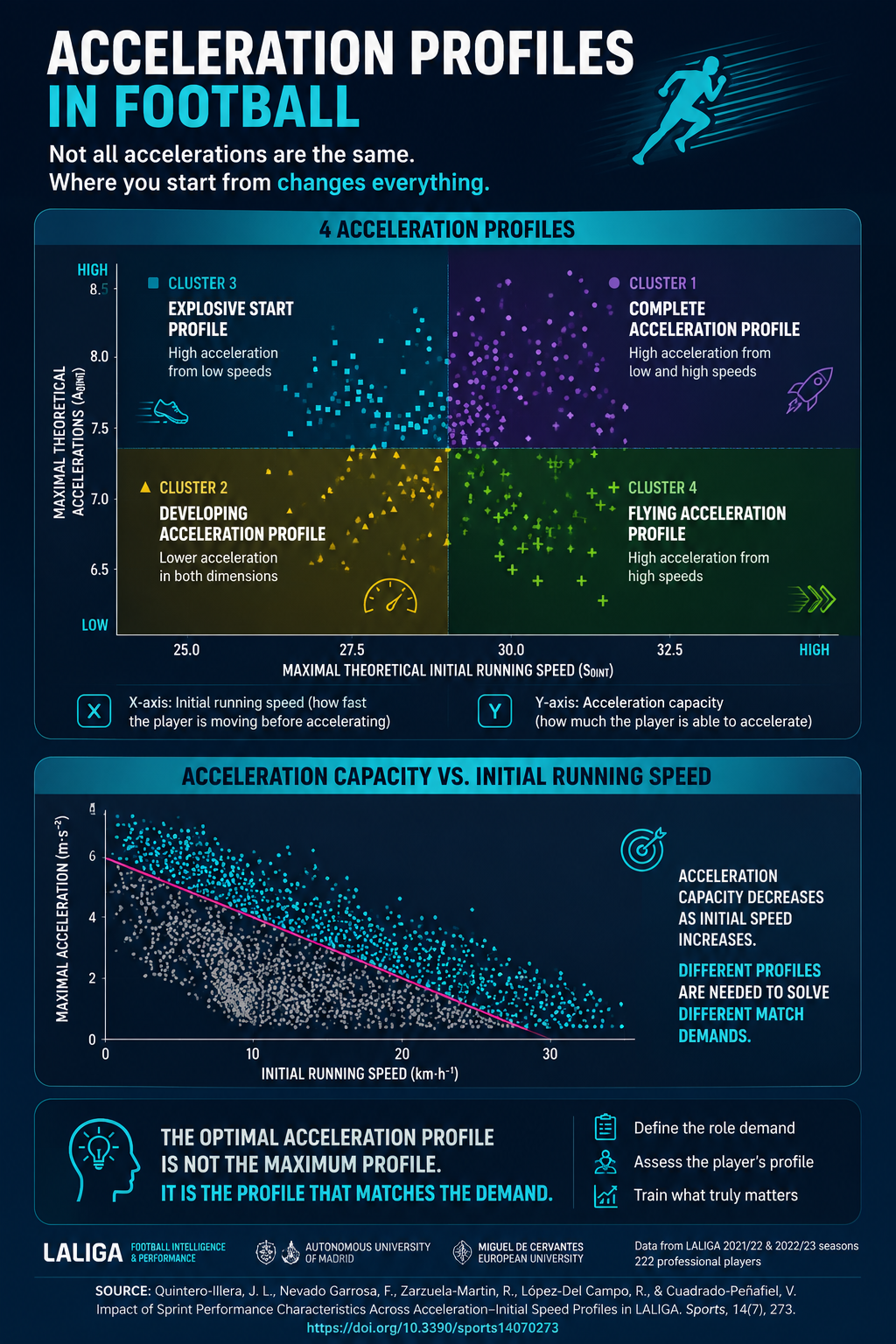
To capture this distinction, the study used an acceleration–initial speed profile. In simple terms, this allows us to distinguish between two capacities.
The first is the ability to accelerate from low initial speeds, which is important for starts, short reactions, duels, defensive corrections, pressing actions and first steps.
The second is the ability to accelerate from high initial speeds, which is important for flying sprints, attacking space, long transitions, progressive runs and actions where the player is already moving fast but still needs to increase speed.
Based on these two dimensions, players were grouped into four acceleration profiles.
| Technical cluster | Applied name | Main meaning |
|---|---|---|
| C1 | Complete acceleration profile | High capacity from both low and high initial speeds. |
| C2 | Developing acceleration profile | Lower relative capacity in both dimensions. |
| C3 | Explosive start profile | High capacity from low initial speeds. |
| C4 | Flying acceleration profile | High capacity when already running fast. |
This translation is important. Coaches and performance staff do not need another abstract label. They need a practical way to understand what type of acceleration a player is better prepared to express.
The Acceleration Fingerprint of Each Position
One of the most interesting findings was that acceleration profiles were not randomly distributed across positions. The study found a significant association between playing position and profile membership, suggesting that different roles tend to express different acceleration characteristics in competition.
The distribution was especially revealing:
| Position | Complete profile | Developing profile | Explosive start profile | Flying acceleration profile | Most frequent profile |
|---|---|---|---|---|---|
| Centre-back | 22.8% | 18.5% | 42.4% | 16.3% | Explosive start |
| Central midfielder | 6.7% | 38.3% | 33.3% | 21.7% | Developing |
| Forward | 25.0% | 9.4% | 25.0% | 40.6% | Flying acceleration |
| Full-back | 34.3% | 6.9% | 23.3% | 35.6% | Flying acceleration, close to complete |
| Attacking midfielder | 9.6% | 32.7% | 25.0% | 32.7% | Developing and flying acceleration |
| Winger | 29.4% | 9.8% | 13.7% | 47.1% | Flying acceleration |
These numbers should not be read as universal rules. The study does not prove that every centre-back should be C3 or every winger should be C4.
But it does show something very useful: each position tends to have its own acceleration fingerprint.
For centre-backs, the most frequent profile was the explosive start profile. That makes sense. Many of their decisive actions involve short corrections, duels, covering movements, defensive reactions and accelerations from relatively low speeds.
For wingers, the most frequent profile was the flying acceleration profile. Again, this fits the role. Wingers often need to attack space, accelerate while already running, receive in wide areas, drive forward or continue increasing speed during offensive transitions.
For forwards and full-backs, the flying acceleration profile was also highly present. In full-backs, the complete profile was almost equally common, which reflects the mixed nature of the role: defensive reactions, repeated high-speed runs, attacking support, recovery runs and long actions along the sideline.
Central midfielders are more difficult to interpret. The category is probably too broad. A holding midfielder, a box-to-box midfielder and a more advanced interior may have very different physical and tactical demands. This may partly explain why their distribution was less clear.
That is a key lesson: position matters, but role matters even more.
The Complete Profile Is Powerful, but It Is Not Always the Target
The study also showed that players with a complete acceleration profile performed more high-intensity accelerations and covered greater distances at high speed, very high speed and sprinting than players with a developing profile.
This is logical. A player who can accelerate well from both low and high initial speeds has a wider physical repertoire. He can solve more situations: starting, reacting, pressing, correcting, attacking space, sustaining speed and accelerating again while already moving.
But this is where the most important applied message appears:
The optimal acceleration profile is not necessarily the maximum profile. It is the profile that matches the demand.
In football, the goal is not to maximise every physical quality in every player. The goal is to develop the qualities that the player needs to express most often and with the greatest impact in his specific role.
A centre-back in a low defensive block may not need the same flying acceleration profile as a centre-back who defends with 40 metres behind him.
A full-back who constantly attacks high and wide may need a different profile from a full-back whose role is more conservative.
A forward who lives from runs behind the defensive line may need different acceleration qualities from a forward who mainly plays with his back to goal, fixes centre-backs and attacks the box over short distances.
More is not always better.
Better is better.
And in football, “better” means more specific to the role.
From Data to Decisions
This is where data becomes useful.
The value of acceleration profiling is not simply saying: this player is C1, this player is C3, this player is C4.
That is classification.
The real value appears when the coaching staff asks:
Does this player’s acceleration profile match what his role requires in our playing model?
If the answer is yes, the goal may be to maintain that capacity and protect it during the season.
If the answer is no, the profile may help practitioners identify which acceleration qualities deserve closer attention relative to the player’s role demands.
This distinction is important. The study does not prove that changing a player’s training will automatically move him from one profile to another. It does not demonstrate causality. What it provides is a framework to better interpret physical expression in competition and to ask more precise training questions.
For example, if a centre-back is expected to dominate short defensive corrections but shows a developing profile, the staff may decide to pay closer attention to low-speed acceleration qualities: first steps, short accelerations, horizontal force production, body orientation, duels and reactive defensive actions.
If a winger or attacking full-back is expected to accelerate repeatedly from medium-to-high speeds but does not express a flying acceleration profile, the staff may consider whether he needs more exposure to rolling accelerations, flying sprints, progressive runs, long transitions or tactical actions where acceleration starts from an already moving state.
The point is not to prescribe a universal recipe.
The point is to make training questions more specific.
Each Team Needs Its Own Reference Profiles
The most powerful application of this research should happen inside each club.
The study provides an elite LALIGA reference, but every team has its own playing style. Teams press differently, defend at different heights, use full-backs differently, attack space differently and expose players to different physical demands.
That means each club should build its own acceleration reference profiles by position and role.
Not as rigid labels.
Not as universal ideals.
But as practical references.
The relevant question is not:
What profile does a winger usually have?
The better question is:
In our team, with our way of attacking and defending, what acceleration profile does this winger need to perform better?
Once that reference is defined, the player’s current profile can be compared with the role demand. That comparison can support better decisions: who needs more work on explosive starts, who may need more exposure to high-speed acceleration, who already matches the role demand, and who may have a profile that fits another tactical function better.
This is the real step from data to knowledge.
Data describes.
Knowledge helps decide.
The Biggest Mistake: Trying to Maximise Everything
One of the most common mistakes in physical preparation is assuming that the best player is always the one with the highest value in every capacity.
But football is not a decathlon of physical qualities. It is a tactical sport where physical qualities only matter when they help the player solve the problems that the game creates.
Training also has a cost: time, neuromuscular load, fatigue, injury risk and interference with other contents. Developing a quality that the player rarely needs to express may improve the athlete, but not necessarily the footballer.
That is why the question should not be:
How do we make every player reach the complete profile?
The better question is:
What acceleration profile does this player need to compete better in this role?
For some players, the complete profile may be a valuable target. For others, the priority may be much more specific: improve the first metres, improve flying acceleration, maintain current strengths or simply avoid investing excessive load in a capacity that does not strongly transfer to their role.
A Practical Framework for Performance Staff
This research can be translated into a simple working process for clubs.
1. Assess the player’s acceleration profile.
Not only how much he accelerates, but from which initial speeds he is able to produce high-intensity accelerations.
2. Define the role demand.
Do not stop at the generic position. A full-back, a centre-back or a midfielder can have very different demands depending on the team’s playing style.
3. Compare the player with the reference profile.
The key question is whether the player’s current profile matches what his role requires.
4. Individualise training accordingly.
The training target should not be maximum development of every quality, but the reduction of the most relevant gap between current profile and role demand.
This is how profiling becomes useful. It does not replace the coach’s eye. It does not replace tactical analysis. It does not replace individual context.
It improves the conversation.
It gives the staff a more precise way to connect physical capacity, tactical role and training design.
Conclusion
Acceleration in football should not be understood only by volume.
The initial speed from which a player accelerates changes the meaning of the action. Starting from low speed, accelerating from medium speed or continuing to accelerate while already running fast are different physical problems. They have different tactical meanings and may require different training priorities.
This study shows that professional players express different acceleration profiles, and that those profiles are associated with positional roles in LALIGA competition. More importantly, it opens a practical path for performance staff: use data not only to classify players, but to support better decisions.
Each team should define the acceleration profile required for each position and role according to its own playing style. Then, each player’s current profile can be compared with that reference. From that comparison, training can become more specific, more efficient and more connected to the game.
Because the objective is not for every player to have the maximum profile.
The objective is for every player to develop the profile that helps him compete better.
The optimal acceleration profile does not mean maximum. It means matched to the demand.
Original Paper
Quintero-Illera, J. L., Nevado Garrosa, F., Zarzuela-Martin, R., López-Del Campo, R., & Cuadrado-Peñafiel, V. Impact of Sprint Performance Characteristics Across Acceleration–Initial Speed Profiles in LALIGA. Sports, 14(7), 273.