


07 Nov Optimizing Defensive Transitions: How Our New Analysis Model Can Improve Your Team’s Defensive Reactions
In professional football, a team’s ability to retreat quickly and cohesively after losing possession in the opponent’s final third is crucial to minimizing risks and maintaining defensive control. At LALIGA’s Football Intelligence & Performance area, we are developing an advanced analysis model that can transform the way coaches plan and execute their transition strategies.
What This Model Measures and How It Can Help You
- Distance to Goal and Recovery Speed
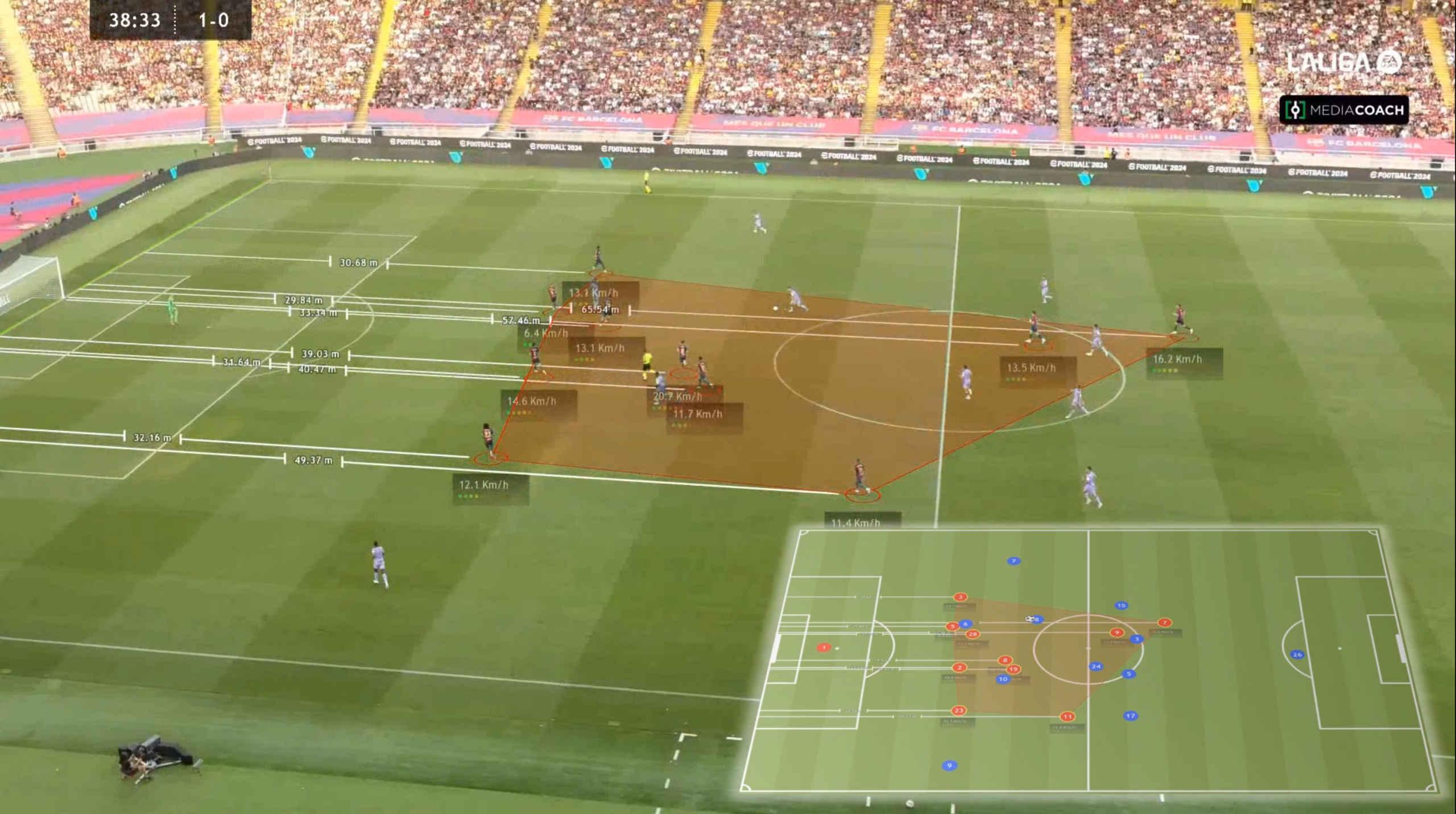
The model tracks the distance of each player (excluding the goalkeeper) from their own goal line, recording data 25 times per second. This real-time analysis allows for a detailed understanding of how quickly players recover their positions after losing the ball.
How to Apply It: Design training drills that test your players’ ability to retreat quickly, improving their reaction to possession losses and preventing defensive disorganization. - Defensive Block Cohesion via Convex Hull Analysis
The model uses convex hull analysis to assess whether the defensive block remains cohesive during the retreat. If a player separates from the block, it is quickly detected, making it easier to understand when and why the structure breaks down.
Practical Application: Implement training scenarios where the team must retreat as a cohesive unit, focusing on correcting any disruptions. Cohesion is crucial for preventing spaces that opponents can exploit. - Adapt Strategies to the Context of Play
The model takes into account whether the team is following a game plan that involves a low, medium, or high block. Additionally, it adjusts the evaluation of each player based on the exact position of the ball. This means that a player pressing the opponent or blocking passing lanes may have justifiable behavior instead of retreating with the block.
How to Apply It: Set up drills where players practice transitions in different tactical scenarios, adjusting based on the ball’s positioning. This allows them to act smarter and more effectively during competition.
Why This Matters for Your Team
This developing model will allow coaches to better understand how their team behaves in critical transition phases. By precisely measuring recovery speed, block cohesion, and players’ contextual decisions, training sessions can be adjusted to maximize defensive effectiveness and maintain a solid structure. This detailed analysis can be key to gaining crucial seconds during retreats, preventing goals, and ensuring better game control.