


24 Jun Asymmetries in Football: The Pass—Goal Paradox
Posted at 11:15h
in Paper
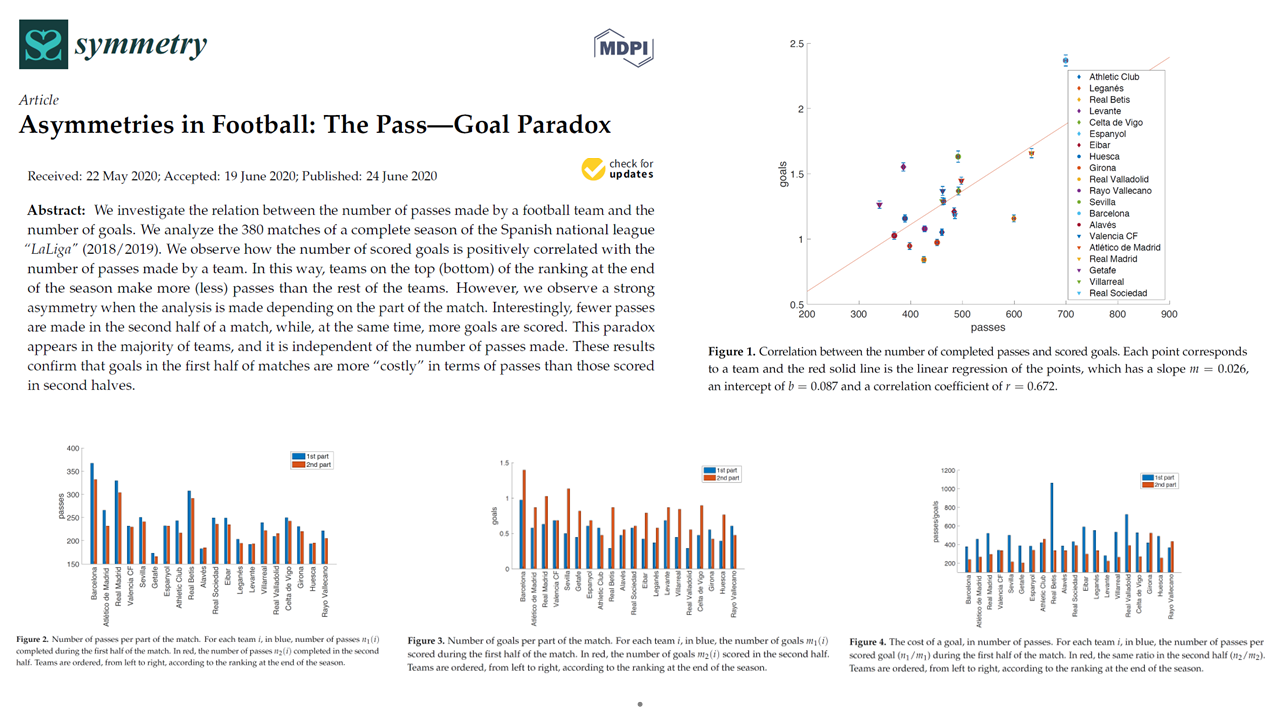
Why do teams often complete more passes in the first half but score more goals in the second? This scientific study dives into over 350,000 passes and nearly 1,000 goals from the 2018/2019 LALIGA season to uncover a counterintuitive reality: goals are more “expensive” in terms of passes during the first half of a match.
Key Practical Takeaways for Coaches and Analysts
- More Passes, More Goals—To a Point
Teams that finish at the top of the table make significantly more passes and score more goals. The four highest-ranked teams averaged 573 passes and 1.71 goals per match, compared to 422 passes and 1.07 goals for relegated teams. Passing quantity correlates with performance, but only up to a level of efficiency. - The Paradox of Match Halves
Despite completing more passes in the first half, teams scored more goals in the second half. This pattern was observed in 17 out of 20 teams. The second half saw a drop in pass volume but an increase in scoring efficiency, suggesting a shift in playing dynamics. - Pass Efficiency Varies by Half
On average, more passes are required to score a goal in the first half. The data showed that most teams needed fewer passes to convert in the second half, likely due to tactical changes, fatigue-induced mistakes, or more direct play as the game progresses. - Getafe’s Directness as a Case Study
Getafe stood out for needing the fewest passes to score, demonstrating that pressing high and recovering possession near the opponent’s goal can lead to quick, efficient scoring chances.
Implications for Tactical Planning
- Plan for tempo shifts: Teams may benefit from combinative play early in the game to control possession and field position.
- Adapt second-half strategies: Emphasize verticality and risk-taking once the opponent’s structure starts to break down, especially when trailing.
- Monitor pass fatigue: Mental fatigue could affect pass decision-making more than physical metrics suggest, requiring rotation or rethinking in-game coaching interventions.
By understanding the evolving pass–goal dynamics across halves, coaches and analysts can align their training and match strategies more effectively with real match behaviors.
Access the full scientific article (DOI): https://doi.org/10.3390/sym12061052