


11 Nov Performance Analysis of the Spanish Men’s Top and Second Professional Football Division Teams during Eight Consecutive Seasons
This study looks at how professional football in Spain has changed over time. It analyzes eight full seasons in LaLiga and LaLiga2. From 2011/12 to 2018/19. The goal is simple. To understand how teams play. How they move. How they use space. And how performance evolves at the highest competitive levels.
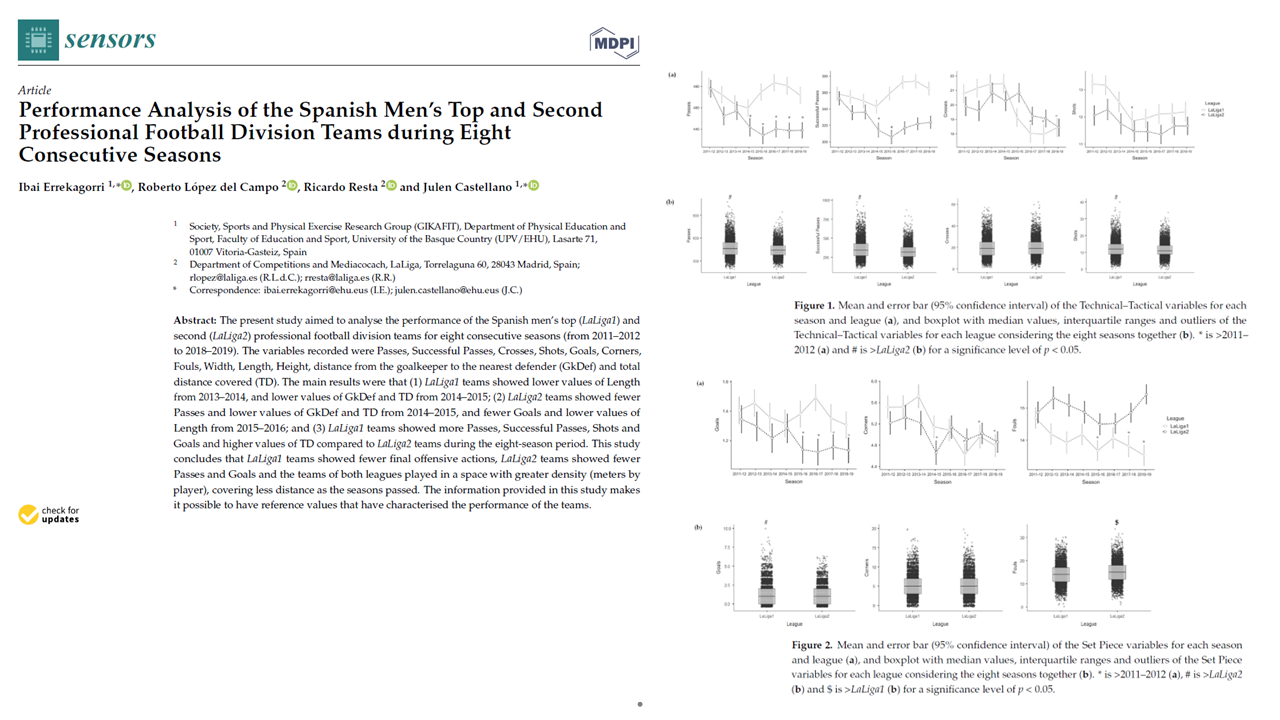
The first key message is stability with subtle but important shifts. LaLiga teams remain technically superior. They complete more passes. They shoot more. They score more goals. These are not small differences. They consistently separate first division teams from second division teams across eight seasons.
But the game is not expanding. It is compressing. Teams now play in shorter and denser spaces. Team length decreases season after season. The distance between the goalkeeper and the nearest defender also gets shorter. This reflects more compact blocks. More coordinated defensive structures. And goalkeepers more involved in build-up play.
Total distance covered by teams decreases over time. In both divisions. This does not mean football is less demanding. It means teams are managing space better. They run less but in more specific moments. Efficiency replaces volume. This has direct consequences for physical preparation and load management.
LaLiga2 shows a different profile. Fewer passes. Fewer goals. More fouls. A more defensive and direct style. Matches are often tighter. Margins are smaller. Scoring efficiency becomes critical. For coaching staffs, this reinforces the importance of set pieces, transitions, and defensive organization in second division contexts.
Another practical insight is offensive evolution. Top division teams reduce crosses and corners over time. Attacks become cleaner. More controlled. More positional. This suggests that training attacking play should prioritize structure, spacing, and decision-making rather than volume of final actions.
For analysts, this paper provides reference values. Benchmarks across leagues. Across seasons. For coaches and performance staff, it offers context. Not every decrease is a problem. Sometimes it is adaptation. Sometimes it is evolution.
This research helps answer a key question. How has elite football really changed. Not through opinion. But through eight seasons of objective data. It gives staff a framework to interpret their own numbers. And to align training, tactics, and physical demands with the reality of modern professional football.