


26 Ene Physical Match Performance of Professional Men’s Football Players from Different Competitive Levels During Direct Competition
Do First Division players really run more?
Or does everything change when teams from different divisions face each other?
Most research compares leagues separately. This study does something different.
It analyses 25 Copa del Rey matches across three seasons where Spanish First and Second Division teams competed directly against each other.
Instead of comparing isolated league contexts, this design removes many structural biases.
The objective was clear.
To examine position-specific physical demands — separated into in-possession and out-of-possession phases — during direct competition between competitive levels.
A total of 324 full-match observations were analysed across five positions:
– Central defenders (CD)
– Wide defenders (WD)
– Central midfielders (CM)
– Wide midfielders (WM)
– Forwards (FW)
Physical variables included:
– Total distance (TD)
– Distance in possession (TD-A)
– Distance out of possession (TD-D)
– High-speed running (>21 km·h⁻¹)
– Sprint distance (>24 km·h⁻¹)
– Number of sprints
– Maximum velocity (VMax)
The results provide a more nuanced picture of competitive standard.
Total distance: context matters
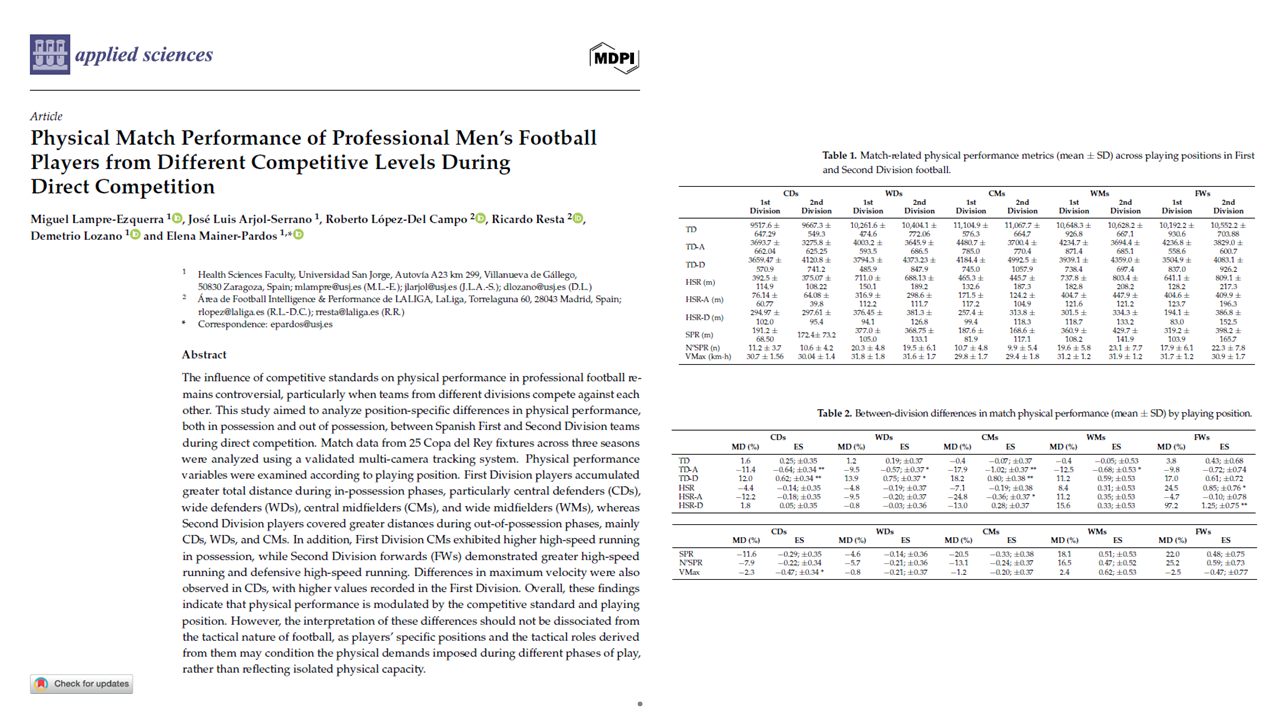
There were no major differences in total match distance between divisions.
This is important.
When First and Second Division teams compete directly, global volume converges.
However, when match phases are separated, differences appear.
First Division players accumulated greater total distance during in-possession phases, particularly:
– Central defenders
– Wide defenders
– Central midfielders
– Wide midfielders
In contrast, Second Division players covered greater total distance during out-of-possession phases, especially:
– Central defenders
– Wide defenders
– Central midfielders
This suggests that First Division teams tend to dominate possession, while Second Division teams respond with greater defensive workload.
The difference is not physical capacity alone.
It is tactical context.
High-speed running reveals positional asymmetries
Central midfielders from the First Division covered more high-speed distance during possession (HSR-A).
This reflects greater offensive involvement, ball progression and final-third participation.
However, Second Division forwards showed greater high-speed running overall, particularly in defensive high-speed running (HSR-D).
This is a key insight.
Lower-division forwards, when facing stronger opponents, may be required to defend deeper and over larger spaces.
Rather than pressing high, they may perform repeated high-intensity defensive transitions.
This reverses the typical narrative that higher-level attackers always perform more high-speed actions.
Sprint metrics followed similar patterns.
Second Division forwards showed greater high-intensity defensive exposure.
Maximum velocity
Only central defenders showed differences in maximal speed, with First Division CDs reaching higher peak velocities.
This may be explained tactically.
Higher-possession teams often defend with a higher line, requiring central defenders to sprint into deeper recovery zones when defending space behind them.
Thus, VMax may reflect structural tactical risk rather than pure physical superiority.
Direct competition changes interpretation
One of the most important contributions of this study is methodological.
Previous comparisons between leagues have produced conflicting results.
Some research suggests higher divisions run more.
Others show lower divisions accumulate more distance.
This study demonstrates that when teams face each other directly, overall physical output becomes similar.
Differences emerge primarily in:
– Game phase (possession vs non-possession)
– Tactical structure
– Positional roles
This reinforces a central message.
Physical performance cannot be interpreted independently from tactical context.
Playing level does not automatically mean greater running volume.
It often means different running distribution.
Practical implications
For coaches and performance staff:
- When preparing for cross-level matches, anticipate phase-dependent demands rather than global increases in load.
- First Division defenders and midfielders may require greater preparation for ball-dominant attacking phases.
- Second Division teams should prepare for prolonged defensive phases and transitional high-intensity actions.
- Forwards in lower-level teams may accumulate greater defensive high-speed load when facing superior opponents.
- Maximum velocity exposure in central defenders may increase when tactical lines are higher.
The key conclusion is clear.
Competitive level influences physical performance.
But not in isolation.
It is the tactical nature of football — possession dominance, defensive exposure and positional role — that ultimately shapes running demands.
Football is relational.
Physical output reflects context.