


21 Mar Does player age influence match physical performance? A longitudinal four-season analysis in Spanish Soccer LaLiga
Introduction
In football, age is often associated with experience, tactical awareness, and leadership. Yet, as players mature, questions persist about how much age truly affects physical performance during matches.
A large-scale, longitudinal study conducted with LaLiga data across four consecutive seasons (2015/16–2018/19) provides clear evidence:
Match running performance progressively declines with age, particularly in high-intensity and sprint actions.
This research offers valuable insight into how performance evolves not only between age groups but also within each season — a key factor for load management and squad planning.
Study Design
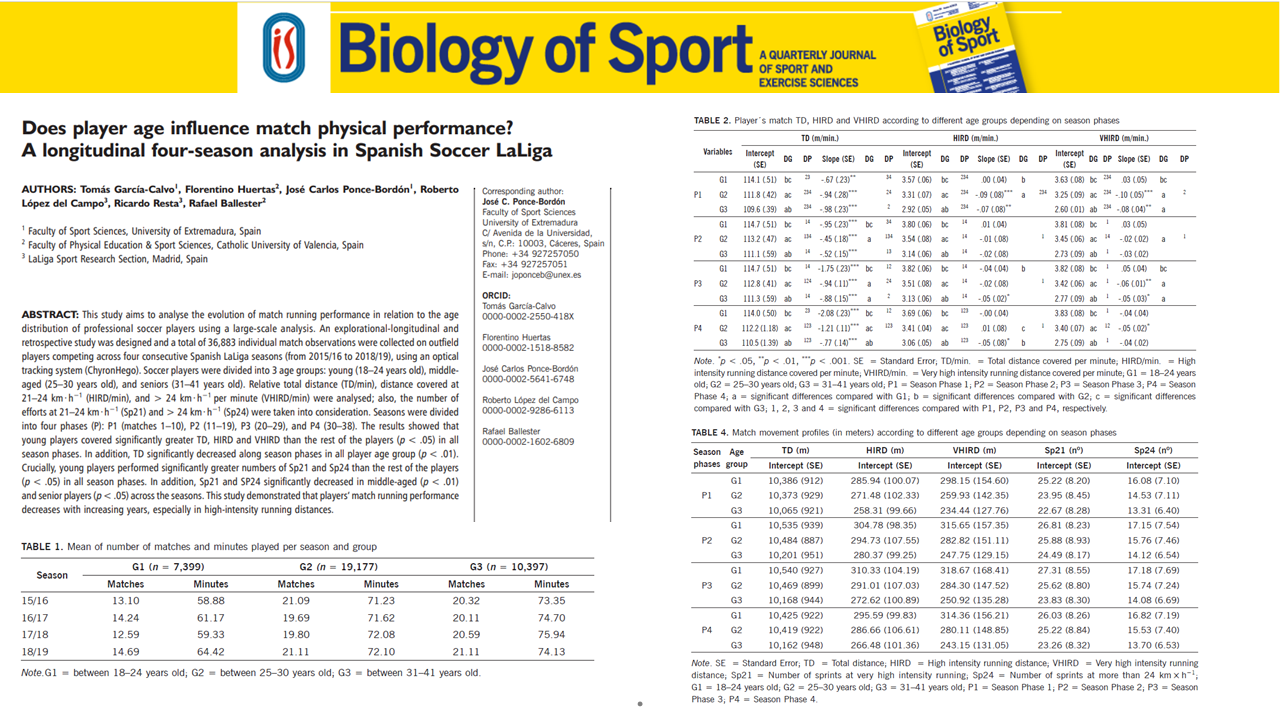
Researchers from the University of Extremadura, Catholic University of Valencia, and LaLiga Sport Research Section analyzed 36,883 match observations from 1,037 players in LaLiga, collected using the ChyronHego TRACAB optical tracking system.
Players were classified into three age groups:
- Young: 18–24 years
- Middle-aged: 25–30 years
- Senior: 31–41 years
Across four full seasons, the study examined:
- Total distance per minute (TD/min)
- High-intensity running distance (HIRD; 21–24 km/h)
- Very high-intensity running distance (VHIRD; >24 km/h)
- Number of high-intensity runs (Sp21) and sprints (Sp24)
Each season was divided into four phases (P1–P4) to track performance evolution from the opening rounds to the final stretch.
Key Findings
1. Younger players consistently outperform older ones
Across all four seasons and in every phase:
- Young players (18–24 y.o.) covered more total distance, more high-intensity running, and performed more sprints than both middle-aged and senior players.
- Senior players (31–41 y.o.) recorded the lowest values in all speed ranges.
2. Age differences are most pronounced at high intensities
- High-intensity running and sprint distances (HIRD, VHIRD) showed the steepest declines with age.
- Older players performed fewer sprints per minute, reflecting reduced explosive capacity and accumulated fatigue management.
3. Seasonal dynamics: performance rises mid-season, then drops
- Regardless of age, TD, HIRD, and VHIRD peaked in mid-season (P2–P3) before slightly declining in the final phase.
- This suggests adaptation to competition demands followed by cumulative fatigue as the season progresses.
4. Long-term trends: performance declines year by year
- Over four seasons, all age groups exhibited a progressive decrease in total distance per minute.
- However, younger players’ decline was sharper, possibly due to adaptation to tactical constraints or playing fewer full matches as they gain experience.
Interpreting the Findings
The study reinforces that age is a strong determinant of match running performance, particularly for actions requiring explosive power.
However, the pattern is nuanced:
- Younger players run more and at higher speeds — reflecting both physical freshness and their tactical role as energy providers late in games.
- Older players maintain more stable output across seasons — likely due to experience, pacing ability, and positional intelligence that compensates for reduced physical output.
As the authors suggest:
“Older players maintain their physical performance throughout the season thanks to greater expertise and better knowledge of the game’s demands.”
Practical Applications for Coaches and Performance Staff
- Plan load and recovery by age profile
- Younger players may tolerate higher training volumes but require progressive exposure to full-match demands.
- Senior players benefit from individualized load modulation focusing on recovery, sprint maintenance, and tactical efficiency.
- Integrate age into rotation strategies
- Mid- and late-season rotations can prevent cumulative fatigue, especially in older players who show steeper declines in sprint metrics.
- Track high-speed running evolution
- HIRD and VHIRD are sensitive indicators of fatigue and aging. Monitoring them longitudinally helps detect early performance drops.
- Adapt conditioning by phase of the season
- Emphasize high-intensity running development early in the season, and recovery/sprint maintenance later (P3–P4).
Key Takeaway
Age doesn’t just influence performance — it reshapes the profile of effort.
In LaLiga, over four consecutive seasons:
- Young players ran faster and more often,
- Older players ran smarter and more efficiently,
- But all players gradually reduced total distance per season.
Understanding these trajectories allows coaches to optimize match exposure, design position-specific conditioning, and preserve high-intensity capacity across the career span.
Reference
García-Calvo T, Huertas F, Ponce-Bordón JC, López-Del Campo R, Resta R, Ballester R. (2023). Does player age influence match physical performance? A longitudinal four-season analysis in Spanish Soccer LaLiga. Biology of Sport, 40(4), 1097–1106.
DOI: https://doi.org/10.5114/biolsport.2023.124844