


20 Oct Differences in playing style and technical performance according to the team ranking in the Spanish football LaLiga. A thirteen seasons study
Why do top teams consistently finish at the top of the table season after season? Beyond talent and budget, this study shows that long-term success in LaLiga is strongly linked to how teams play, not just what they play.
Using data from 13 consecutive LaLiga seasons (2008/09–2020/21) and almost 5,000 matches, this research compared the playing style and technical performance of teams based on their final league position, from champions to relegated teams. The analysis controlled for key contextual factors such as match location, opponent quality and match outcome, making the findings especially robust and directly applicable to real competition scenarios.
The results highlight a very clear tactical pattern: higher-ranked teams play in a more controlled, patient and advanced way, while lower-ranked teams tend to adopt faster, more direct and less efficient approaches.
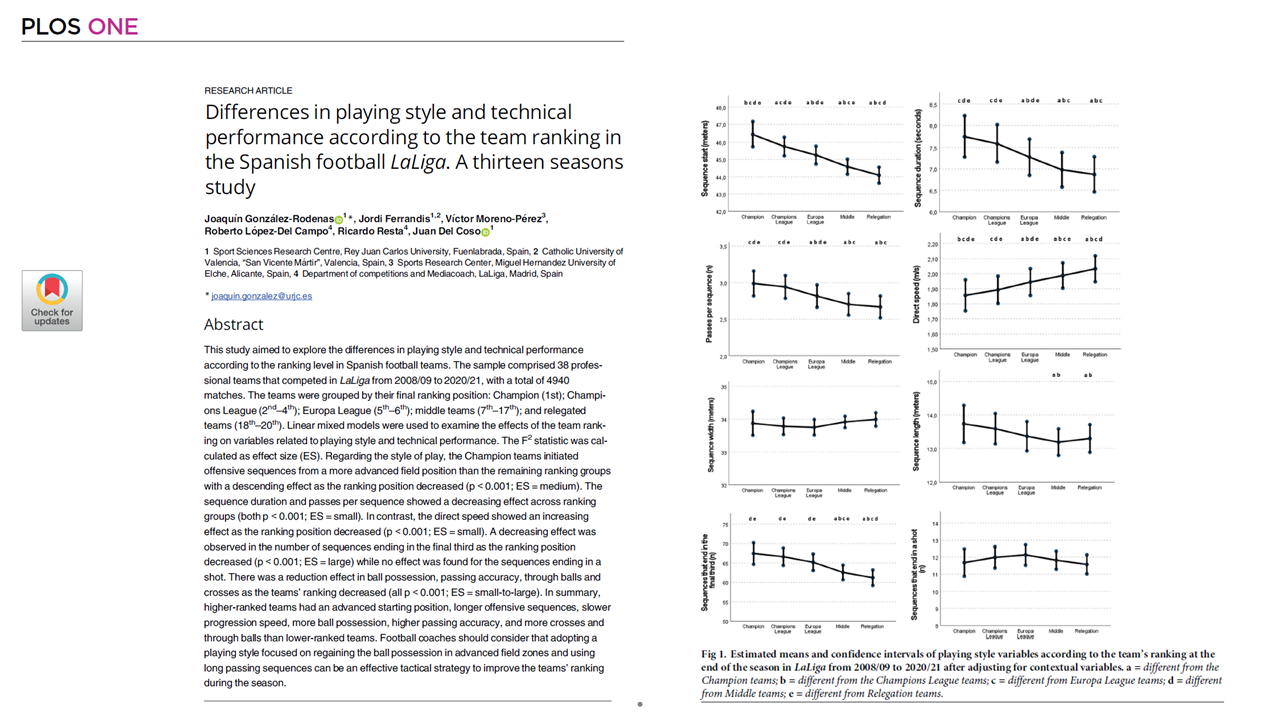
Top teams consistently recover the ball in more advanced areas of the pitch, which means their attacking sequences start closer to the opponent’s goal. This is not a minor detail. Starting attacks higher up the field reduces defensive organization time for the opponent and increases the likelihood of progressing into dangerous zones. From a coaching perspective, this underlines the importance of high pressing, counter-pressing and collective defensive organization in advanced zones.
Once in possession, successful teams build attacks differently. They use longer sequences, more passes per possession, and progress with lower vertical speed. In simple terms, they do not rush attacks. Instead, they circulate the ball, move the opposition, and wait for the right moment to break lines. Lower-ranked teams, by contrast, tend to progress faster towards goal but with fewer passes and shorter sequences, often resulting in less effective territorial gain.
Despite moving the ball more slowly, top teams actually advance more meters per sequence and reach the final third more frequently. This combination of patience and effectiveness is a key tactical takeaway: slower does not mean passive, and faster does not mean more dangerous.
From a technical standpoint, higher-ranked teams show greater ball possession, higher passing accuracy, more through balls and more crosses. These teams are better at sustaining attacks, manipulating defensive blocks and creating penetration options, especially against compact defenses. Interestingly, the number of shots and shot conversion did not differ significantly once contextual variables were considered, suggesting that chance quality and field position before the shot may matter more than raw shot volume.
Another important practical insight is related to dribbling. While relegated teams actually attempt more dribbles, their dribbling accuracy is lower, reinforcing the idea that isolated individual actions often replace collective solutions in struggling teams.
For coaches, performance staff and analysts working in professional football, the message is clear. League success is strongly associated with a playing style based on territorial control, patience in possession and advanced defensive organization. Training tasks should therefore prioritize:
• Regaining possession higher up the pitch
• Sustaining longer passing sequences under pressure
• Improving collective positioning to support ball circulation
• Creating structured opportunities for through balls and effective crossing
• Developing tactical patience rather than promoting constant vertical speed
This study confirms that success in elite football is not built on isolated actions or reactive play, but on repeatable collective behaviors sustained over an entire season.
DOI link to the paper: https://doi.org/10.1371/journal.pone.0293095