


09 Ene A Practical Tool to Interpret High-Intensity Physical Demand in Football
“He ran less today.”
That is what the report says. That is what the dashboard shows. And very often, that is where the analysis stops. But before questioning fitness, effort or motivation, it is worth pausing for a moment. Did the player really perform worse, or did the match simply demand something different?
This distinction matters more than we usually think.
The common mistake in physical performance analysis
In football, we constantly compare matches. We compare players, weeks and competitions. We look at high-intensity metrics such as high-speed running and sprinting, often expressed per minute, and we assume they are directly comparable from one game to another.
They are not.
Two matches can both last 90 minutes and still be physically incomparable. The context in which those minutes are played changes everything.
The question behind this research
This research was conducted by the Football Intelligence & Performance Department at LALIGA, following all scientific and methodological standards and published in a peer-reviewed journal. However, the starting point was not academic. It was practical.
Are we really measuring physical performance, or are we measuring the context in which performance takes place?
Why high-intensity data needs context
High-intensity actions matter. High-speed running and sprinting reflect physical strain and are widely used to support decisions related to training, recovery and match preparation. But they are also highly sensitive to how the game unfolds.
They change with tactical structure. They change with playing role. They change with the rhythm and continuity of the match.
Previous research has already shown that high-intensity actions are strongly context-dependent. What is often missing in applied settings is a structured way to account for that context when interpreting the data.
The contextual factors we focused on
In this study, we focused on three contextual variables that are often analysed separately, but rarely integrated.
Effective Playing Time. Time in possession. Time out of possession.
We also incorporated a fourth element that fundamentally changes the interpretation of physical data: playing position, understood as a functional role rather than a static label.
How the analysis was performed
We analysed thousands of full-match performances in LALIGA. Only outfield players who completed the full 90 minutes were included. Goalkeepers were excluded.
Physical output was analysed only during effective playing time, removing inactive periods. High-intensity actions were separated into those performed in possession and out of possession. All metrics were expressed per minute to avoid the misleading effect of raw totals.
The focus was placed on high-speed running (>21 km/h) and sprinting (>24 km/h), not on total distance.
What the data showed
Context does not affect all positions in the same way
One of the clearest findings is that there is no universal response to match context. Central defenders, full-backs, midfielders and attackers respond differently to the same game conditions.
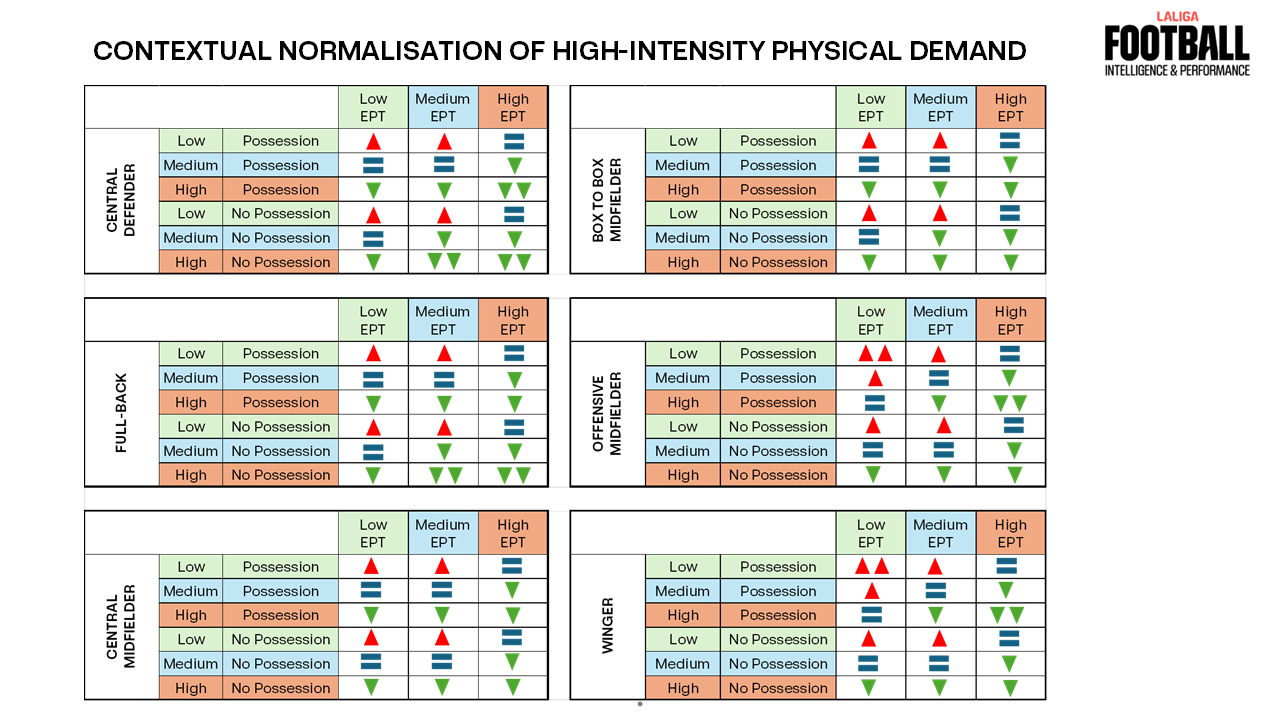
Full-backs are highly sensitive to long defensive phases, especially when effective playing time is high. Attacking players are strongly influenced by time spent in possession. Central and box-to-box midfielders tend to show more balanced patterns, though they are not immune to contextual effects.
The same match can generate very different high-intensity demands depending on the position.
More time often means less intensity per minute
Another consistent finding may seem counterintuitive at first. As the duration of a game phase increases, high-intensity actions per minute tend to decrease. This applies both to possession and non-possession phases and becomes more pronounced when effective playing time is high.
This does not mean the match is easier. It means the physical demands change in nature. There are fewer explosive actions, more positional adjustments and fewer opportunities for micro-recovery.
Context can easily be mistaken for performance change
This is where problems arise in daily practice. A reduction in high-speed running or sprinting is often interpreted as a drop in performance. In many cases, the data suggests something else.
The match context changed, and the player adapted accordingly.
Without contextual normalisation, we risk attributing to the player what actually belongs to the game.
From research to tool
The graphic accompanying this article translates these findings into a practical contextual normalisation tool for high-intensity physical demand. It aggregates information from high-speed running and sprinting into a qualitative reference framework.
This tool does not aim to score or rank players. Its purpose is different. It helps practitioners understand whether a given match context is likely to inflate, reduce or stabilise high-intensity demand per minute for a specific playing position.
It supports a better question: given this context, is the observed physical output higher or lower than what we should reasonably expect?
How this tool can be used in practice
This framework helps physical trainers, coaches and analysts compare matches more fairly. It improves post-match interpretation and supports more informed training design. It also facilitates clearer communication with coaching staff and players when physical outputs change from one game to another.
Most importantly, it promotes a shift in mindset. The pitch is not just a stage for performance. It is a living laboratory where assumptions must be tested against evidence.
What this tool does not do
This is not a predictive model. It does not replace internal load monitoring or individual baselines. It does not provide exact percentages, and this is intentional. Precision without context creates false certainty.
The value of this tool lies in direction and interpretation, not in artificial accuracy.
Positioning this work within football science
Previous studies have consistently shown that physical demands are position-specific and highly dependent on tactical and contextual factors. This research builds on that foundation and adds a structured, position-specific way to interpret high-intensity demands through the combined effect of effective playing time and game phases.
It does not replace existing approaches. It complements them.
Final thought
If football wants to truly benefit from data, it must stop treating numbers as answers and start treating them as questions.
Not “How much did he run?”
But “What did the game ask him to do?”
That change in perspective is where better decisions begin.
Further resources
Scientific article (DOI): https://doi.org/10.1080/24748668.2025.2604447