


22 Abr Can We Predict Corner Kicks Before They Happen?
From Descriptive Analysis to Predictive Intelligence in Set Pieces
What if coaches could know, before a match, which corner situations are most likely to occur — and why?
In recent LALIGA seasons, approximately 30% of goals originate from set pieces, with a significant proportion coming from corner kicks.
Yet most analyses still focus on describing what happens after the ball is delivered.
In high-performance football, that is no longer enough.
The real challenge is not analysing corners, but anticipating them.
A New Approach: Corner Kicks as Dynamic Systems
Before presenting the model, it is important to understand one key idea:
Corner kicks should not be analysed as isolated events, but as complex, dynamic systems shaped by interaction.
Each corner emerges from the continuous interaction between attacking and defensive structures, evolving in both space and time.
Model Framework: From Space to Behaviour
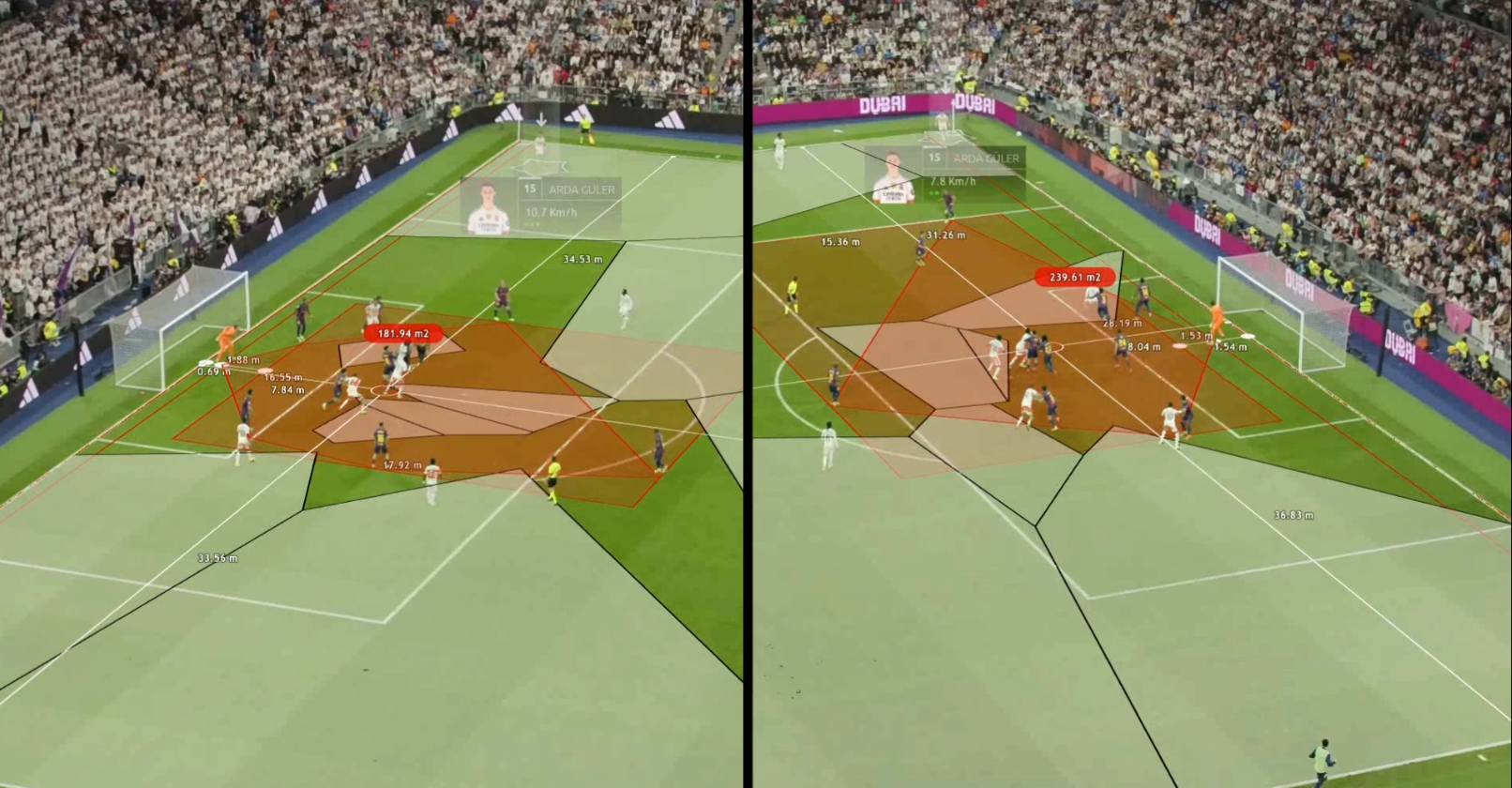
The model combines spatial, temporal and behavioural data to represent the true nature of corner kicks.
Each of these layers captures a different dimension of the same phenomenon.
1. Spatial Structure of the Defensive Block
We analyse how the defending team occupies space using:
- Convex Hull → representing the real area occupied by the defensive block
- Centroid and spatial projections → identifying balance and directional bias
- Dynamic zonal division → adapting to the movement of the block
This allows us to understand not just where players are, but how the defensive structure behaves in real time.
2. Offensive–Defensive Interaction
The model incorporates:
- Voronoi diagrams → capturing individual zones of influence
- Interaction between attackers and defenders to identify:
- marking behaviour (man-oriented, zonal, hybrid)
- spatial advantages
- contested vs free spaces
Performance in corners does not depend on isolated actions, but on how both teams interact within the same space.
3. Structural Constraints of the Defence
In addition to the convex hull, we introduce:
- Width–Depth rectangles → defining the structural limits of the defensive block
This provides a second layer to interpret:
- compactness
- line height
- defensive organisation
Together, these layers allow us to understand not just where the corner happens, but how and why it unfolds.
4. Ball Tracking and Temporal Dynamics
Using tracking data, the model incorporates:
- moment of ball contact
- trajectory (direction, height, speed)
- time to target zone
This enables the analysis of:
- synchronization between ball and player movements
- timing of offensive runs
- defensive reaction speed
5. Kicker Behaviour and Pre-Action Cues
One of the most innovative aspects is the use of skeleton data to analyse:
- body orientation
- approach angle
- pre-kick gestures
These variables provide insights into:
- potential intent
- disguise or predictability of execution
This introduces a pre-action layer, allowing us to study not only outcomes, but also signals before the action occurs.
From Modelling to Prediction
The methodological challenge is not modelling the corner.
The real breakthrough is using that model to anticipate future scenarios.
By combining historical attacking patterns with defensive behaviours of the opponent, the model moves from description to predictive analysis of set pieces, enabling a more effective match preparation process.
This approach contributes to a more advanced framework of predictive analysis of set pieces, directly linked to match preparation in professional football.
A Practical Example: Scenario Simulation
Instead of analysing corners retrospectively, the model allows us to:
- define a realistic number of expected corners in a match (e.g. 8–10)
- generate the most probable scenarios based on historical data
- simulate how these scenarios are likely to unfold
This creates a tactical preview, where coaches and analysts can:
- anticipate opponent behaviours
- prepare defensive adjustments
- design targeted offensive strategies
Measuring What Matters: From Intangibles to Observable Behaviour
A common challenge in football analysis is the presence of intangible factors such as:
- competitive intensity
- decision-making
- goalkeeper behaviour
Rather than attempting to measure these directly, the model focuses on how they manifest through observable actions.
For example:
- goalkeeper decision-making → positioning, timing of interventions, success in aerial actions
- defensive intensity → duels, first contacts, structural consistency
- attacking intent → movement timing, spatial occupation
This approach allows us to transform subjective concepts into measurable behavioural patterns.
Key Insight: Performance as Interaction
The outcome of a corner is not driven by a single variable, but by the interaction between multiple factors.
In particular:
- delivery quality
- attacking aerial ability
- defensive aerial capacity
A high-quality delivery may not generate danger if the defensive structure dominates the space.
Conversely, small advantages in timing or positioning can create high-value opportunities.
Conclusion: Towards Predictive Set-Piece Intelligence
Set-piece analysis is evolving.
From:
- static descriptions
- isolated metrics
To:
- dynamic modelling
- interaction-based analysis
- predictive intelligence for match preparation
This framework is part of an ongoing research line within the Football Intelligence & Performance area of LALIGA.
Further methodological developments and applied use cases will be shared progressively.