


10 Mar Reduced Match Exposure in the Previous 2 Matches Accounts for Hamstring Muscle Injury Incidence in Professional Football Players
Introduction
Hamstring injuries remain one of the most frequent and costly problems in professional football. Despite years of prevention research, their incidence continues to rise — about 22% of elite players sustain at least one hamstring injury per season, with an annual increase of over 4%.
A new study using LaLiga data across three full seasons provides a counterintuitive finding:
Players who played less in the previous two matches were more likely to suffer a hamstring injury.
This challenges the common perception that overload alone causes injury. Instead, underexposure to match demands—insufficient competition rhythm and intensity—appears to increase the risk.
Study Overview
Researchers from Miguel Hernández University, Rey Juan Carlos University, and LaLiga followed 144 professional players from two LaLiga teams over three seasons (2011–2014).
They examined match data for 37 hamstring injuries, comparing each injured player with a matched control from the same team and position who remained uninjured.
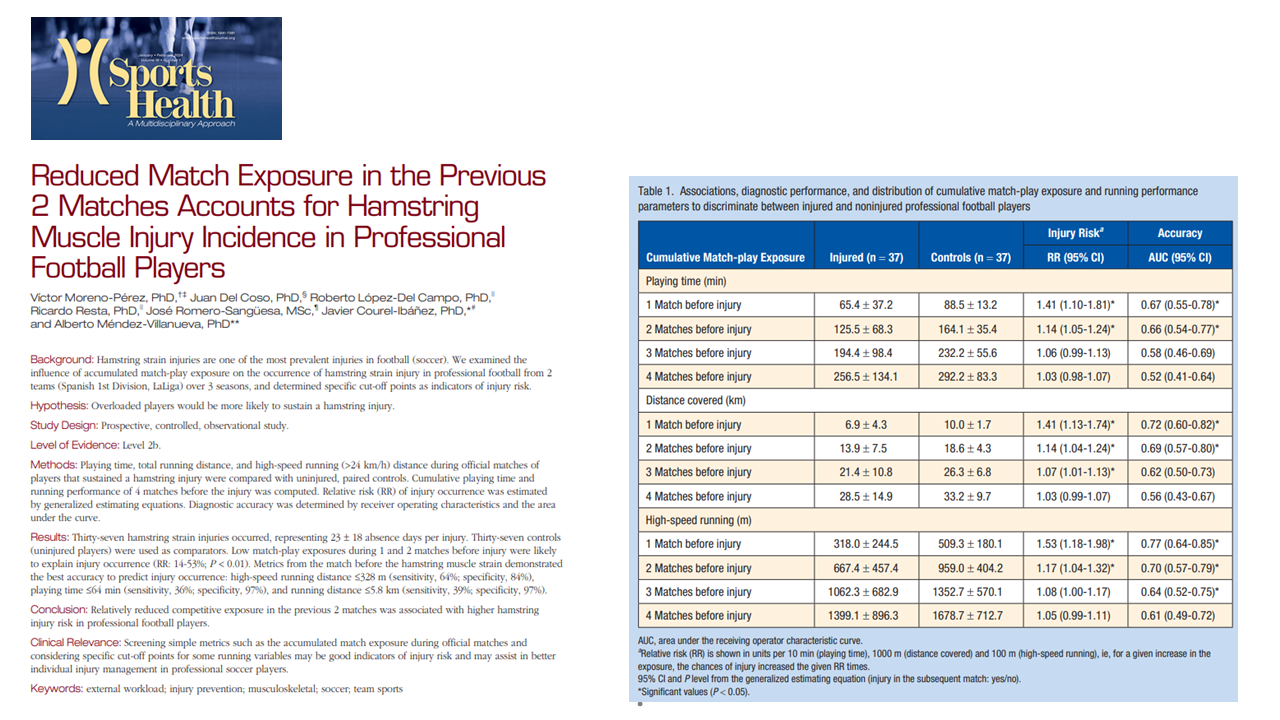
All match exposure and running metrics—playing time, total distance, and high-speed running (>24 km/h)—were tracked using Mediacoach, LaLiga’s validated multi-camera system.
Each player’s performance was analyzed over the four matches before injury, calculating relative risk and diagnostic accuracy for injury prediction.
Key Findings
| Variable | 1 Match Before Injury | 2 Matches Before Injury | Risk Pattern |
|---|---|---|---|
| Playing time | ≤64 min → Higher risk | ≤95 min → Higher risk | Reduced time doubled risk |
| Distance covered | ≤5.8 km → Higher risk | ≤12.0 km → Higher risk | Low distance ↑ injury likelihood |
| High-speed running | ≤328 m → Higher risk | ≤901 m → Higher risk | Underexposed players at greatest risk |
Low exposure across just two matches was consistently associated with higher injury probability.
Players with reduced minutes or high-speed running distance were 14–53% more likely to suffer a hamstring injury than controls.
In simple terms, not playing enough—rather than overloading—can be just as dangerous.
Why Reduced Exposure Increases Injury Risk
The study suggests that insufficient match exposure may lead to temporary detraining, particularly in the neuromuscular and eccentric demands unique to competition.
While training sessions can replicate aspects of match intensity, only real match play provides the chaotic, high-speed actions (sprints, accelerations, decelerations, changes of direction) that condition hamstrings to tolerate repeated stress.
As the authors note:
“Participation in match-play itself is the most appropriate stimulus to prepare players for the physical demands of match-play.”
Thus, players who spend consecutive matches on the bench or play limited minutes may lose the very adaptations that protect them.
Practical Applications for Coaches and Medical Staff
This study introduces a simple yet powerful monitoring idea:
Track players’ cumulative match exposure over the last two games.
- Establish exposure thresholds
- Players with ≤95 minutes over the last two matches are at increased risk.
- Those under 65 minutes in the most recent match warrant specific reconditioning.
- Design compensatory strategies
- Integrate high-speed running drills (>24 km/h) and match-like sprint volumes for underexposed players.
- Schedule these sessions within 3–4 days post-match to simulate competitive stimulus safely.
- Simplify monitoring
- Even without GPS or tracking data, playing time alone (a readily available metric) provides valuable risk information.
- Four out of ten injuries in this study occurred when players played ≤64 minutes in their last match.
Key Takeaways
- Underexposure—not only overload—raises injury risk.
- Playing time in the previous two matches is a strong, simple indicator for risk profiling.
- Regular match involvement maintains protective adaptations in hamstring strength and coordination.
- Bench players or rotation players require tailored workloads to bridge competitive gaps.
- Monitoring match exposure is practical, low-cost, and applicable across all levels of professional football.
Conclusion
This research reframes the injury prevention debate:
Players who don’t play enough matches are at greater risk of hamstring injury than those who play too much.
For performance and medical departments, this means tracking “exposure deficits” is as important as managing overload.
Maintaining adequate match rhythm isn’t just a tactical decision — it’s a protective strategy for muscle health and performance longevity.
Reference
Moreno-Pérez V, Del Coso J, López-Del Campo R, Resta R, Romero-Sangüesa J, Courel-Ibáñez J, Méndez-Villanueva A. (2023). Reduced Match Exposure in the Previous 2 Matches Accounts for Hamstring Muscle Injury Incidence in Professional Football Players. Sports Health, 16(1): 109–114.
DOI: https://doi.org/10.1177/19417381231158117