


15 Abr It’s Not January: What LaLiga Data Reveals About the Relative Age Effect
Introduction
For years, one idea has dominated football:
Players born in January are more likely to become professionals.
It’s simple. It’s intuitive.
And analytically, it’s misleading.
Using data from all players in LALIGA EA SPORTS 2024/25, we revisited the Relative Age Effect (RAE).
The conclusion is clear:
The issue is not January.
It’s what happens to players born later in the year.
The Structural Bias Behind RAE
Youth football is structured using a fixed annual cut-off (January 1st).
This creates age gaps of up to 12 months within the same category.
At early stages, that difference is decisive:
- physical development
- coordination
- confidence
As a result:
Football systems tend to select the most developed players at a given age, not necessarily the most talented in the long term.
This bias accumulates over time.
1. The Effect Exists — But It’s Misinterpreted
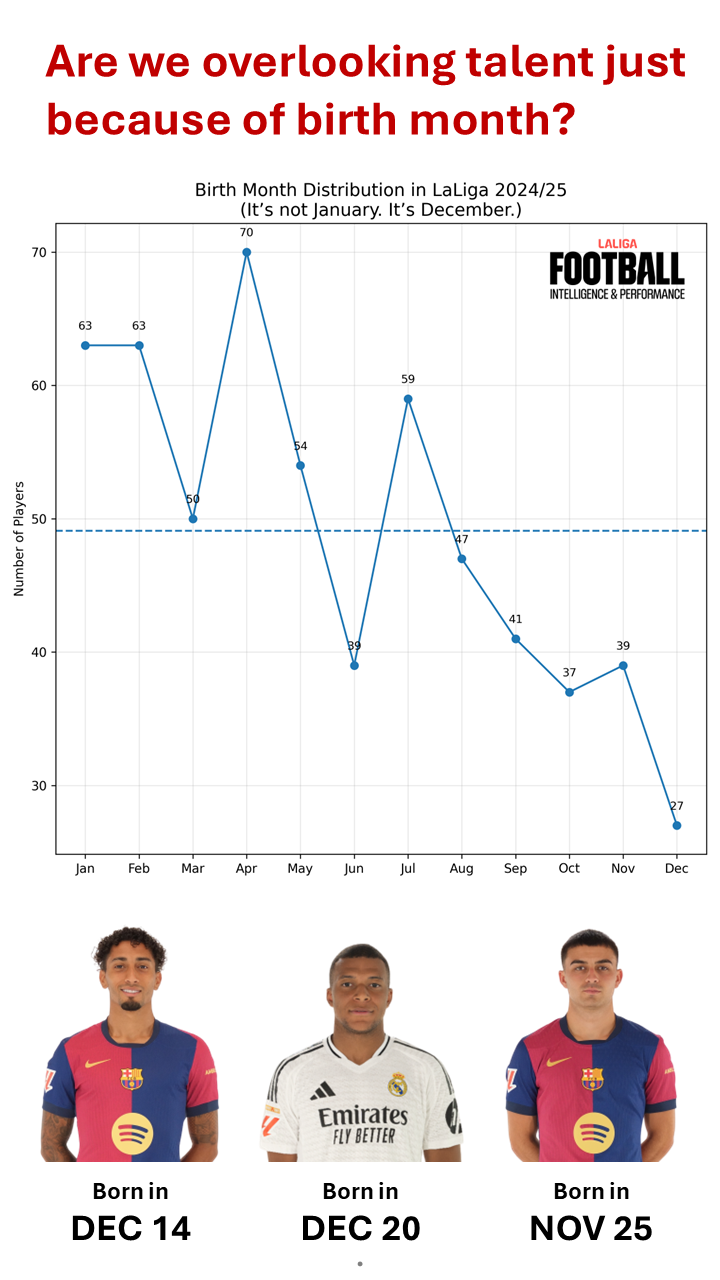
Player distribution in LALIGA is not uniform:
- Q1: 176
- Q2: 163
- Q3: 147
- Q4: 103
(p < 0.001)
But this is where interpretation matters.
January is a poor analytical shortcut.
The data does not show a distinct advantage for early-born players.
It shows a progressive drop toward the end of the year.
The effect is not a January advantage.
It is a Q4 penalty.
2. Performance Tells a Different Story
If the bias reflected talent, we would expect performance differences.
We don’t see them.
- No differences in minutes played (p = 0.75)
- No differences in participation levels
Late-born players are not worse.
They are just fewer.
3. A Selection Problem, Not a Talent Problem
This leads to a more precise interpretation:
The Relative Age Effect does not reflect differences in ability,
but a selection bias introduced during early development.
Or more directly:
Football may be selecting the most developed players… not the most talented ones.
4. Are We Losing Talent?
This is the critical question.
If late-born players:
- reach professional football less often
- but perform at the same level
then:
How much talent is filtered out before reaching the elite level?
Even among current top players, this pattern appears:
- Mbappé (December)
- Pedri (November)
- Raphinha (December)
Not underperforming. Not playing less.
Just part of a smaller group that made it through.
5. Context Matters — But Doesn’t Change the Conclusion
Additional analysis shows:
- The effect varies by position
- It does not depend on team performance
- It remains stable across age groups in professional football
Which reinforces a key idea:
The bias is created upstream — not at the elite level.
Conclusion
The Relative Age Effect is real.
But the common narrative is incomplete.
It’s not that players born in January are better.
It’s that players born in December are less likely to get the same opportunities.
And once they do:
They perform just as well.
So the real question is not who has an advantage.
It’s how much talent we are overlooking.