


26 May Returning to Play Is Not the Same as Returning to Performance
What LaLiga data reveal about recovery after anterior cruciate ligament injury
Returning to play after an anterior cruciate ligament injury is often treated as the end of the process.
But in reality, it may just be the beginning of a far more complex phase.
Because returning to play is not the same as returning to performance.
A recent study published in Biology of Sport followed 51 professional male LaLiga players during the three seasons after a complete anterior cruciate ligament rupture, analysing both their competitive level and their match running performance after return to competition.
And the findings challenge one of the most common assumptions in elite football:
A player may be available to compete long before he has fully recovered the qualities that sustain his performance.
Original paper: https://doi.org/10.5114/biolsport.2026.160857
The real challenge begins after the player returns
Three seasons after return to play:
- around two thirds of the players were still competing in one of Europe’s top five leagues,
- while others had moved to lower-level competitions or ended their professional careers.
This should not be interpreted negatively.
Many players successfully return. Many continue performing at elite level. Many rebuild excellent careers after ACL injury.
But the study suggests something important:
The return-to-play date may not reflect the true timeline of performance recovery.
That distinction matters enormously in modern football.
Because availability is not the same as readiness.
And readiness is not the same as performance sustainability.
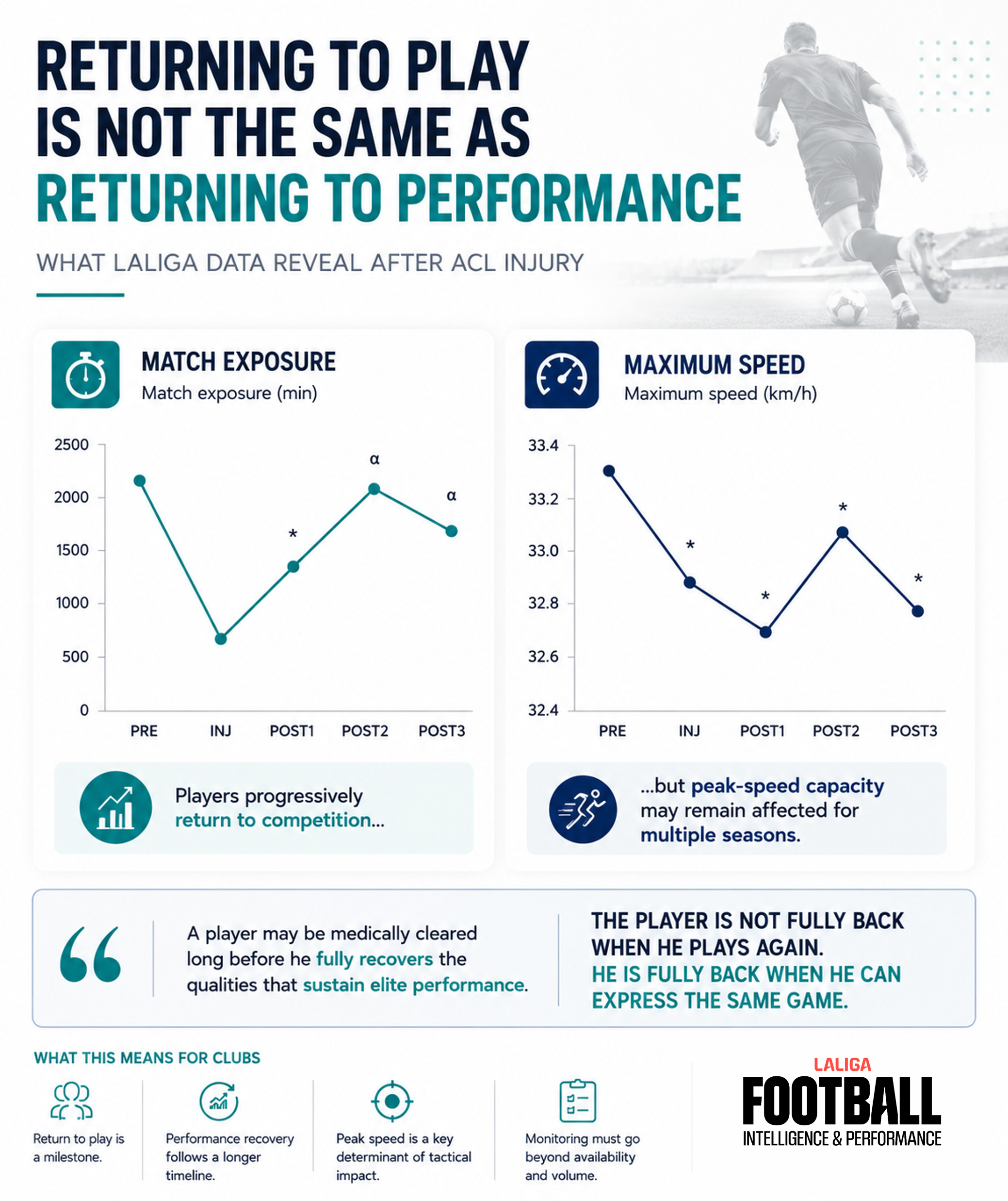
The most important finding was not volume. It was peak capacity.
One of the most interesting aspects of the study is that several commonly monitored physical metrics remained relatively stable after return to play:
- total distance covered,
- sprint distance,
- and sprint frequency.
However, one variable showed a persistent reduction:
Maximum running speed.
That detail changes the interpretation completely.
Because maximum speed is not just another physical variable.
It directly conditions which tactical solutions remain available to the player.
It influences the ability to:
- attack depth,
- recover defensively,
- cover large spaces,
- win transition duels,
- and solve high-speed situations under pressure.
The player may still run.
He may still compete.
He may still accumulate minutes.
But some of the highest-intensity expressions of his game may still be rebuilding.
The body may compensate before it fully recovers
This is probably the most powerful insight of the paper.
The study suggests that many performance metrics can appear “normal” while peak locomotor capacity remains affected.
In other words:
The player may look ready before the system has fully recovered.
That matters because football performance is highly adaptive.
Players compensate.
Teams compensate.
Coaches adapt structures around players.
Players modify behaviours without even realising it.
A player may:
- sprint less aggressively,
- avoid certain actions,
- change movement timing,
- defend differently in large spaces,
- or rely more on positioning than acceleration.
And externally, many of these adaptations may be difficult to detect.
This is why return to performance should probably be understood differently from return to play.
Because the question is not only:
“Can the player compete again?”
But also:
“Can he still express the same game?”
He is back.
But he may not yet be the same player.
This is where the study becomes especially useful for coaches.
A player returning after ACL injury may:
- train normally,
- complete matches,
- and even reproduce many external load metrics,
while still lacking some of the peak-speed capacities that support elite tactical behaviour.
That does not mean the process has failed.
It means recovery is rarely linear.
And it reinforces something many practitioners already intuitively feel:
Performance restoration often continues long after medical clearance.
Match exposure also follows a longer timeline
The study showed a major reduction in playing time during the injury season, followed by a gradual recovery over the following years.
Importantly, competitive exposure did not appear to fully normalise until approximately two to three seasons after return to play.
That matters because minutes are not just a workload metric.
They also reflect:
- trust,
- tactical integration,
- rhythm,
- robustness,
- and the player’s ability to repeatedly tolerate competitive demands.
The first match back is important.
But sustainable availability is a completely different challenge.
Age changes the recovery context
The study also found that players older than 25 years experienced more persistent reductions in maximum speed after return to play.
This does not mean older players cannot successfully return.
Many clearly do.
But it may suggest that the recovery context changes with age.
Some players may require:
- longer reconditioning phases,
- more progressive sprint exposure,
- and more individualised performance rebuilding strategies.
This is highly relevant not only for medical and performance departments, but also for:
- coaches,
- sporting directors,
- recruitment departments,
- and long-term squad planning.
Because the key question is no longer simply:
“When can the player return?”
but:
“What support does he need to progressively recover his competitive identity?”
An important methodological nuance
There is another detail that makes these findings even more interesting.
The full cohort included 51 players, but match running performance was analysed only in the 34 players who remained in LaLiga during the three-year follow-up.
That means the physical impact may actually be underestimated.
Because the study is effectively analysing the players who were capable of remaining at elite level.
And even within that group, maximum speed still showed persistent reductions.
What this means for football practitioners
This study supports a broader and more modern understanding of recovery after ACL injury.
Return to play should not be treated as the finish line.
It should be treated as a transition point between:
- medical recovery,
- physical rebuilding,
- tactical reintegration,
- and performance sustainability.
For clubs, this reinforces the importance of monitoring not only:
- availability,
- training participation,
- or external load volume,
but also the player’s ability to progressively recover:
- peak speed,
- confidence in high-speed actions,
- tactical expression,
- and long-term competitive robustness.
Because in elite football, the most difficult part is often not helping the player return.
It is helping him become fully expressive again within the game.
Final reflection
In professional football, returning to the pitch is a milestone.
But returning to your true performance level is often a much longer journey.
This study reminds us that recovery after anterior cruciate ligament injury is not simply about medical clearance or match participation.
It is about progressively rebuilding the capacities that allow the player to express his game freely, confidently, and competitively again.
And perhaps that is the most important distinction modern football still needs to make:
Return to Play is not always Return to Performance.