


27 Ene The relationship between running distance and coaches’ perception of team performance in professional soccer player during multiple seasons
Posted at 11:40h
in Paper
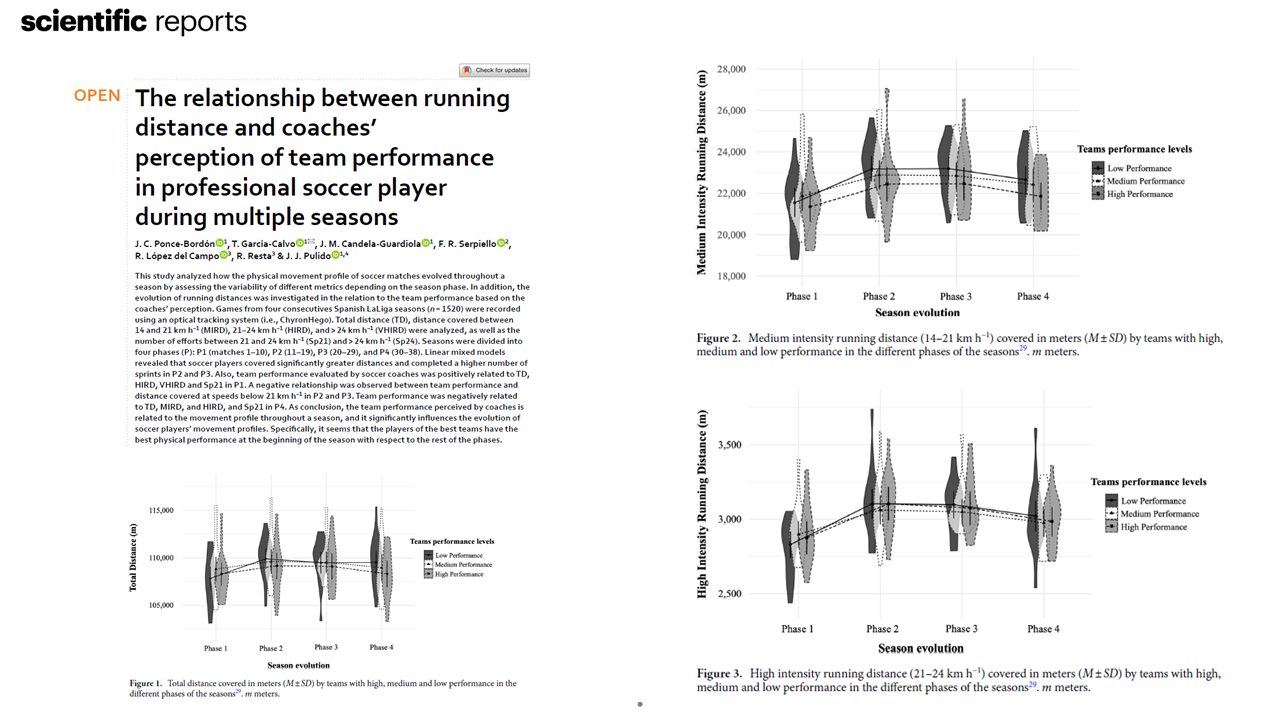
How much a team runs during the season does not only reflect fitness levels—it also connects directly with how coaches perceive overall performance. This study analyzed more than 1,500 LaLiga matches across four full seasons, looking at distances covered at different intensities (total distance, medium-intensity runs, high-intensity runs, very high-intensity runs, and sprints).
Key findings with direct application to coaching and match planning:
- Strong start matters: Successful teams were those that ran more and sprinted more in the early season. Entering the first 10 matches with high fitness levels was a clear marker of better end-of-season performance.
- Mid-season peak: Teams tended to reach their highest running volumes and sprint numbers in the middle of the season (phases 2 and 3). This reflects adaptation to training loads and competitive rhythm.
- End-season patterns diverge: High-performing teams actually ran less at the end of the season, especially at low and medium speeds, while low-performing teams were forced to cover greater distances—likely due to tactical disorganization or the pressure of avoiding relegation.
- Coaches’ perspective adds value: Instead of only using final rankings, performance was assessed by expert coaches considering budget, squad quality, and results. Their perception aligned strongly with physical data, highlighting that fitness and tactical efficiency are perceived holistically.
Practical takeaways:
- Pre-season fitness is decisive: plan conditioning to ensure players hit peak levels by the start of the season, avoiding a slow start that can heavily condition final results.
- Use mid-season to consolidate and adapt loads, knowing this is when teams naturally reach their physical maximum.
- In end-season, tactical organization and recovery management become key, since successful teams reduce physical output but maintain performance through efficiency and synchronization.
- Monitoring running metrics (especially high-intensity distance and sprints) can help anticipate performance trends across the season phases.
Read the full paper here (DOI): https://doi.org/10.1038/s41598-022-05519-x