


18 Feb Scoreline Bias
Why the evolution of the scoreboard systematically distorts performance analysis in elite football
Performance does not happen in neutral conditions.
In elite football, we often analyse players as if performance were stable.
- Total distance.
- High-speed running.
- Number of passes.
- Duels won.
But performance does not occur in a vacuum.
It occurs under a scoreline.
And the scoreline constantly reshapes behaviour.
This is Scoreline Bias.
When a team is winning, incentives shift.
When a team is losing, the game changes.
Space changes. Tempo changes. Risk changes. Decision-making changes.
Yet we still compare players as if 10.5 km meant the same thing at 1–0 and 0–1.
It does not.
What the data actually shows
Large-scale research in LaLiga leaves little room for interpretation.
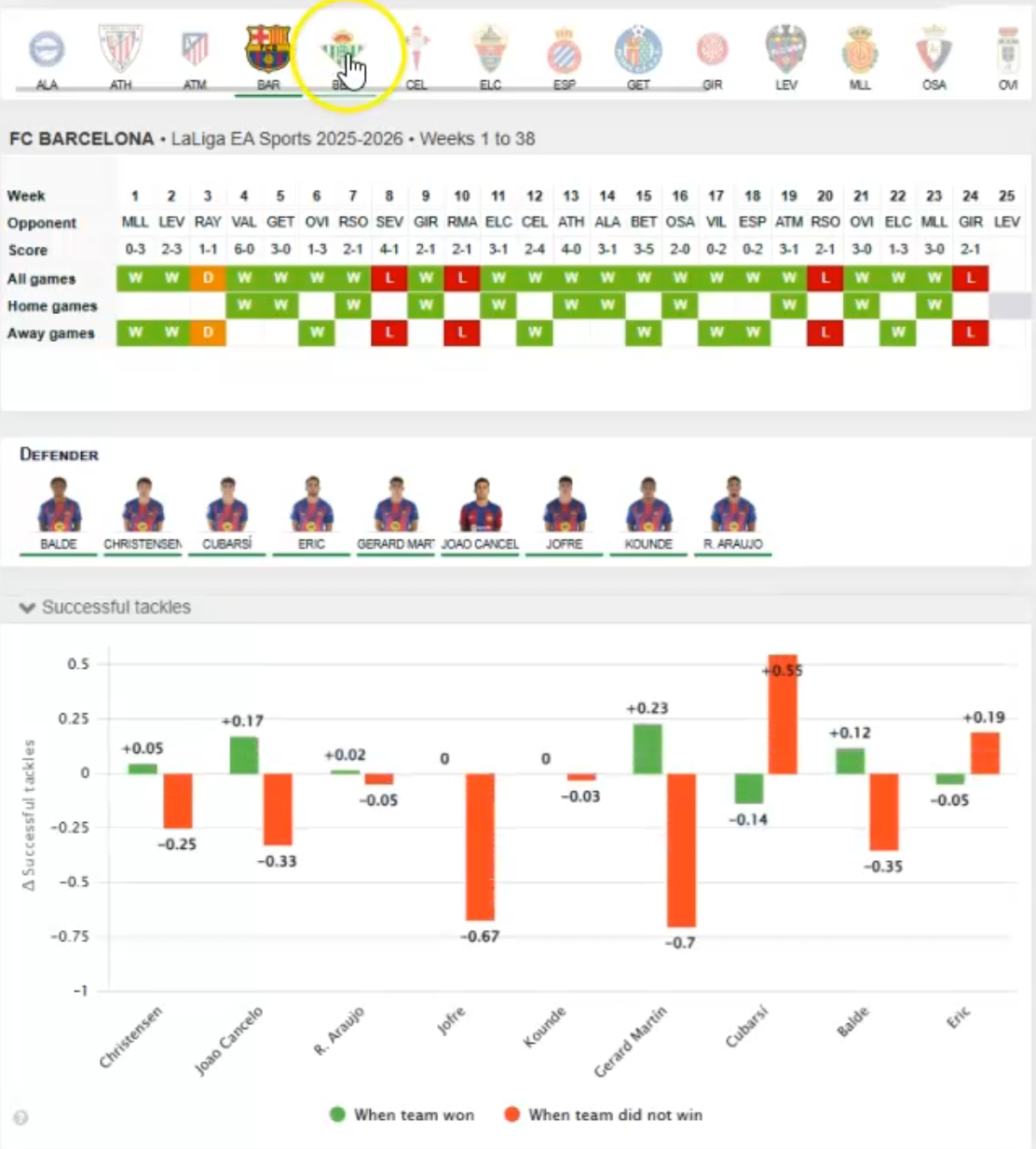
In more than 10,000 observations from Spain’s top division, match running performance depended strongly on the scoreline. When teams were losing, defenders increased total distance and high-intensity running, while attacking players showed the opposite pattern.
https://doi.org/10.1177/1747954120982270
The same position behaves differently under different scoreboard pressures.
But the effect goes further.
When researchers analysed time winning and time losing, the relationship became even clearer. For every minute a team was ahead, distance with ball possession decreased. For every minute behind, it increased.
https://doi.org/10.3390/s21206843
It is not only about the final outcome.
It is about how long the match was played under each incentive.
Scoreline reshapes tactical behaviour
The bias is not only physical.
Across a full LaLiga season, possession behaviour changed significantly according to match outcome.
Winning teams produced longer possessions and more passes.
Losing teams advanced more metres per possession, increasing verticality and risk.
https://doi.org/10.55166/reefd.v437i4.1102
The scoreboard does not just reflect the match.
It structures it.
Why this matters in professional practice
A centre-back protecting a 1–0 does not face the same physical and tactical demands as one chasing a 0–1.
A forward managing a 2–0 does not sprint like one trying to equalise in added time.
Different scoreline → different incentives.
Different incentives → different outputs.
If we ignore this, we risk mistaking:
adaptation for decline,
context for capacity,
tactical necessity for physical superiority.
For performance staff, training load should reflect how long the team spent winning or losing in the previous match. Recovery and tactical demands are not the same across game states.
For analysts and scouts, benchmarking requires filtering KPIs by match status. Raw metrics create structural distortion.
Performance at 0–0 is not performance at 0–2.
A decisive distinction
Understanding Scoreline Bias allows clubs to separate behaviour driven by context from behaviour driven by capability.
It converts intuition —“the team looked different after the goal”— into measurable structure.
In elite football, that distinction is not subtle.
It is decisive.