


27 Abr What Does It Really Mean to Be Fast in Football?
Speed is one of the most valued physical attributes in modern football. It is used to describe players, compare profiles, and often to justify tactical decisions. However, the concept itself is rarely defined with precision.
- Is a fast player the one who reaches the highest top speed?
- The one who accelerates faster over short distances?
- Or is speed a more complex, multidimensional quality?
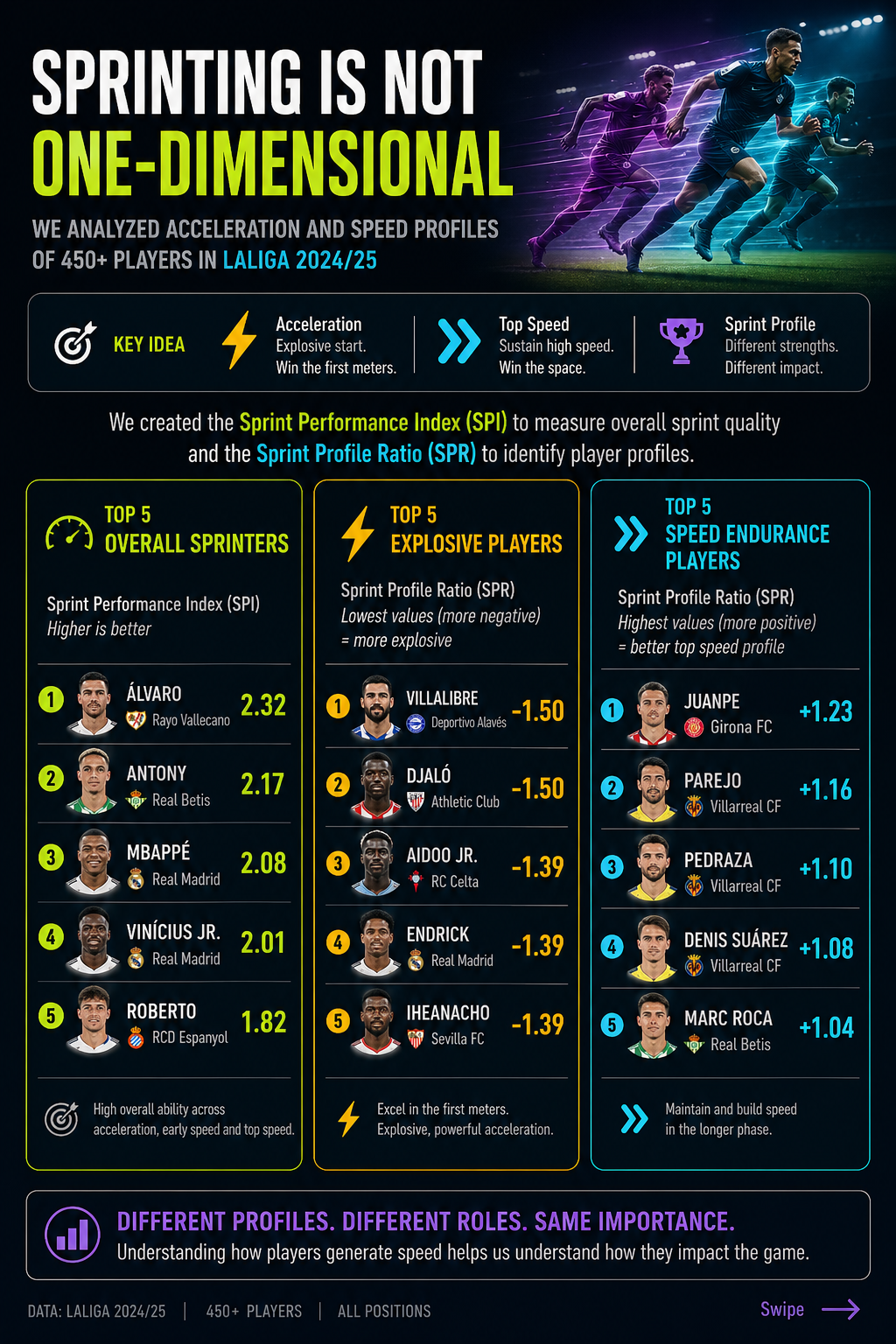
In this study, we analyzed sprint performance in LALIGA EA Sports 2024/25 using data from more than 450 players. The objective was to understand how speed is expressed in elite football and whether it is mainly an individual trait or shaped by contextual factors such as position, age or physical characteristics.
Methodology: How We Measured Sprint Performance
The dataset includes players with more than 400 minutes played during the season. For each player, we analyzed:
- Maximum acceleration
- Maximum speed
- Maximum speed over 10m, 20m, 40m and 60m
- Position, age and height
To move beyond isolated metrics, two composite indicators were developed.
Sprint Performance Index (SPI)
The Sprint Performance Index captures overall sprint capacity by integrating acceleration, early speed and top speed. All variables were standardized before aggregation.
This allows us to compare players on a common scale, combining different dimensions of sprint performance into a single metric.
Sprint Profile Ratio (SPR)
The Sprint Profile Ratio reflects how speed is expressed. It is calculated as the difference between top speed and early speed.
- Negative values indicate more explosive profiles
- Values close to zero indicate balanced profiles
- Positive values indicate players who develop speed progressively over longer distances
This distinction is key. Two players can have similar performance levels but completely different physical profiles.
Speed Is Not One-Dimensional
The first finding is clear. Acceleration and speed are related, but they are not the same.
The correlation between maximum acceleration and maximum speed is moderate, around 0.60. More importantly, this relationship weakens as sprint distance increases.
In short distances, acceleration plays a dominant role. As distance increases, the contribution of acceleration decreases and other factors such as running mechanics and efficiency become more relevant.
This means that players can reach similar sprint performance levels through different physical pathways.
Does Position Explain Sprint Performance?
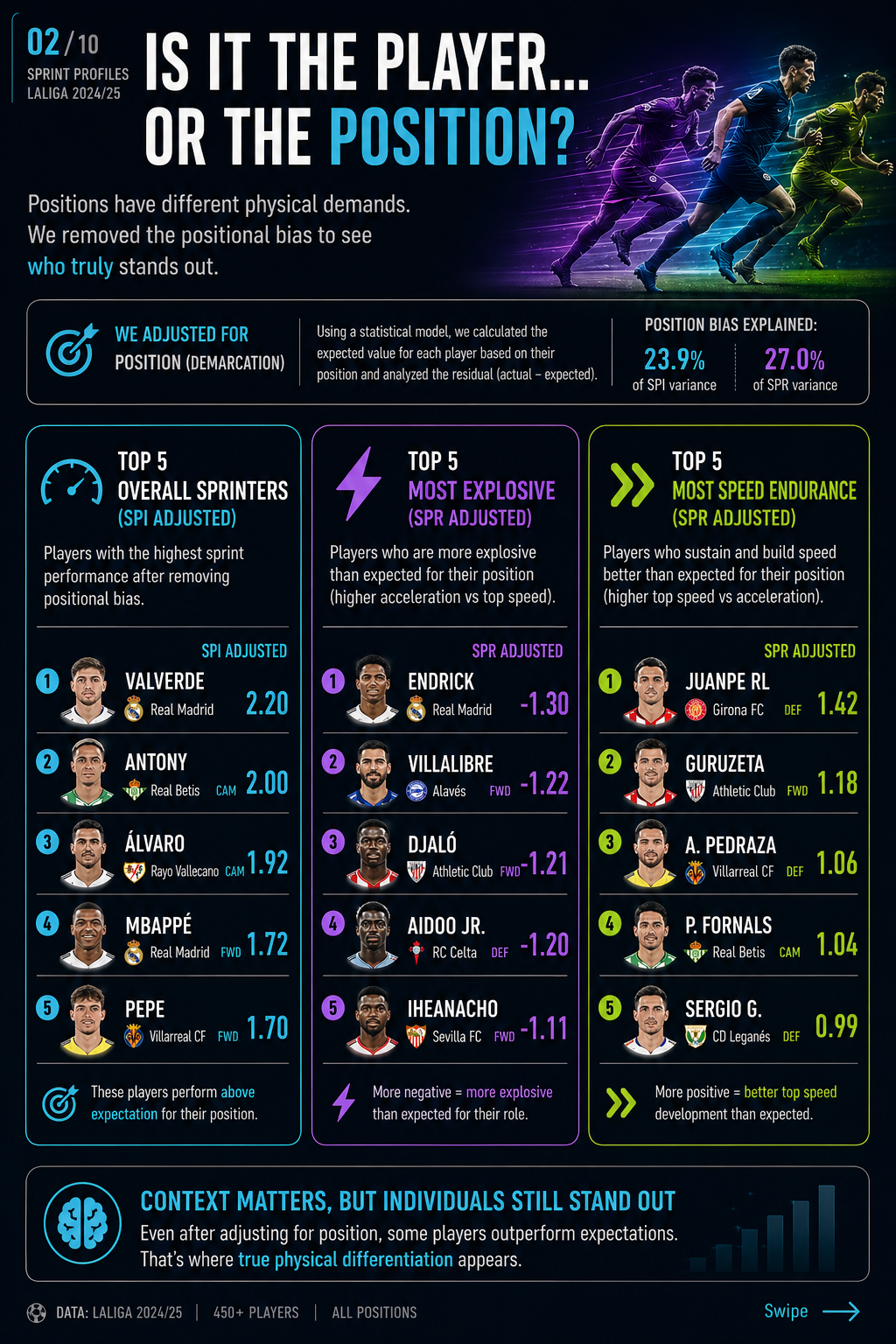
To evaluate the influence of context, we tested the effect of position using a regression model.
Position explains approximately:
- 23.9% of the variance in Sprint Performance Index
- 27.0% of the variance in Sprint Profile Ratio
This confirms that different positions impose different physical demands. However, more than 70% of the variability remains unexplained.
After adjusting for positional demands, several players still stand out. These are players who perform above what would be expected for their role.
Among them, we find profiles such as:
- Valverde, Antony and Mbappé in overall sprint performance
- Endrick and Djaló as highly explosive players
- Juanpe and Pedraza as speed-oriented profiles
One of the most interesting insights is that some of the most pronounced long-speed profiles are not found among wide attackers, but among central defenders and midfielders.
Does Age Influence Sprint Performance?
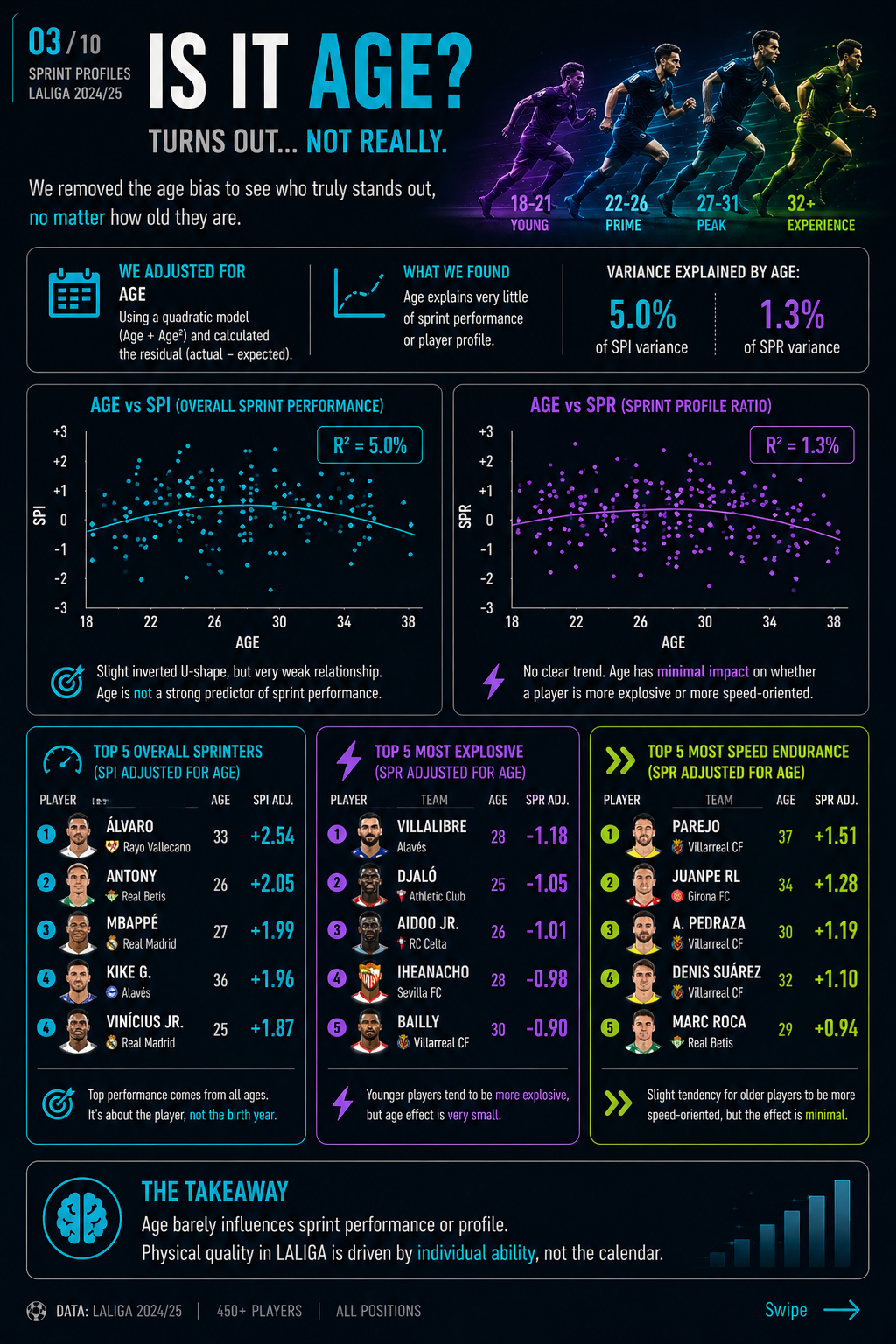
We then analyzed the effect of age using a quadratic model to account for potential non-linear relationships.
The results show that:
- Age explains around 5% of sprint performance
- Age explains around 1% of sprint profile
Although there is a slight tendency for performance to peak within certain age ranges, the effect is weak and not practically meaningful.
Top performers are distributed across a wide age spectrum, including players in their thirties.
Does Height Matter?
The same analysis was applied to height.
The results are even clearer:
- Height explains less than 2% of sprint performance
- Height explains less than 2% of sprint profile
This challenges common assumptions about body type and speed. Taller players are not necessarily more speed-oriented, and shorter players are not necessarily more explosive.
Discussion: What Really Drives Speed in Football
Bringing all results together, a clear pattern emerges.
Position has a measurable influence on sprint performance, but it does not fully define it. Age and height have minimal impact.
This leads to a key conclusion. Sprint performance in elite football is largely individual.
Players do not simply inherit their physical profile from their position, their age, or their body type. Instead, they express speed in ways that are specific to their own characteristics and interaction with the game.
Practical Applications for Coaches and Analysts
For coaches, this means that players should not be evaluated solely based on positional expectations. Individual profiling is essential.
For performance staff, it reinforces the importance of developing both acceleration and top speed, rather than focusing on a single dimension.
For scouting, identifying players who outperform positional norms can provide a competitive advantage.
For analysts, the key takeaway is methodological. Context must always be considered before comparing players. Adjusting for variables such as position allows for more meaningful evaluations.
Conclusion
Speed in football is not defined by a single metric, nor by simple assumptions about age or physical characteristics.
It is a multidimensional quality, partially shaped by context but largely driven by individual capacity.
Position explains part of performance. The rest belongs to the player.