


16 Abr Teams Don’t Win the Way You Think They Do
Introduction: Forget What You Think You Know About Winning
Most coaches intuitively associate winning with dominance: more possession, more passes, more control. But what if the data from an entire LaLiga season suggests something different?
A recent scientific study analyzing all 380 matches of the 2021–2022 LaLiga season provides a unique perspective. Instead of asking what the best teams look like, it asks a more subtle question:
What actually happens, on average, when a team wins a match?
This distinction is critical. We are not looking at identity or philosophy. We are looking at behavioural patterns associated with winning outcomes.
Importantly, many of these behaviours are not necessarily the cause of winning, but rather the result of how teams adapt once they gain an advantage.
Key Idea: Winning Is About Adaptation, Not Just Dominance
The data shows a consistent pattern:
Teams that win matches tend to adapt their behaviour, becoming more efficient, more vertical, and more defensively engaged.
Winning is not simply about doing more. It is about doing what matters, when it matters.
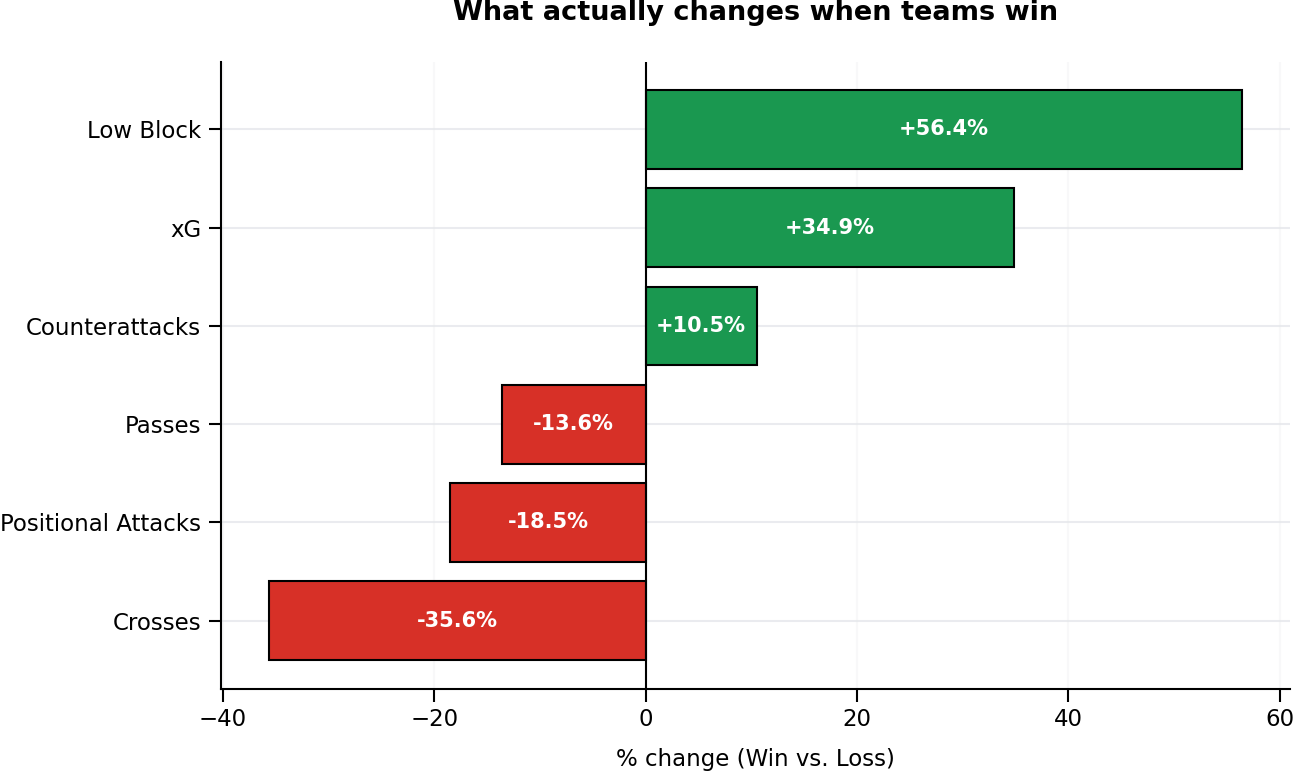
1. Attacking Behaviour: Less Volume, More Impact
What the data shows
When teams win, they tend to:
- Perform fewer positional attacks
- Execute fewer passes and crosses
- Generate more expected goals (xG)
- Use more counterattacks
How to interpret it
This does NOT mean that teams should attack less. It means that in matches they win, teams:
- Select better moments to attack
- Progress faster toward goal
- Create higher-quality chances with fewer actions
In other words, attacking becomes more efficient and more vertical.
Practical application
Coaches should prioritize:
- Training transitions and counterattacks
- Designing tasks that reward fast progression with purpose
- Improving decision-making in the final third
2. Defensive Behaviour: The Hidden Engine of Victory
What the data shows
Winning teams:
- Spend more time in low-block defending
- Face and defend more set pieces
- Perform more clearances
- Apply less high pressing
- Concede fewer expected goals
How to interpret it
Winning is strongly associated with an increased defensive load.
This is not a weakness. It is a consequence of game dynamics. Teams that are ahead often:
- Protect their advantage
- Accept deeper defensive positions
- Are exposed to more attacking situations from the opponent
Practical application
Elite teams must be prepared to:
- Defend in a low block with structure and discipline
- Manage sustained defensive phases
- Dominate set-piece defending
- Protect the penalty area effectively
3. Physical Demands: Not More Running, But Better Running
What the data shows
In matches they win, teams:
In attack:
- Cover less total distance
- Perform less high-intensity running
- Perform more high-speed running (HSR)
In defense:
- Cover more total distance
- Perform less high-speed running
How to interpret it
Winning is associated with a shift in physical demands:
- Attacking actions are short, explosive, and decisive
- Defensive phases are longer and more sustained
The key differentiator is not volume, but the quality and timing of high-speed actions, especially with the ball.
Practical application
Training should include:
- Sprinting in tactical contexts, not isolated drills
- Repeated defensive efforts in structured blocks
- Conditioning for phase-specific demands (attack vs defense)
4. Verticality Over Possession
One of the most interesting insights is conceptual.
Winning teams do not necessarily play more direct football (long balls), but they do show signs of increased verticality:
- Faster progression toward the opponent’s goal
- Fewer passes to reach dangerous zones
- More actions in open space
This suggests a shift from:
- Possession for control → to → progression for impact
Here, verticality refers to progressing the ball toward the opponent’s goal in fewer actions and less time, rather than simply maintaining possession.
5. Game Management: The Real Competitive Edge
All findings converge on one central idea:
Winning teams manage the game better.
When the context changes (for example, after scoring), successful teams tend to:
- Reduce unnecessary attacking volume
- Increase defensive organization
- Exploit transition opportunities
This ability to adapt is often what separates good teams from winning teams.
Final Takeaways for Coaches
If we translate the science into clear principles:
- Efficiency over volume in attack
- Mastery of defensive phases, especially low block
- High-speed actions as key offensive moments
- Vertical progression instead of sterile possession
- Adaptation to match context as a core competence
Conclusion
The science does not say that possession is useless or that teams should abandon their identity. Instead, it reveals something more nuanced:
Teams win when they adapt their behaviour to the demands of the match, becoming more efficient, more vertical, and more defensively resilient.
Understanding this distinction is essential for translating data into better decisions on the pitch.