


10 Ene The Evolution of Match Running Performance in the Top Two Spanish Soccer Leagues: A Comparative Four-Season Study
Modern professional football is moving faster every season. This study looks at how match running demands have changed across four full seasons in the top two Spanish leagues. It does not focus on one team or one position. It looks at the reality of the competition as a whole. What the game is asking from teams, week after week.
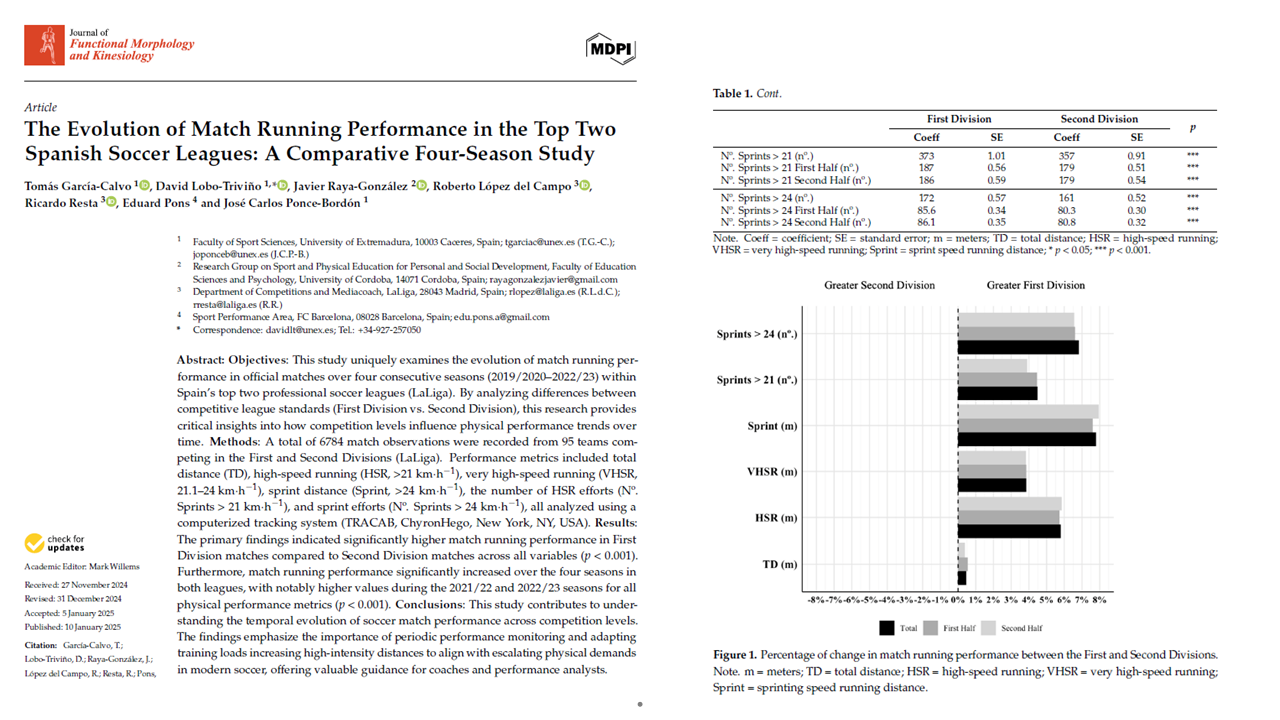
The first clear message is simple. First Division football is more demanding than Second Division football. Teams in the top league run more. They run faster. They sprint more often. This happens in total distance, high-speed running, very high-speed running, and sprint distance. It happens in both halves. Not just at peak moments. This defines the physical gap between competitive levels.
For coaches and performance staff, this matters when preparing players for promotion, European competition, or squad rotation. A player moving up a level is not just facing better opponents. He is entering a faster game with more repeated high-intensity actions. If training loads stay the same, the player will be underprepared.
The second key message is even more important. Match running demands are increasing over time in both leagues. From 2019/20 to 2022/23, teams covered more distance at high speed and sprinting speed. The jump is especially clear from the 2021/22 season onwards. This is not noise. It is a clear trend.
This means that “last season’s demands” are already outdated. Training plans based on historical averages will slowly fall behind the game. Weekly microcycles must evolve. Exposure to high-speed running and sprinting cannot be occasional. It must be planned, repeated, and protected.
Another critical finding challenges old assumptions. Physical output did not drop in the second half. It increased. Teams ran more at high intensity after halftime. This reflects modern football. More substitutions. Higher physical preparation. More aggressive tactical phases late in matches. For practitioners, this changes how fatigue is interpreted. A drop in output is no longer inevitable. The game now demands sustained intensity until the final minutes.
This has direct consequences for recovery strategies, in-game load management, and substitution planning. Players entering from the bench are not just replacing tired legs. They are amplifying team intensity. Training substitutes only for “short efforts” is no longer enough. They must be ready for immediate high-speed contribution.
Sprint distance deserves special attention. Distances above 24 km/h increased across seasons and leagues. Sprinting is no longer an occasional action. It is a repeated requirement. This reinforces the need for structured sprint exposure in training. Not only with the ball. Not only in transitions. But with clear mechanical and neuromuscular intent.
From an injury prevention perspective, this study sends a clear warning. High-speed and sprint demands are rising. If training does not reflect this reality, injury risk increases. If training overloads it without structure, injury risk also increases. The solution is not less intensity. It is better planned intensity.
In practical terms, modern elite football requires training weeks that prepare players for faster matches than last year. Coaches and performance staff must monitor trends, not just averages. Match demands are moving. Preparation must move with them.
This study provides evidence of that evolution. The game is not waiting.