


19 Jun The Higher the Intensity, the More Football Becomes a Deceleration Game
Football loves acceleration.
Sprints.
Explosive runs.
Maximum speed.
High-speed distance.
But our data show something that should change the conversation:
At medium intensity, players accelerate more than they decelerate.
At high intensity, the game flips.
At high intensity, football becomes dominated by deceleration.
Not slightly.
Clearly.
Across professional players:
- High intensity total: +61% more decelerations than accelerations
- High defensive intensity: +79%
- High offensive intensity: +45%
So, for every 100 high-intensity accelerations, there are around 161 high-intensity decelerations.
In the defensive phase, around 179.
That is the real story.
Football is not only about accelerating hard.
It is about accelerating, decelerating, reorienting and accelerating again.
The Positional Pattern Is Even Stronger
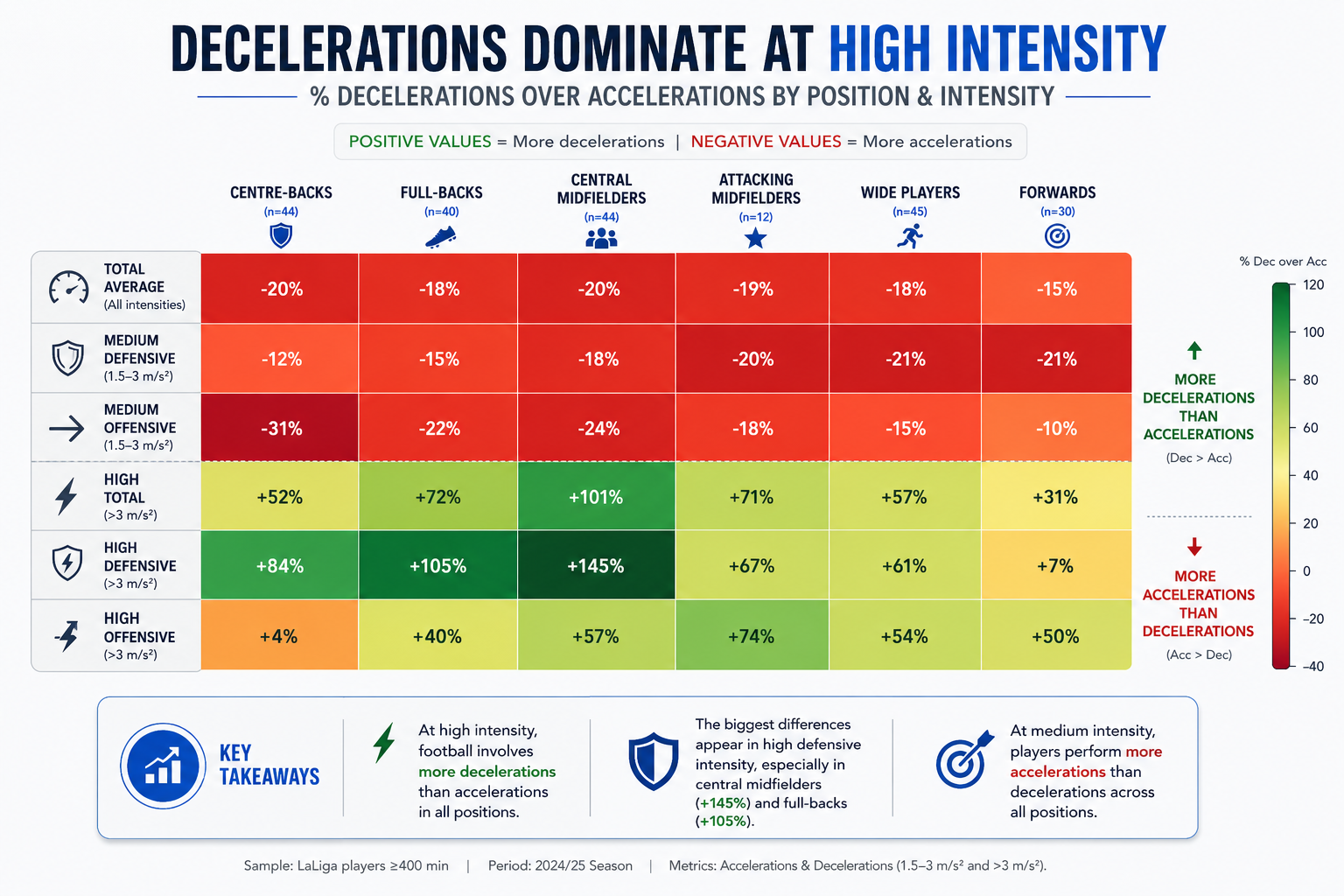
The heatmap makes the message obvious.
At medium intensity, most positions show more accelerations than decelerations.
But at high intensity, everything changes.
High-intensity defensive phase:
- Central midfielders: +145%
- Full-backs: +105%
- Centre-backs: +84%
- Attacking midfielders: +67%
- Wide players: +61%
- Forwards: +7%
The biggest signal appears in central midfielders.
Almost 2.5 high-intensity defensive decelerations for every high-intensity defensive acceleration.
That makes sense.
Central midfielders live in the most unstable area of the pitch.
They press, adjust, turn, close passing lanes, recover position and reorient constantly.
Their load is not just running.
It is repeatedly changing mechanical state.
Why This Matters
Deceleration is often less visible than acceleration.
A sprint is obvious.
A high-speed run is easy to identify.
An explosive acceleration catches the eye.
But a high-intensity deceleration can be hidden inside a tactical action:
- stopping before a duel;
- adjusting body orientation;
- closing a passing lane;
- reacting after losing possession;
- controlling depth;
- preparing the next acceleration.
Biomechanically, this matters.
Deceleration requires force absorption, eccentric control, trunk stability, joint control and rapid reorientation.
So two players may cover similar distances but experience very different neuromuscular loads.
One runs more linearly.
The other repeatedly decelerates, turns and re-accelerates.
The second load is less visible.
But it may be more decisive.
The Performance Layer: Active vs Reactive Profiles
The most important point is not simply that deceleration is high.
The key is why it happens.
A high-intensity deceleration can be part of an effective action:
- pressing aggressively;
- stopping to intercept;
- closing space;
- preparing a tackle;
- triggering a defensive trap.
But it can also reflect a reactive action:
- arriving late;
- correcting poor positioning;
- chasing an opponent;
- defending in emergency;
- compensating for a tactical disadvantage.
That is why the acceleration–deceleration relationship should not be read as “good” or “bad”.
It should be read as context.
And this is where team level becomes interesting.
Champions, Europa and Relegation Groups
When teams were grouped by competitive level, the high-intensity Dec/Acc ratio showed a clear gradient:
- Champions group: 1.50
- Europa group: 1.67
- Relegation group: 1.73
All groups decelerate more than they accelerate.
But lower-performing teams are more dominated by deceleration relative to acceleration.
In the defensive phase:
- Champions: 1.67
- Europa: 1.82
- Relegation: 1.93
This may suggest a more reactive physical profile.
More correction.
More chasing.
More emergency adjustments.
Not less effort.
A different kind of effort.
Higher-level teams still decelerate a lot, but their high-intensity profile appears less dominated by deceleration and more balanced by explosive accelerations.
Defensive Functional Explosiveness
This leads to a useful indicator:
Defensive Functional Explosiveness
Defined as:
High-intensity defensive accelerations / defensive-phase minutes × 90
Why is it interesting?
Because it is not just a physical metric.
It is a physical action placed inside a tactical context:
- pressing;
- jumping to the ball carrier;
- reacting after losing possession;
- closing space;
- activating the first defensive line.
The strongest performance-related pattern appeared here.
Higher-level teams showed more high-intensity defensive accelerations per real minute of defensive exposure.
Especially in forwards.
The modern forward does not only finish attacks.
He also starts the defence.
And to start the defence effectively, he must accelerate to press — but also decelerate to block passing lanes, control the duel and trigger the trap.
Training Implication
If we only train acceleration, we train half of the problem.
High-intensity football requires players to:
- accelerate;
- decelerate;
- stabilise;
- reorient;
- re-accelerate.
So deceleration should not only be treated as an injury-prevention topic.
It is a performance topic.
The key questions are:
How often does a player decelerate intensely?
In which phase?
In which role?
And with which tactical consequence?
That is where the value is.
Final Thought
The modern physical advantage in football is not simply running more.
It is not even accelerating more.
At high intensity, the game changes.
The higher the intensity, the more football becomes a deceleration game.
And the best players are not only those who accelerate explosively.
They are those who can:
accelerate, decelerate, reorient and accelerate again — at the right time, in the right space, within the right tactical role.
That is why deceleration deserves a central place in football performance analysis.