


04 Ene The influence of red cards on match-running performance in elite soccer
What really happens when a team goes down to ten men?
Or even more interesting.
What happens when a team gains a numerical advantage?
Red cards are often described as decisive moments that shift momentum, alter tactics and influence match outcomes. But their impact on physical performance is less understood.
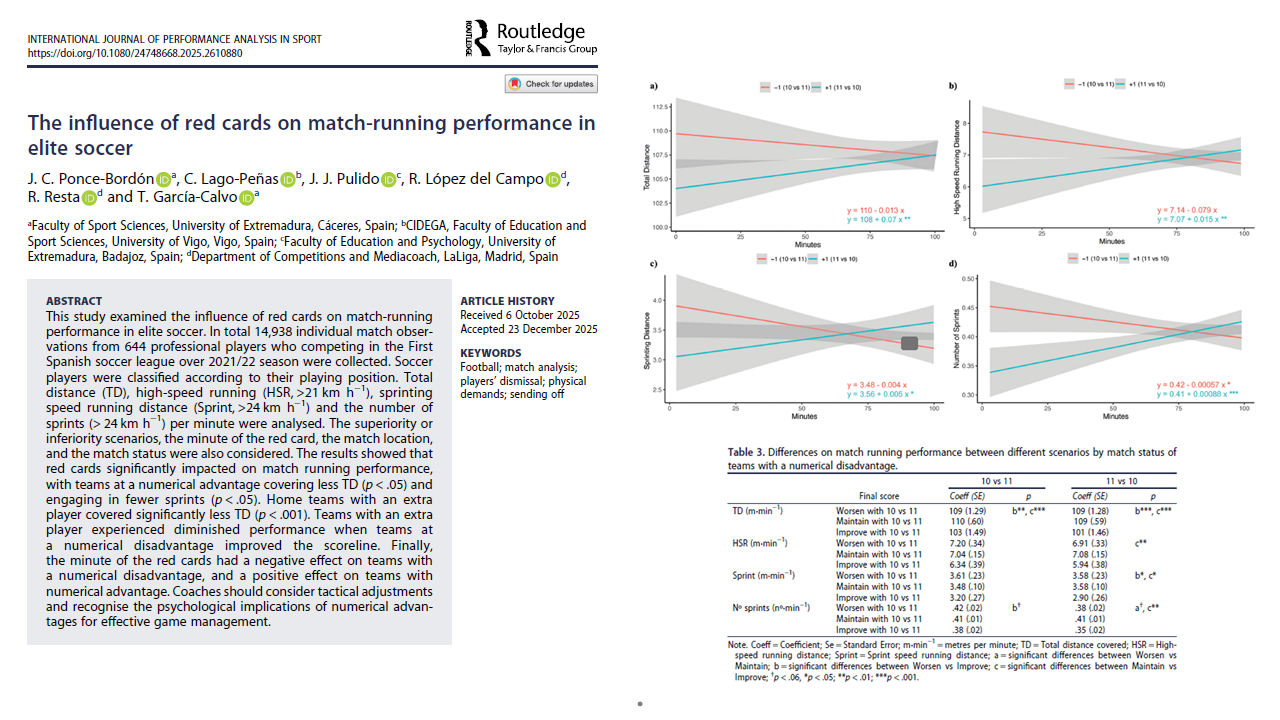
This study analysed 14,938 individual match observations from 644 professional players competing in LaLiga during the 2021/22 season. A total of 760 matches were included, of which 78 involved a red card situation (single dismissal only).
Players were classified by position:
– Central Defenders
– Wide Defenders
– Central Midfielders
– Wide Midfielders
– Forwards
The analysis focused on total distance (TD), high-speed running (HSR >21 km/h), sprint distance (>24 km/h), and number of sprints per minute. Contextual variables were also considered:
– Numerical scenario (11v11, 11v10, 10v11)
– Minute of dismissal
– Match location
– Match status (worsen, maintain, improve)
– Final league ranking tier
The findings challenge intuitive assumptions.
Teams with a numerical advantage (11 vs 10) covered less total distance and performed fewer sprints compared to teams with a numerical disadvantage.
In other words, having an extra player does not automatically increase physical output.
In fact, the opposite trend was observed.
Teams reduced their physical intensity when playing with superiority.
Conversely, teams with 10 players often increased their work rate.
This aligns with previous evidence suggesting that reduced teams compensate through greater moderate-intensity and high-intensity activity.
But the context matters.
Match location played a key role.
Home teams with an extra player covered significantly less total distance.
This contradicts the traditional concept of home advantage.
One explanation may be psychological comfort.
Perceived control and dominance may reduce urgency and intensity.
Away teams with numerical superiority, however, tended to increase running output, possibly attempting to exploit the advantage more aggressively.
Scoreline evolution added another layer.
When teams with a numerical disadvantage improved the scoreline, both teams reduced running performance.
This suggests that game control, defensive organization and tempo management become priorities over physical expansion.
Interestingly, when teams with numerical superiority saw the opponent improve the scoreline, their physical output decreased even further.
This may reflect negative psychological effects.
Complacency can backfire.
From a ranking perspective, lower-tier teams (Tiers D and E) covered significantly more total distance and performed more sprints when playing with a numerical disadvantage compared to when playing with superiority.
This suggests that weaker teams respond to disadvantage with greater physical compensation.
Higher-tier teams showed more stable patterns, possibly reflecting tactical maturity.
Playing position analysis revealed important nuances.
Central defenders and central midfielders reduced total distance when their team had an extra player.
Wide defenders increased sprint frequency when their team was down to ten players, likely due to greater defensive demands and transition exposure.
Forwards covered less total distance when playing with superiority, possibly reflecting controlled tempo rather than continuous pressing.
The timing of the red card also influenced performance.
The later the red card was issued:
– The more positive the effect for teams with superiority
– The more negative the effect for teams with inferiority
This highlights that the duration of numerical imbalance matters.
Early red cards produce different physical demands than late dismissals.
The practical implications are clear.
Coaches should not assume that numerical superiority increases physical output.
Instead, they should:
– Actively manage tempo
– Maintain pressing intensity
– Avoid psychological relaxation
– Prepare structured tactical responses for both 10v11 and 11v10 scenarios
For teams reduced to ten players:
– Increased physical load is likely
– Fatigue risk rises
– Recovery protocols should be adapted
– Tactical compactness can reduce unnecessary load
For teams with superiority:
– Avoid complacency
– Sustain tactical discipline
– Recognize that reduced intensity can compromise advantage
Red cards reshape match dynamics physically, tactically and psychologically.
Numerical advantage does not automatically translate into greater physical dominance.
Sometimes, it leads to less.
Football is not only about numbers on the field.
It is about how teams respond to imbalance.