


11 Sep The Revolution of Real-Time Tactical Analysis: From the Voronoi Model to Data-Driven Decision-Making in Football
In recent years, data analysis in football has transformed how coaches prepare and manage matches. From using advanced metrics to interpreting heat maps, analytical tools have become essential to optimize both individual player performance and collective team strategies. However, most of these approaches focus on post-match analysis or pre-match planning. What if we took this analysis a step further and could access real-time data that allows coaches to make tactical adjustments the moment imbalances are detected?
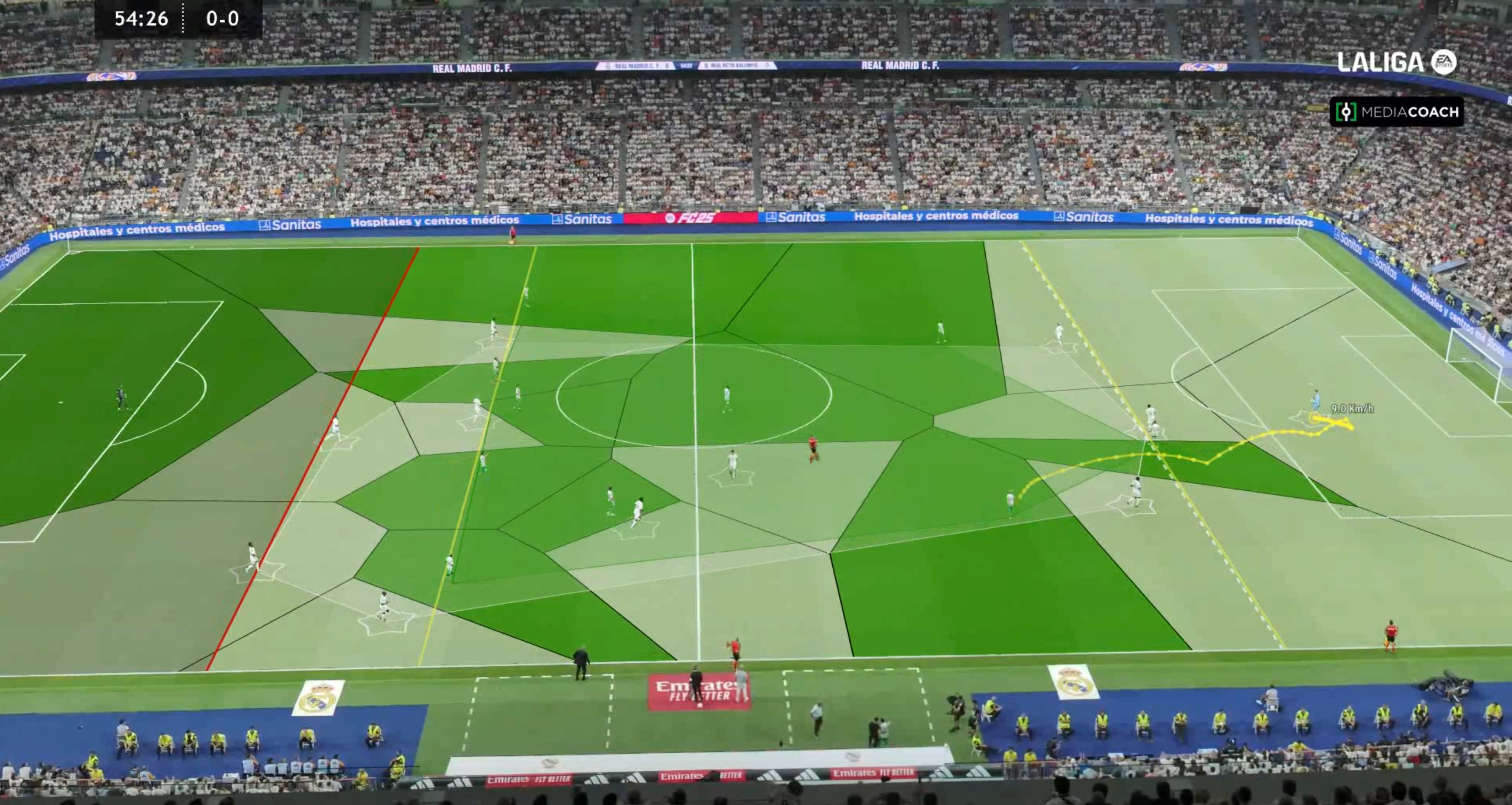
This is where our new tactical analysis model based on dynamic Voronoi zones comes into play. Inspired by research on multilayer networks in football (you can check the paper here), this model not only provides a precise representation of players’ spatial control but also offers real-time alerts to the coaching staff, allowing them to correct tactical imbalances before they become obvious issues.
What Are Voronoi Zones?
Before diving into how our model works, it’s important to understand the concept of Voronoi zones. In mathematics, Voronoi regions divide a space into areas where each point in a region is closest to a specific point. Applied to football, each player on the field has their own «control zone,» which dynamically changes based on their position and that of their teammates and opponents.
Traditionally, tactical analyses divide the pitch into fixed zones of equal size to assess performance, but this approach doesn’t reflect the true dynamics of the game. Voronoi zones, on the other hand, adapt in real-time to players’ positions, providing a more accurate representation of who controls which part of the field at any given moment.
The Power of Real-Time Analysis
One of the greatest advancements of this model is its ability to provide real-time feedback. During a match, players’ positions and movements constantly change, and with them, their zones of control. Our model detects tactical imbalances in their early stages, before they become visible to the naked eye. This gives the coaching staff more time to make decisions and tactical adjustments, maximizing their reaction time.
Practical Use Cases of the Model
This system has multiple applications to improve decision-making during a match:
- Imbalances in transitions: In football, transitions between defense and attack are crucial. If the system detects that the team is losing control of space during a transition, it generates an early alert. This allows the coach to reorganize the team before the opponent exploits the imbalance.
- Midfield control: Dominating the midfield is key in tight matches. If the system identifies that the team is losing influence in this area, it sends an alert, allowing the coach to adjust pressing or reinforce the midfield before the opponent takes control.
- Opponent attacks on the wings: If an opposing player is gaining too much space on a wing and creating dangerous situations, the system will alert the coaching staff early, enabling them to close those spaces before the opponent can take advantage.
Data-Driven Decision-Making: The Coach Always Has the Final Say
While the model is a powerful tool, the coach always has the final say. The goal of this system is not to replace human judgment, but to support tactical decisions with objective and accurate information. The alert system allows coaches to detect imbalances that may not be immediately obvious and react before it’s too late.
For example, if the analysis reveals that an opponent is dominating a critical area of the field, the coach can choose to adjust the defensive structure, make player substitutions, or rework the game plan to balance the match. However, as any coach knows, it’s not always possible to correct the imbalance, even if it’s detected early. The opponent’s quality or the inability to execute certain tactics can cause the issue to persist. It’s not just about knowing what to do, but about being able to do it—and whether the opponent allows you to.
What Does This Model Offer?
This approach brings multiple benefits to the coaching staff:
- Early detection and increased reaction time: Detecting an imbalance in its early stage provides valuable time to make adjustments, allowing the team to react more efficiently and effectively.
- Real-time analysis: While traditional analyses require time after the match, this model offers instant feedback that allows decisions to be made on the spot.
- Improved decision-making: Coaches can make more informed decisions with the support of accurate data, helping to optimize tactics and minimize errors.
- Better control over tactical imbalances: The model not only indicates when a problem occurs but also where and why, offering tactical solutions to correct the imbalances before they worsen.
The Future of Tactical Analysis in Football
Our model, based on dynamic Voronoi zones and real-time analysis, is just the beginning of what we believe will be a revolution in how coaches manage their matches. By providing early alerts and detecting imbalances before they become obvious, coaching staffs will have more tools to optimize their teams’ performance. However, football is not just about data: it will always depend on the coach to interpret that information and make the necessary decisions on the field.
Check out the initial research on which this model is based here: https://doi.org/10.1016/j.chaos.2023.114355.