


29 Abr Use of the playing systems in Spanish professional football leagues in relation to situational variables
Modern football is not played with a single fixed formation. This study confirms it with real competition data from Spanish professional football. More than 5,000 matches from LaLiga EA Sports and LaLiga Hypermotion were analysed across three full seasons. The objective was simple. To understand which playing systems are really used in elite competition. And how they change depending on context.
The first clear message is stability mixed with constant adaptation. Teams do not reinvent themselves every weekend. Most clubs rely on one main system during the season. But that system is far from exclusive. On average, teams used around five different formations per season. This tells us something important. Tactical flexibility is not optional in professional football. It is a requirement.
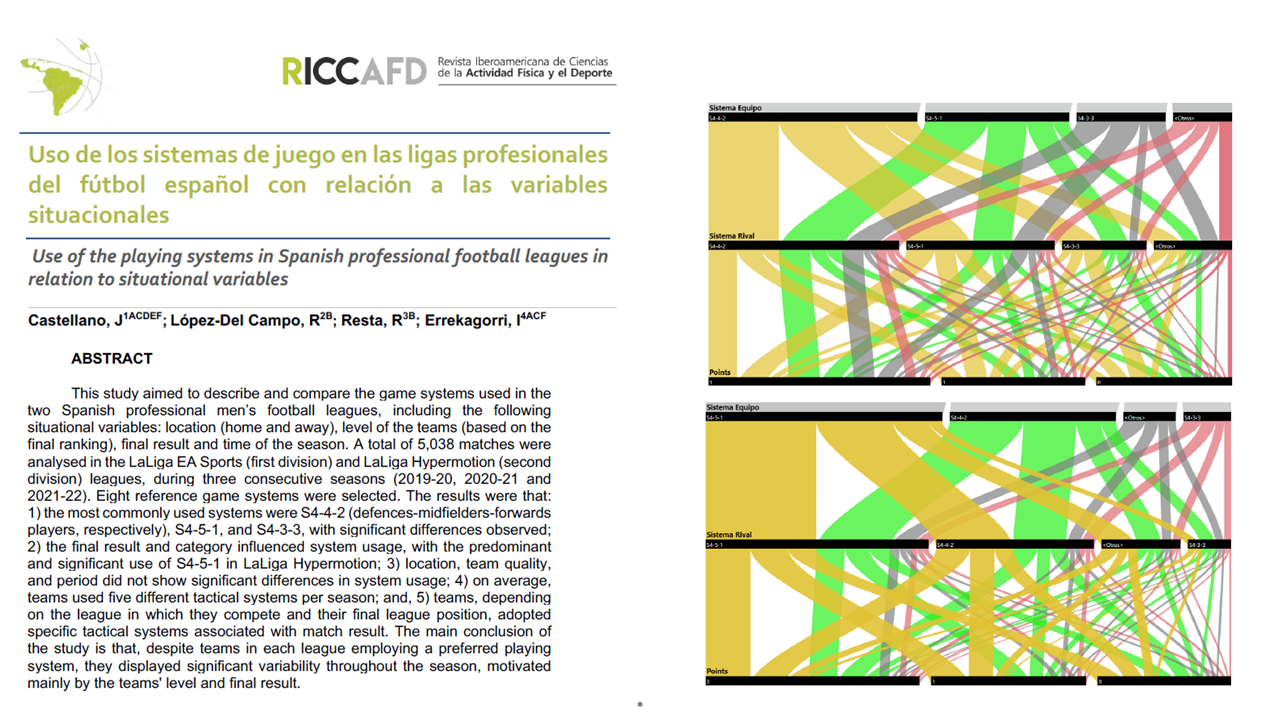
Across both divisions, three systems dominate match time. The 4-4-2. The 4-5-1. And the 4-3-3. Together, they account for the majority of minutes played. However, their use is not identical between leagues. In LaLiga EA Sports, the 4-4-2 is the most common reference system. In LaLiga Hypermotion, the 4-5-1 clearly dominates. This difference matters for coaches moving between categories. Promotion and relegation are not only competitive changes. They are tactical environments with different norms.
Interestingly, playing at home or away does not meaningfully change system selection. Teams do not radically alter their formation just because they change stadium. This challenges some traditional assumptions about home advantage and conservative away strategies. What really drives tactical change is the match result and the competitive level of the team.
Better-ranked teams in LaLiga EA Sports spend more time using systems with three forwards, especially the 4-3-3. This reflects their ability to dominate territory, sustain possession, and press higher. Lower-ranked teams rely more on balanced or defensive structures such as the 4-4-2 or 4-5-1. In LaLiga Hypermotion, even top teams tend to stay within the 4-5-1 framework, suggesting a more cautious and defensively structured competition overall.
Another key finding is what happens inside matches. More than half of all games are played using a single dominant system. But in the remaining matches, teams switch formations once or multiple times. These changes are not random. They are responses to scoreline, fatigue, red cards, injuries, or tactical mismatches. Lower-ranked teams are especially likely to change systems during matches, often because they spend more time chasing results.
For performance staff and analysts, this has direct consequences. Training should not be built around one formation only. Players must be exposed to multiple positional demands within the same week. Tactical periodisation must include transitions between systems, not just rehearsals of the preferred one. Physical preparation should also reflect this variability, as different systems impose different running, acceleration, and spatial demands on players.
The study also shows that no system guarantees success on its own. There is no magic formation. Winning probability depends on the interaction between both teams’ systems and their competitive level. The same formation can be effective or ineffective depending on context. This reinforces a key principle for elite football. Systems are tools. Not solutions.
From a recruitment and squad-building perspective, the message is clear. Players who can interpret multiple roles across different systems are more valuable. Tactical intelligence and adaptability are performance assets. Especially in long seasons with congested calendars.
In short, Spanish professional football is tactically stable but operationally flexible. Teams have an identity. But they survive and compete through adaptation. Coaches who prepare their players for this reality are better aligned with the demands of elite competition.