


14 Mar Validity of Coupling TRACAB’s Gen5 and Mediacoach Systems to Calculate Accelerations and Decelerations in Professional Football
In elite football, not all physical load is about how far players run. Many decisive actions happen in very short spaces. Sharp accelerations. Sudden stops. Explosive changes of direction. These actions stress muscles, tendons, and the nervous system far more than steady running. That is why accelerations and decelerations matter so much for performance and injury risk.
This study answers a very practical question faced daily by professional clubs. Can the accelerations and decelerations provided by the TRACAB Gen5 tracking system, processed through Mediacoach, be trusted in the same way as data from GPS-IMU devices?
The analysis was based on real competition. Official LaLiga matches. Three full seasons. Forty-six professional players. More than six hundred match observations. GPS-IMU data were used as the reference, because they measure acceleration directly through inertial sensors worn by the player. TRACAB and Mediacoach estimate acceleration indirectly from player movement captured by cameras.
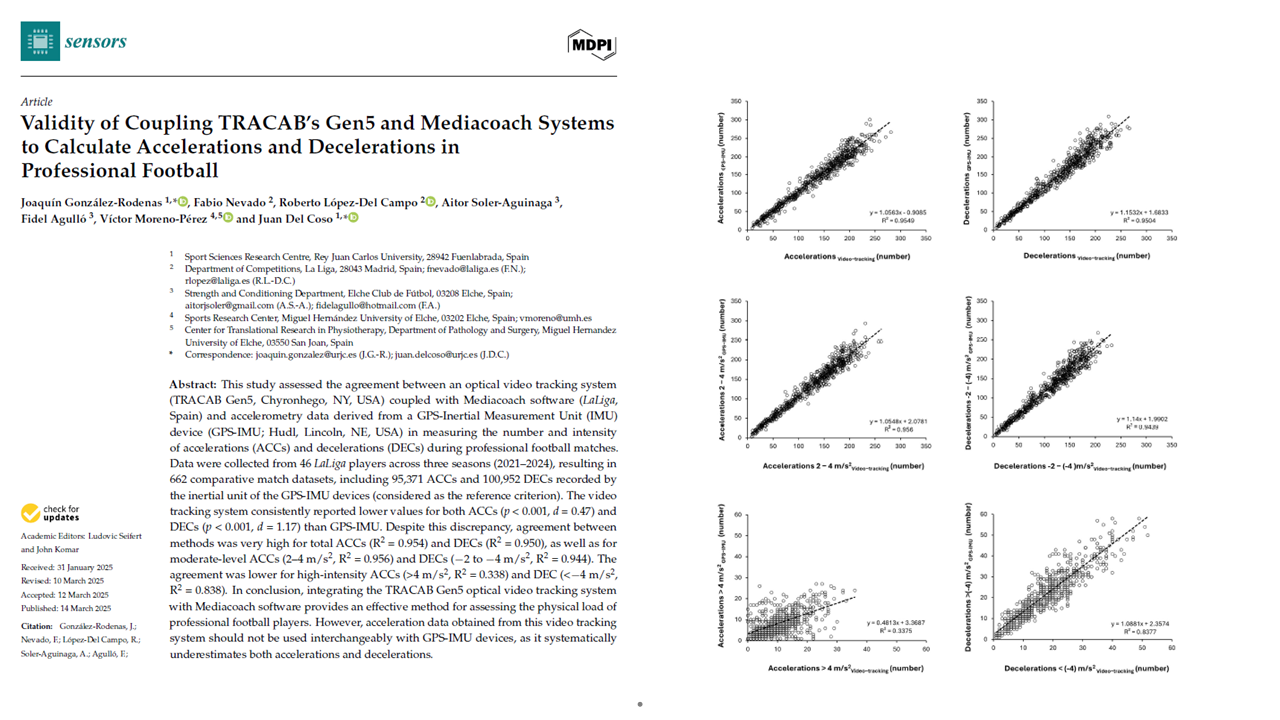
The first key message is simple. The agreement between systems is very high for total accelerations and total decelerations. It is also very high for moderate-intensity actions, between 2 and 4 m/s². This means the video tracking system is very good at identifying which players accumulate more or less mechanical load across a match. From a team perspective, the ranking of players is reliable.
This has immediate value for competition analysis. Staff can confidently use Mediacoach data to understand overall match demands. They can compare positions. They can identify games with unusually high mechanical stress. They can support post-match recovery decisions. All without putting a device on the player during the match.
However, the second message is just as important. TRACAB Gen5 combined with Mediacoach consistently underestimates the absolute number of accelerations and decelerations compared to GPS-IMU. This underestimation appears across most intensity zones. It is systematic. It is not random noise.
The issue becomes more relevant at very high intensities. For accelerations above 4 m/s², the agreement drops clearly. These are the most demanding actions for muscles and tendons. These are also the actions most associated with injury risk. Here, video tracking and GPS should not be treated as interchangeable.
For practitioners, this has clear consequences. Mediacoach data are excellent for internal consistency. Match-to-match comparisons are valid. Player-to-player comparisons within competition are valid. Trends across the season are meaningful. But absolute values should not be mixed with training data collected via GPS-IMU.
If training load is monitored with GPS and match load with video tracking, staff must avoid adding both datasets together without adjustment. Doing so would underestimate total mechanical stress. This could lead to poor load management decisions, especially in congested schedules.
The reason for these differences is not trivial. GPS-IMU devices sample inertial data at very high frequencies. They directly measure acceleration. Optical systems sample movement less frequently and calculate acceleration from positional changes. High-intensity actions happen fast. Small timing differences matter. The technology explains the bias.
From an applied perspective, the message is not to choose one system over the other. It is to understand what each system does well. Mediacoach is a powerful, non-invasive solution for match analysis in professional football. It allows clubs to monitor physical demands during official competition with confidence. GPS-IMU remains the reference when precise quantification of high-intensity mechanical load is required.
Used correctly, both systems complement each other. Used interchangeably, they can mislead.
This study provides the evidence needed to make informed decisions. It helps performance staff align training and competition data. It helps coaches interpret match demands with greater clarity. And it reinforces a key principle in elite football. Technology is only useful when its limits are fully understood.