


04 Ago «Championships Are Won in Enemy Territory»
Why mastering away games is the hallmark of champions
It’s the final stretch of the season. Your team is in the top two. Home games? Solid. Stats? Clean. But then you look at your away record. A few too many draws. One or two losses that still sting. And suddenly, that title slips away.
What separates a good team from a champion? That’s exactly what the Football Intelligence & Performance Department at LALIGA set out to uncover across a trilogy of scientific studies. Spanning eight full seasons and over 3,000 matches, these investigations went deep into what defines success in professional football.
But this isn’t just data for data’s sake. This is practical intelligence. Below, we unpack the key findings from this research and show how they can shape your next session, tweak your match prep, or reframe how you interpret performance stats.
Rethinking Success in Modern Football
“More passes, more possession, more wins”? Not always.
In the first study, the question was broad: Which match statistics best explain success in LALIGA over a full season?
Researchers analyzed 3040 matches from 2010 to 2018, correlating team stats with final league points. Among the findings:
- Shooting accuracy was the offensive variable most strongly associated with league position.
- Defensive shot prevention (i.e., few clear chances conceded) explained more variance in points than total possession or passing metrics.
- Surprisingly, passing accuracy and volume had a minimal predictive value.
What this means for you:
- Focus on finishing quality over shot volume.
- Design defensive setups that prioritize disrupting final-third penetration.
- Use possession not as a KPI, but as a means to create shooting opportunities.
Practical Takeaway:
Build finishing drills that replicate high-pressure, low-angle scenarios. And shift defensive work to prevent shots, not just recover possession.
Comparing the Extremes: Top vs Bottom
Not all stats are created equal when it comes to separating elite from struggling teams.
The second paper zoomed in on the top 3 and bottom 3 teams in each of the same eight seasons.
What stood out?
- Again, shooting accuracy had the biggest effect size in distinguishing elite teams.
- Top teams had significantly fewer shots conceded and allowed fewer corners.
- Variables like passes, crosses, or possession played a minor role.
- Away games revealed sharper contrasts: elite teams took more shots and maintained passing efficiency under pressure.
What this means for you:
- Train your team to generate higher-quality shots with fewer touches.
- Structure defending drills to reduce corners and zone entries.
- Reinforce tactical discipline in away contexts where margins are tighter.
Practical Takeaway:
Away match simulations should emphasize quick execution and psychological resilience under crowd pressure.
The Decisive Margin: 1st vs 2nd Place
Where championships are truly won
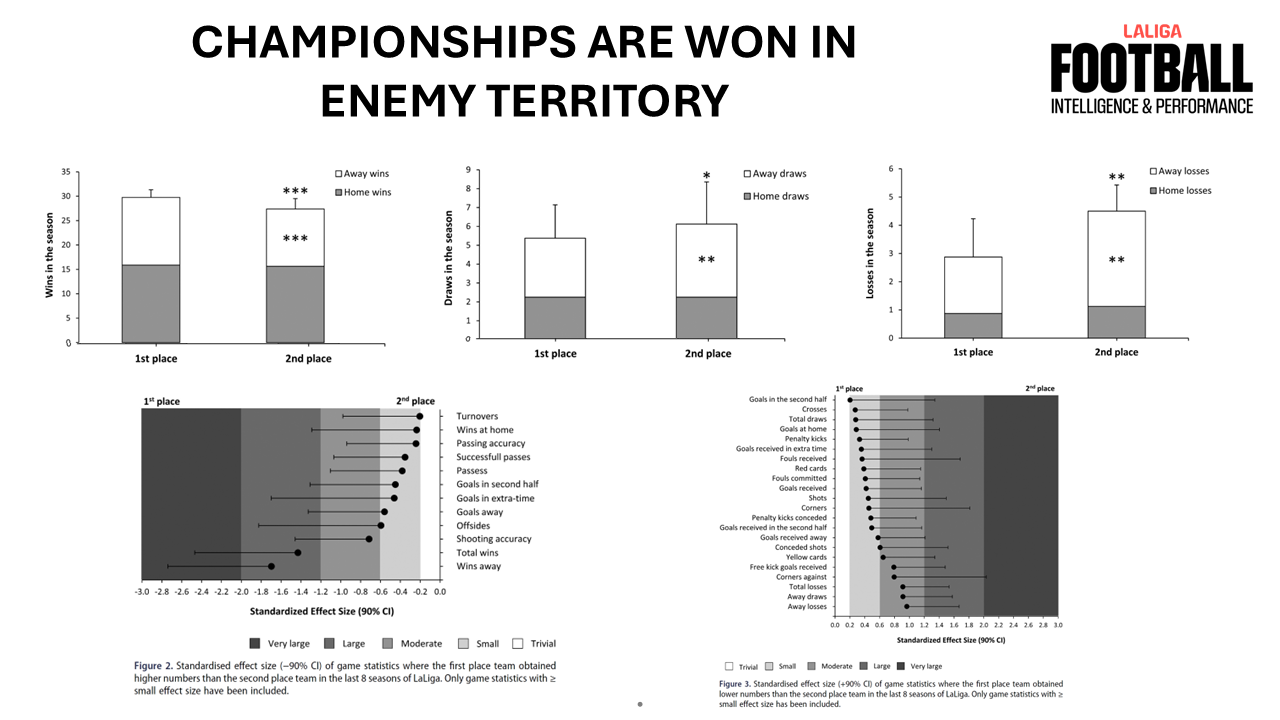
In the final study, researchers examined a rare but critical question: What separates the league champion from the runner-up?
Using detailed stats from the top two finishers each season, they found:
- Both teams performed similarly at home.
- The league winner consistently had more away wins (up to 3 more per season).
- Champions had higher shooting accuracy and conceded fewer corners and set pieces.
This wasn’t just statistical noise. The most robust differentiator across seasons was away performance.
What this means for you:
- Rethink how you prepare tactically and physically for away fixtures.
- Monitor not just win/loss ratios, but the efficiency of shots taken and conceded away.
- Make tactical decisions that favor aggressive play even as visitors.
Practical Takeaway:
Draws away might feel like progress. But across 8 seasons, they were the biggest reason teams finished second.
The Bigger Picture: What This Trilogy Adds to Football Science
These findings align with and expand upon broader literature. Previous studies (Lepschy et al., 2018; Collet, 2013) have questioned the overemphasis on possession. Others (Pappalardo et al., 2017; Moustakidis et al., 2023) show how predictive models based on shooting, defending and context outperform traditional stats.
What LALIGA’s trilogy does differently is:
- Use longitudinal data (8 seasons) to avoid one-season anomalies.
- Compare teams of similar competitive level (e.g., 1st vs 2nd), not just top vs bottom.
- Translate findings into actionable priorities for coaches and analysts.
From Research to Practice: What You Can Do This Season
✅ Train for quality over quantity in shooting.
✅ Design defensive patterns to avoid clear shots and corners.
✅ Prepare away game scenarios with tactical flexibility and offensive intent.
✅ Stop overvaluing passing accuracy in isolation; instead, tie it to final-third productivity.
✅ Use league data to track not just performance, but title-winning efficiency.
Learn More
- Research conducted by the Football Intelligence & Performance Department at LALIGA.
- Explore the trilogy:
- Paper 1 – A new paradigm to understand success: https://doi.org/10.1080/24748668.2019.1632580
- Paper 2 – An extensive comparative analysis: https://doi.org/10.3389/fpsyg.2019.02566
- Paper 3 – The football championship is won when playing away: https://doi.org/10.1080/24748668.2020.1801201