


09 Dic When Your Players Go to the World Cup… Do You Lose or Win? The Data Finally Answers
A question every club faces sooner or later
A World Cup approaches.
Your players leave with their national teams.
Inside the club, two opposing feelings coexist:
Pride — because international visibility can elevate a player’s market value.
Concern — because domestic performance still depends on the same player when they return.
This long-standing contradiction raises a simple but strategic question for any club:
“Do we lose or win when our players go to the World Cup?”
Until recently, the answer depended more on intuition than evidence.
Why We Investigated This
The 2022 FIFA World Cup created a rare natural experiment: an elite international tournament held mid-season, interrupting the rhythm of domestic leagues. Despite the huge interest around potential fatigue and performance drop-offs, surprisingly little scientific work had examined what actually happens when World Cup players return to their clubs.
This study emerges from a collaborative effort between university research groups, professional clubs and the Football Intelligence area within LaLiga. Rather than approaching the question from the perspective of a single organisation, the project brings together academic rigour, applied performance expertise and real match data to shed light on an issue that has long concerned clubs: what actually happens to player performance when they return from a World Cup?
Earlier work from our team analysed LaLiga players who did not participate in Qatar 2022, showing a different adaptation pattern during the break.
But the key question for clubs remained:
What about the players who did play the World Cup? How did their performance change once they returned to domestic competition?
Our new peer-reviewed study provides the clearest evidence to date.
How the Study Was Conducted — Without the Technical Noise
Participants
57 LaLiga players who competed in the FIFA World Cup Qatar 2022.
Data Source
Measurements came from LaLiga’s validated tracking systems (TRACAB at 25 Hz) and individualised speed thresholds via WIMU — the same technologies used by clubs every matchday.
Comparison Window
For each player, we analysed:
- 8 LaLiga matches before the World Cup
vs. - 8 LaLiga matches after returning from international duty
To ensure meaningful match-load exposure, only performances with >60 minutes played were considered.
Variables Assessed
- Total distance
- Maximal speed
- High-speed running (HSR)
- Sprint actions and distance
- High-intensity accelerations and decelerations
These metrics define how players express physical performance within tactical contexts.
What the Data Revealed
1. Players did not return with reduced performance
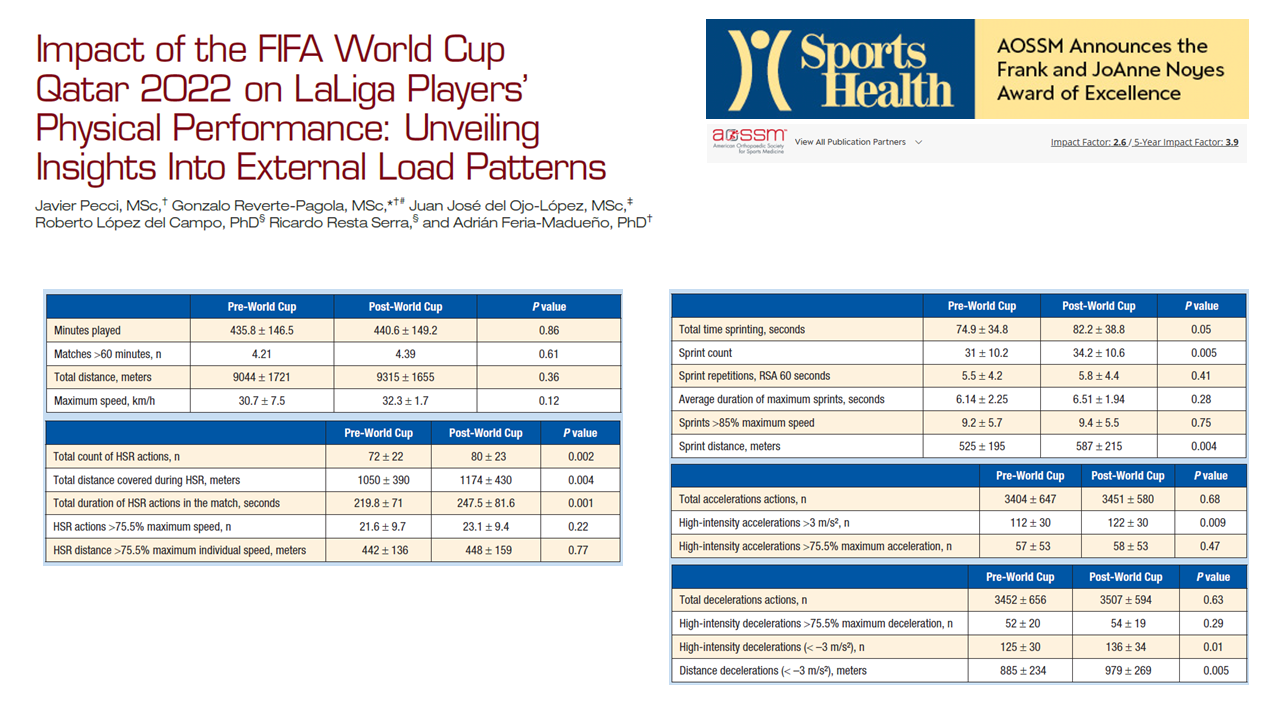
Across all major variables—minutes played, total distance and maximal speed—there were no declines after the World Cup.
For clubs, this is immediately reassuring:
international duty did not reduce baseline physical performance in domestic league matches.
2. In many cases, performance increased
Several high-intensity metrics were actually higher post-World Cup:
More high-speed running
- ↑ number of HSR actions
- ↑ HSR distance
- ↑ total duration at HSR
More sprint actions
- ↑ sprint count
- ↑ sprint distance
More high-intensity accelerations and decelerations
These actions shape phases of pressing, transitions, and positional dynamics.
From a club perspective, the message is clear:
Players did not return fatigued — in fact, many returned capable of producing more high-intensity work.
Why Might Performance Increase?
1. Continuous exposure to elite match intensity
During the World Cup, players repeatedly execute high-intensity actions under maximal competitive stress — a stimulus difficult to replicate in training blocks.
2. Elevated tactical and cognitive sharpness
High-level international football reinforces decision speed, timing, and execution patterns that may transfer into domestic performance.
3. Different adaptation profiles between participants and non-participants
In contrast, our companion study on players who did not go to Qatar 2022 showed a slight reduction in maximal speed after the break — likely due to fewer exposures to very-high-speed running during the interruption.
For clubs, this nuance is crucial:
two groups return with two different physical trajectories, and microcycle design should reflect that.
What This Means for Clubs and Performance Departments
1. Reconsider assumptions about post-World Cup fatigue
The evidence does not support the idea that players inevitably return physically diminished.
Individual monitoring and context remain essential, but fear-based planning is unnecessary.
2. Expect higher volumes of high-intensity match actions
Players may return performing:
- more sprints
- more high-speed running
- more accelerations and decelerations
This does not imply anything about injury risk; it simply describes performance behaviour that may help guide recovery protocols, rotation decisions and training design.
3. Leverage the World Cup as both a visibility opportunity and a performance stimulus
Clubs often fear losing performance when a player goes to the World Cup — yet also hope for increased market value and confidence on return.
The evidence shows that:
The tournament does not reduce physical performance — and in some aspects, players return performing more.
This helps clubs navigate the emotional and strategic contradiction inherent in international duty.
A Necessary Clarification: What About Injuries?
This study focuses strictly on match-running performance and external load.
It does not analyse injuries, nor does it infer links between physical outputs and injury risk.
For context (not as conclusions of this study):
- UEFA’s epidemiology for the 2022/23 season reported no major changes in overall injury incidence before vs. after the World Cup.
- FIFA injury surveillance has documented a long-term decrease in injury incidence during World Cups.
- Some non-academic reports have discussed variations in injury severity (days lost), but these use different methodologies and cannot be directly compared.
In summary:
Current scientific evidence does not show a systematic increase in injury incidence after a World Cup, and our study does not evaluate this area.
What This Study Adds to Football Science
- It is the first peer-reviewed study analysing post-World Cup physical performance in LaLiga players who actually competed in Qatar 2022.
- It challenges long-held assumptions about fatigue after major tournaments.
- It highlights distinct physical adaptations between international and non-international players.
- It reinforces a broader principle valuable for clubs:
Good decisions require evidence, not assumptions.
The pitch is a living laboratory — and data must guide our thinking.
About the Research Team
This study was developed through a multi-institutional collaboration involving university researchers, performance practitioners and competition analysts from professional football. The work was led by Javier Pecci (University of Seville), together with Gonzalo Reverte-Pagola (University of Seville / Universidad CEU Fernando III), Juan José del Ojo-López (Sevilla FC), Roberto López del Campo (LaLiga), Ricardo Resta (LaLiga) and Adrián Feria-Madueño (University of Seville).
The project reflects the integration of academic methodology and applied expertise, ensuring that the findings are both scientifically robust and practically meaningful for clubs and technical staff across professional football.