

27 Nov When one player peaks, a teammate usually does too. Do we train for that?
Card summary: 35,415 individual peak-demand periods from 380 LaLiga matches show that a player’s worst-case scenario most often coincides with a teammate’s. What this changes, and what it doesn’t, when we prescribe peak-demand work.
Most of us prescribe peak-demand work in the same way. We identify each player’s most demanding passage (MDP, or worst-case scenario) in metres per minute over 1, 3 or 5 minutes, and we design tasks that reach those individual targets. It is a sound method: it stops us underestimating what a player must withstand compared with the match average.
It also carries an assumption that is rarely stated: that each player’s peak is an individual event. In our latest paper, published in the Journal of Human Kinetics, we tested it.
What we did
We analysed 380 LaLiga matches from 2022–23 (20 teams, 758 team observations), with optical tracking at 25 Hz (TRACAB, processed in Mediacoach). For each player and each window length (1, 3 and 5 minutes) we located the passage with the highest total distance covered, using a rolling average. That gave 35,415 individual peaks, with mean values of 197 m/min in 1 minute, 152 in 3 minutes and 140 in 5 minutes.
We then asked two questions. Within a player, do the peaks of different window lengths fall in the same part of the match? Between teammates, do peaks fall in the same window? Two peaks counted as coinciding when they shared at least one second.
Within a player, the time scales stack
Peaks generally overlapped across windows. The most common patterns were all three windows overlapping and the 3- and 5-minute windows overlapping. In an average team match, 4.7 players showed the first pattern and 4.8 the second. Another 1.9 overlapped only the 1- and 3-minute peaks, 1.6 only the 1- and 5-minute peaks, and 2.6 showed no overlap (large effect, ε² = 0.41).
In practice, the 1-, 3- and 5-minute figures of a player often describe the same stretch of play, not three independent demands.
Between players, peaks are shared
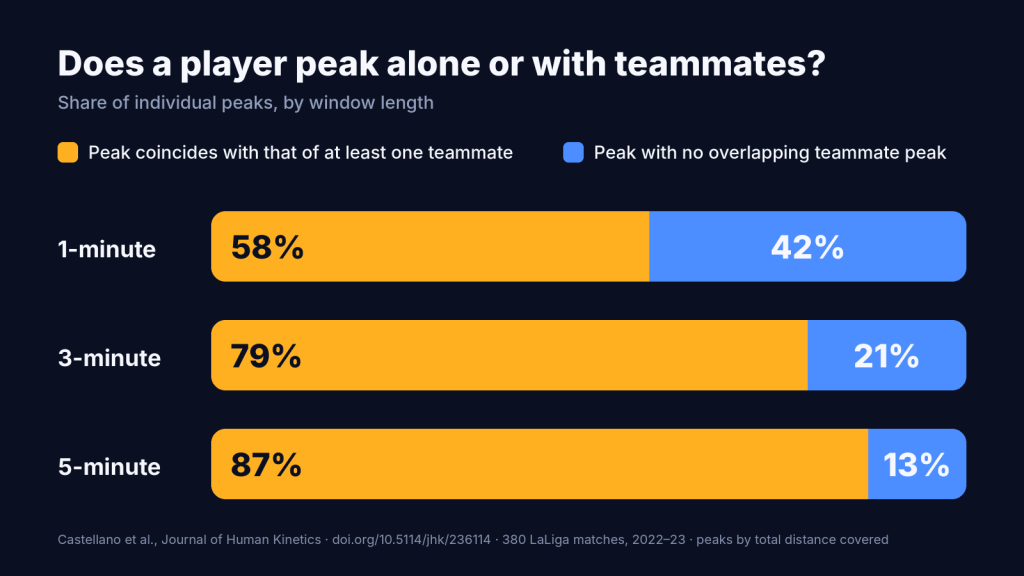
Figure 1. Share of individual peaks that coincide with at least one teammate’s peak, by window length.
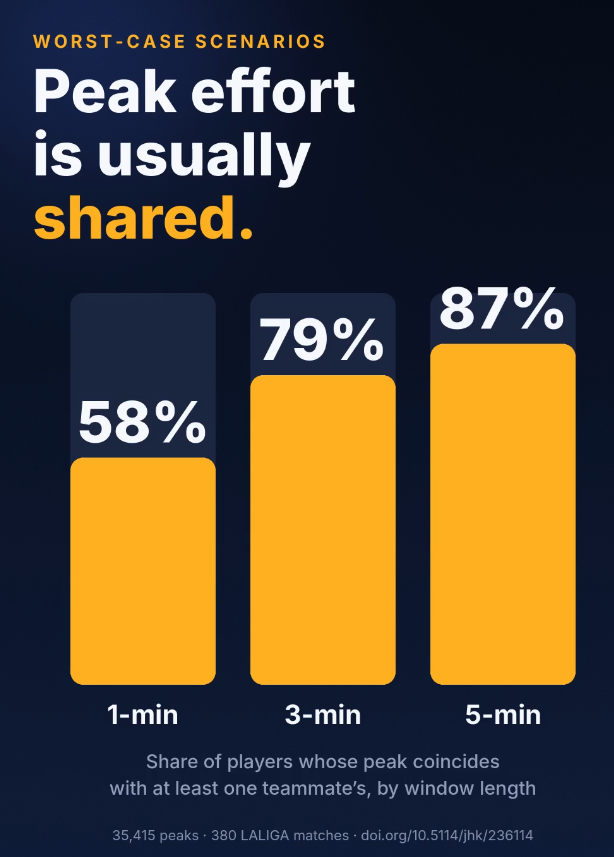
A player’s peak coincided with that of at least one teammate in 58% of 1-minute windows, 79% of 3-minute windows and 87% of 5-minute windows. The longer the window, the more players peak together.
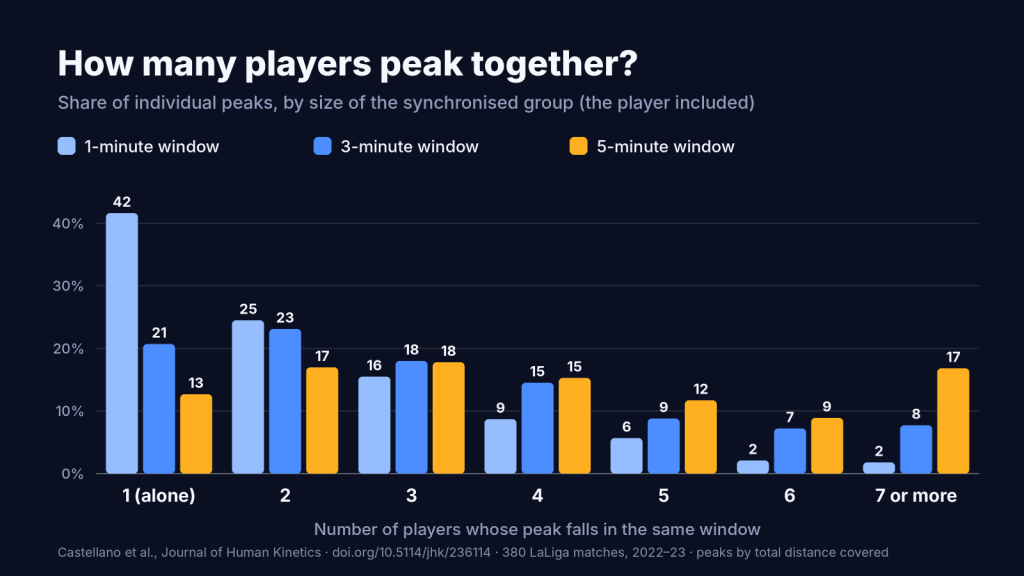
Figure 2. Share of individual peaks by size of the synchronised group (the player included).
Doubles and triples were the most frequent form of synchronisation in all three windows, but together they accounted for only 35–41% of peaks. The rest were either solitary or involved larger groups. In 5-minute windows, 53% of peaks happened alongside at least three teammates, and groups reached 11 players. In 1-minute windows, 42% of peaks had no teammate peaking at the same time.
That 42% does not contradict the collective picture. Our reading, which the data cannot confirm, is that solitary 1-minute peaks are isolated pressing runs, recovery sprints or individual reactions to unpredictable actions. Longer windows would capture sustained phases (organised build-up, collective pressing, a compact low block) in which several players move together.
Context moves the numbers very little
Match location did not affect overlap or synchronisation. Team level had small effects on synchronisation in some comparisons: in 3-minute windows, teams finishing in the bottom three more often showed groups of six synchronised players than the other groups (ε² ≈ 0.02). It may be that lower-ranked teams rely more on collective play, but that is a hypothesis, not a finding.
Opponent level was the only factor that changed the distance covered in all three windows. Peaks were roughly 1–3 m/min higher against teams finishing in the top six, around 1–2% of the peak value. Playing at home added 0.8 m/min in 1-minute peaks and nothing in the other windows.
What this means for training
- Keep the individual targets. They still tell each player how much to cover. What they do not tell us is who shares that demand, and in these data sharing is the norm.
- Stack the windows. Because peaks of different lengths often come from the same passage, a block that reaches the 1-minute target inside a longer continuous effort is a closer copy of the match than separate drills for each window. The example we propose in the paper is transition games immediately followed by about three minutes of positional play under fatigue in a large-sided format (up to 6v6, over 200 m² per player). It is an illustration, not a tested protocol.
- Match the format to the window. The longer the window, the more collective the peak. For 3- and 5-minute targets, tasks that load several players at once reproduce both the demand and the need to coordinate. For 1-minute targets, tasks with few players still make sense, since 42% of those peaks are solitary.
- Look at timing, not only magnitude. If your tracking system gives you each player’s peak windows, check how often they coincide in your own matches. Our figures are LaLiga-wide and your team’s profile may differ.
- Do not expect context to rewrite the targets. Home or away, strong or weak opponent, peak demand moved by roughly 2% at most.
What the paper does not tell us
- Total distance only. Peaks in high-speed running, accelerations and decelerations may not coincide with those of total distance, and may synchronise differently.
- No positions. We did not distinguish positions or starters from substitutes, so we cannot say which lines or units peak together.
- No tactical data. We did not include possession, ball-in-play time or tactical information, so the explanations above are hypotheses.
- A permissive definition. Coincidence meant at least one second of shared time, so longer windows overlap more easily. Read the 87% with that in mind.
- No training effects. We did not test whether drills built on this logic improve preparation or reduce injury risk. That is the next step.
A question for the next session
When you plan the next peak-demand block, are you prescribing a number for each player, or also a moment that several of them have to live through together?
Paper: Castellano J, Carling C, López-Del Campo R, Resta R, Errekagorri I. Intra-player overlaps and inter-player synchronisation of the most demanding passages across different time windows during professional soccer matches. Journal of Human Kinetics. https://doi.org/10.5114/jhk/236114