


16 Jul The Made in Spain Playing Style: The Success of LaLiga Reflected in the Euros and the Champions League

The recent victory of the Spanish National Team in the European Championship has highlighted a trend that has been observed in Spanish football over the last decade. Most of the national team players compete in LaLiga, and their triumph over England in the final underscores the effectiveness of the playing style developed in this competition. Adding to this victory is Real Madrid’s success in the Champions League, achieving European glory with a similar style of play. This leads us to a clear conclusion: the made in Spain playing style is successful and competitive at an international level.
Introduction to the Research: Technical and Tactical Evolution in LaLiga
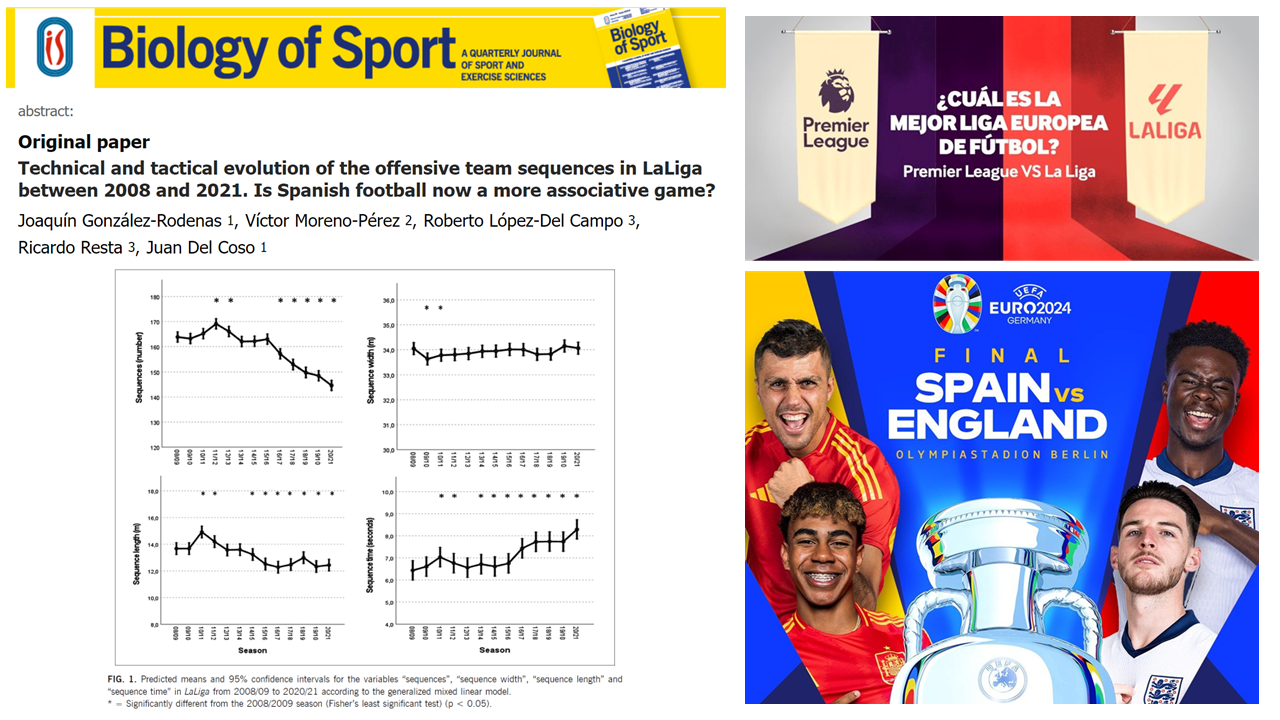
In recent years, match analysis in football has allowed researchers to evaluate player performance more accurately. This study examines the technical and tactical evolution of offensive sequences in LaLiga from the 2008/09 to the 2020/21 seasons, aiming to determine if Spanish football has become a more associative game.
Methodology
The analysis included 4940 matches from 38 professional teams in LALIGA, recording multiple variables related to offensive sequences using a validated tracking system. Linear mixed models were used to examine differences across seasons, considering contextual variables such as match location and outcome.
Key Results
- Increase in Number of Passes: The number of passes per sequence increased by 33.3%, from 2.4 to 3.2 passes per sequence.
- Improved Passing Accuracy: Passing accuracy improved by 6.8%, from 72.1% to 76.9%.
- Duration of Sequences: The average duration of offensive sequences increased by 25.76%, from 6.4 to 8.3 seconds.
- Speed of Progression: The direct speed of progression decreased by 24.5%, indicating a trend towards a more horizontal and less vertical game.
- Decrease in Key Offensive Actions: Sequences ending in the attacking third and in shots decreased by 11.7% and 21.6%, respectively.
Practical Implications for Coaches
- Promote Associative Play: Coaches should encourage a playing style based on ball possession, with a higher number of passes and accuracy.
- Develop Dribbling and Passing Skills: It is crucial to train players to improve their dribbling and passing skills, necessary to overcome well-organized defenses.
- Adapt Offensive Strategies: With the decrease in speed of progression and key offensive actions, coaches should design strategies that favor creating scoring opportunities through more elaborate moves and quick combinations.
- Focus on Key Players: Identifying and developing players capable of delivering key passes and through balls can be decisive for the team’s success in a more controlled and less direct playing context.
Conclusion
Football in LALIGA has evolved towards a more associative and combinative style of play, with longer and more precise offensive sequences, but with lower progression speed and fewer direct offensive actions. This change suggests that teams are adopting a tactical approach that prioritizes possession and play elaboration, adapting to modern trends in European football.
Access to the scientific publication: https://doi.org/10.5114/biolsport.2024.131818