


03 Jul From Data to the Pitch: Do You Really Train the Way You Compete?
A true story about data, possession, and the real meaning of small-sided training
How many times have you heard the phrase: «You play how you train»?
And yet… are you sure your training reflects the real situations your team experiences during matches?
At LALIGA’s Football Intelligence Area, we asked ourselves the same question. Because if football is a sport of ever-changing contexts, rapid decisions, and spaces that vanish in seconds, why are we still training small-sided situations as if they were universal?
What began as a hunch turned into a deep investigation using data from all LALIGA EA SPORTS teams during the 2024/25 season. We applied artificial intelligence, dynamic modeling, and positional analysis to understand how, when, and where small-sided possessions actually occur. And what we discovered should make you rethink how you structure your training week.
Small-sided training: one-size-fits-all?
Every professional team trains small-sided games. But most follow standardized formats: 4v4, 5v5, 6v6, 25×30-meter pitch… rinse and repeat.
But what if I told you that those drills have little to do with the situations your team actually faces in competition?
Our model —based on machine learning and real match data— shows that small-sided situations differ not only between teams, but even within the same team depending on the opponent, system, match moment, or field zone.
So does it make sense to always train the same way?
A model that «listens» to the game
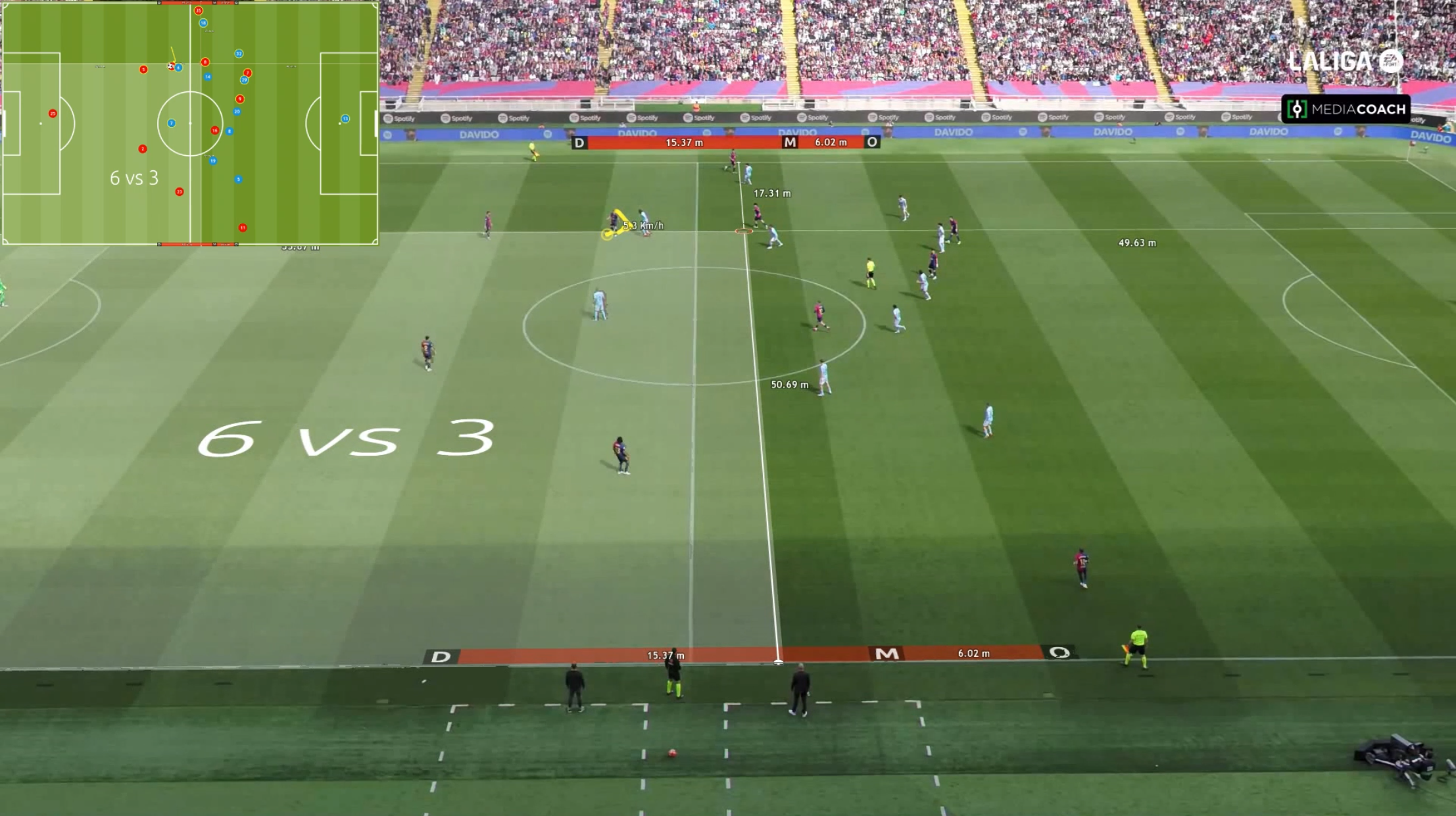
We designed a model that analyzes each possession of the team with the ball and breaks it down into «mini-possessions» within dynamic field quadrants. These quadrants are not fixed —we’re not talking about thirds or flanks— but update second by second based on the centroid of the team in possession.
In each of these quadrants, the model detects:
- Number of own players and opponents.
- Actual playing space dimensions.
- Type of situation (superiority, equality, inferiority).
- Match moment.
- Field zone.
- Own and opponent system.
- Opponent defensive block (high, medium, low).
- Match status at that moment.
The result? A detailed map of your team’s real small-sided situations. But also of where and when the ball is lost.
What did the data teach us?
The main findings were as unexpected as they were revealing:
1. No two teams experience the same small-sided situations
Each team creates its own dominant combinations: some start with 3v2 from the back, others progress through 4v3 in the middle third. There’s no one-size-fits-all.
Studies like Fradua et al. (2013) already suggested that training spaces should be based on real-game spatial data. Our model confirms that, unequivocally.
2. The opponent changes everything
Does your team play the same way against a high block as against a low one? The model shows that the type of possession changes dramatically: in advanced areas, inferiorities skyrocket; in your own half, superiority (often including the goalkeeper) is much more common.
Olthof et al. (2018) documented that adapting the playing area to match-derived parameters enhances tactical representativeness. We’ve gone a step further: we adapt not just the space, but also the context.
3. You can’t train your mistakes if you don’t know them
The model detects in which small-sided contexts the ball is lost most often. Do you frequently lose possession after a throw-in on the right wing in your own half? Are your midfielders failing in 2v2s in the central lane?
That pattern repeats. And it can be trained.
Dellal et al. (2012) already showed that certain constraints (like limiting touches) significantly alter the technical and tactical load of drills. But if you don’t know which situations are costing you matches, how can you train them with purpose?
Contextualized training: from generic to specific
This all translates into a clear proposal for professional training:
1. Internal optimization
Your team must train the real contexts it frequently experiences or struggles with. And that insight doesn’t come from intuition —it comes from data.
Struggling to progress in balanced 3v3s in midfield? Frequently losing possession after passing backwards in zone 3? Train those exact situations.
2. Opponent-specific preparation
Each week you can detect the small-sided situations your next opponent suffers most. Not just to prep the game, but to shape your weekly training accordingly.
Does the opponent struggle in 4v3 on the left flank? Trigger that pattern.
What are you training?
Do your small-sided drills match what the game demands from your team?
Do you analyze when and how you lose possession?
Do you know in which quadrant, with how many players, and under what pressure your errors repeat?
If you can’t answer with data, you’re most likely training by intuition. And while intuition has its place, in modern football the margins are defined by precision.
References (APA style, latest edition)
- Dellal, A., Owen, A., Wong, D., Krustrup, P., Exsel, M. V., & Mallo, J. (2012). Technical and physical demands of small vs. large sided games in relation to playing position in elite soccer. Human Movement Science, 31(4), 957–969. https://doi.org/10.1016/j.humov.2011.08.013
- Fradua, L., Zubillaga, A., Caro, O., Fernández-García, A. I., Ruiz-Ruiz, C., & Tenga, A. (2013). Designing small-sided games for training tactical aspects in soccer: Extrapolating pitch sizes from full-size professional matches. Journal of Sports Sciences, 31(6), 573–581. https://doi.org/10.1080/02640414.2012.746722
- Gonçalves, B., Marcelino, R., Torres-Ronda, L., Torrents, C., & Sampaio, J. (2016). Effects of emphasizing opposition and cooperation on collective movement behaviour during football small-sided games. Journal of Sports Sciences, 34(14), 1346–1354. https://doi.org/10.1080/02640414.2016.1143111
- Olthof, S., Frencken, W., & Lemmink, K. (2018). A match-derived relative pitch area facilitates the tactical representativeness of small-sided games for the official soccer match. Journal of Strength and Conditioning Research, 32(10), 2808–2816. https://doi.org/10.1519/JSC.0000000000002978