


22 Jun The DNA of Goal-Scoring Sequences: Fast Attacks or Patient Build-Ups?
How do possessions that end in a goal really begin, develop and finish?
Football often debates attacking styles as if there were only one correct answer.
Should teams attack quickly?
Should they build patiently?
Should they press high?
Should they dominate through possession?
Should they attack directly after recovery?
The data suggests a more interesting answer.
There may not be one superior attacking model.
There may only be well-executed models.
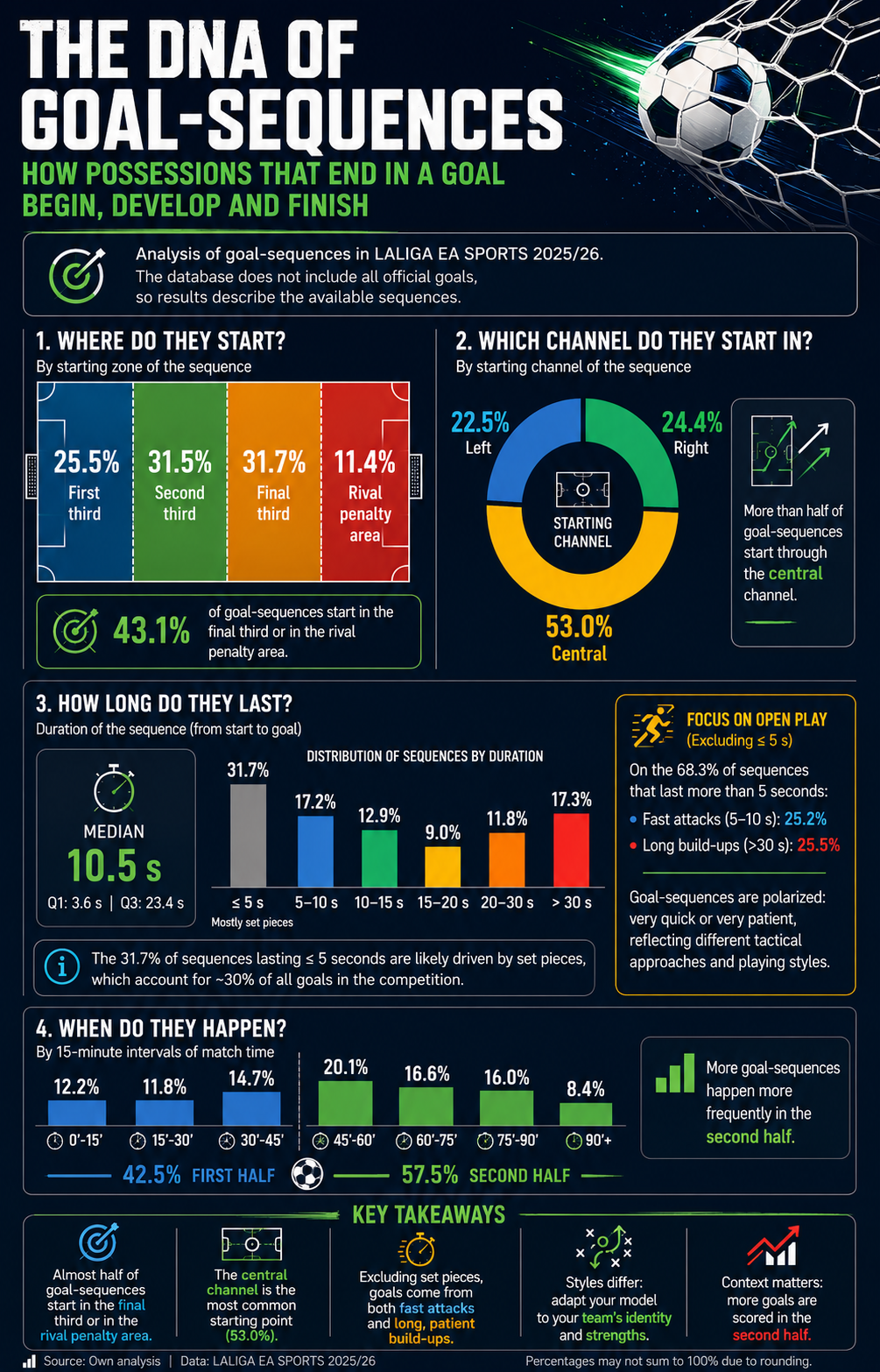
In this analysis, I studied all goal-scoring sequences from LALIGA EA SPORTS 2025/26. A “sequence” refers to the possession or play that ends in a goal.
The dataset does not include all official goals from the competition, so the results should be interpreted as a description of the available goal-scoring sequences, not as the complete universe of goals.
Still, the sample allows us to ask a very useful coaching question:
What does a possession that ends in a goal usually look like?
1. Where do goal-scoring sequences start?
The first key question is not where the goal is scored.
That is obvious: goals finish close to goal.
The more interesting question is:
Where does the possession begin?
| Starting zone | % of goal-sequences |
|---|---|
| First third | 25.5% |
| Middle third | 31.5% |
| Final third | 31.7% |
| Opponent penalty area | 11.4% |
The most relevant figure is this:
43.1% of goal-scoring sequences started in the final third or directly inside the opponent’s penalty area.
That is a powerful coaching message.
It does not mean that high pressing automatically produces more goals. To say that, we would need all possessions, not only those that ended in goals.
But it does show something important:
Among possessions that end in a goal, almost half begin very close to the opponent’s goal.
This reinforces the offensive value of:
- recovering the ball high;
- forcing mistakes near the box;
- winning second balls around the penalty area;
- attacking immediately after a defensive imbalance.
At the same time, only 25.5% of goal-scoring sequences started in the first third.
That does not mean building from the back is useless.
It means something more precise:
Most goal-scoring sequences in this sample did not start in the first phase of build-up.
For coaches, this creates an important reflection.
Teams spend many hours training build-up from the goalkeeper. That work is necessary. It allows progression, control, and attraction.
But the data reminds us that many goals are born later:
after the first line has been broken,
after the ball has reached midfield,
or after the opponent has lost possession near their own goal.
The origin of the goal is often not the start of the attack from the goalkeeper.
It is the moment where the advantage is created.
2. Which channel do they start in?
The next question is the starting channel of the sequence.
This is important: we are not analysing the finishing channel. Since all sequences end in a goal, the final action is naturally biased toward central, high-value areas.
Here we only analyse where the sequence begins.
| Starting channel | % of goal-sequences |
|---|---|
| Left | 22.5% |
| Central | 53.0% |
| Right | 24.4% |
More than half of the goal-scoring sequences started through the central channel.
This does not mean that wide areas are unimportant.
Wide areas are often essential to create crossing situations, switches of play, cut-backs or 1v1s.
But the starting point of many goal-scoring possessions is central.
For coaches, this connects with a core tactical idea:
Central access matters.
When a team starts or recovers possession centrally, it often has more immediate options:
- play forward;
- attack both sides;
- find the striker;
- connect with advanced midfielders;
- accelerate through the most valuable corridor.
The central channel gives the attack multiple directions.
Wide starts usually offer fewer immediate options and often require the team to move the ball back inside before creating a high-value chance.
So the key message is not:
“Attack only through the middle.”
The key message is:
Many goal-scoring sequences begin with central access or central recovery. Protecting and attacking the central corridor remains decisive.
3. How long do goal-scoring sequences last?
At first glance, duration seems simple.
The median duration of a goal-scoring sequence was:
10.5 seconds
But this number needs caution.
The distribution shows that 31.7% of sequences lasted 5 seconds or less.
That is very likely influenced by set pieces, rebounds, second balls and restarts near the box.
In professional football, a significant proportion of goals come from set pieces. These actions naturally create very short sequences:
corner → header → goal;
free-kick → second ball → goal;
throw-in → cross → finish;
rebound → shot → goal.
Therefore, interpreting the ≤5 second group as “open-play fast attacks” would be misleading.
So the more useful coaching approach is to treat that group separately and focus on the remaining sequences.
Among sequences lasting more than 5 seconds, the two largest groups were at opposite ends:
| Duration | % within sequences >5 s |
|---|---|
| 5–10 s | 25.2% |
| 10–15 s | 18.9% |
| 15–20 s | 13.2% |
| 20–30 s | 17.3% |
| >30 s | 25.5% |
This is the most interesting finding.
The distribution is not centred.
It is polarized.
The two most common profiles are:
Fast attacks: 5–10 seconds — 25.2%
Long build-ups: more than 30 seconds — 25.5%
Almost identical frequency.
Different routes.
Same destination.
This suggests that goal-scoring possessions do not follow a single temporal pattern.
Some goals come from immediate exploitation:
recover, play forward, attack the gap, finish.
Others come from patient construction:
circulate, move the block, attract, switch, find the final gap.
This is probably the strongest tactical message of the analysis:
Goals do not seem to have a preferred speed. They seem to have a preferred level of execution.
The practical implication is clear.
A team does not need to copy every attacking model.
It needs to know which model it can execute best.
If your identity is based on attacking immediately after recovery, then your training must develop:
- first forward pass;
- support after recovery;
- runs behind;
- quick occupation of finishing zones;
- decision-making under temporal pressure.
If your identity is based on longer possessions, then your training must develop:
- positional patience;
- circulation speed;
- occupation of interior spaces;
- timing of acceleration;
- ability to move the opponent before attacking.
Both routes can lead to goal.
But both require clarity.
The problem is not being fast or patient.
The problem is being unclear.
4. When do goal-scoring sequences happen?
The timing of goals also provides useful context.
| Match period | % of goal-sequences |
|---|---|
| 0’–15’ | 12.2% |
| 15’–30’ | 11.8% |
| 30’–45’ | 14.7% |
| 45’–60’ | 20.1% |
| 60’–75’ | 16.6% |
| 75’–90’ | 16.0% |
| 90’+ | 8.4% |
The highest percentage appears between 45’ and 60’.
Overall:
| Half | % |
|---|---|
| First half | 42.5% |
| Second half | 57.5% |
More goal-scoring sequences occurred in the second half.
This can be linked to several football factors:
- fatigue;
- tactical adjustments;
- substitutions;
- increased risk-taking;
- lower defensive compactness;
- game-state pressure;
- more spaces as matches open.
Again, we should avoid overclaiming.
The data does not prove why more goals appear in the second half.
But it does support a practical coaching reflection:
The second half is not just a continuation of the first. It is a different tactical and physical environment.
For coaches, this matters.
The ability to keep attacking clarity after half-time, manage substitutions, exploit fatigue and maintain defensive concentration can be decisive.
The 45’–60’ period is especially interesting.
It may reflect the impact of half-time adjustments, renewed intensity, or temporary instability after the restart.
This period deserves specific attention in match preparation.
5. What is the tactical picture?
If we bring the findings together, the “DNA” of goal-scoring sequences in this sample can be described as follows:
- Many begin in advanced areas.
- The central channel is the most common starting channel.
- Very short sequences are likely influenced by set pieces.
- Excluding those, open-play sequences appear polarized.
- Goals come both from fast attacks and long build-ups.
- More goal-scoring sequences occur in the second half.
The key point is not that football has become only fast.
And it is not that long possession is dead.
The key point is that both extremes coexist.
Modern football does not reward one single attacking style.
It rewards clarity, timing and execution.
6. Practical takeaways for coaches
1. Train the moment of origin, not only the final action
Goals do not start with the shot.
They start with the first advantage.
That advantage may come from:
- a high recovery;
- a central regain;
- a second ball;
- a broken defensive line;
- a patient circulation that moves the opponent.
Training should recreate the origin of the advantage, not only the finish.
2. High regains matter, but do not explain everything
The fact that 43.1% of goal-scoring sequences start in the final third or opponent’s penalty area highlights the value of pressure and territorial dominance.
But it does not mean every team should press high all the time.
The real question is:
Can your team press high well enough to convert recoveries into goals?
High pressing without structure can create defensive risk.
High pressing with coordination can create goals.
3. Central access remains decisive
With 53.0% of sequences starting centrally, the central corridor appears as a key origin of goal-producing possessions.
This has two training implications:
In attack:
- create central access;
- find players between lines;
- connect inside before going outside.
In defence:
- protect the central corridor;
- control second balls;
- prevent direct access after losing possession.
4. Do not confuse fast with rushed
The 5–10 second profile is not chaos.
Good fast attacks require structure.
They need:
- immediate support;
- forward options;
- coordinated runs;
- clean first decisions;
- players prepared before the ball arrives.
Fast football is not simply playing quickly.
It is being ready to play quickly.
5. Do not confuse patience with passivity
The >30 second profile is not sterile possession.
Good long build-ups are not about accumulating passes.
They are about preparing the moment to accelerate.
Long possessions only become dangerous when they create:
- disorganisation;
- positional superiority;
- weak-side access;
- timing advantage;
- final-third occupation.
Patience without penetration is harmless.
Patience with intention is dangerous.
Final thought
Football keeps searching for the best attacking style.
But this analysis suggests a different idea.
There may not be one best style.
There may only be styles that are executed with enough clarity, timing and conviction to produce goals.
Some teams attack immediately.
Others build patiently.
The road to goal is not one highway.
It is different routes arriving at the same destination.
Goals do not seem to have a preferred speed.
They seem to have a preferred level of execution.