


24 Jun Do Past Successes Guarantee Future Victories in Football?

Abstract
In this study, we investigate the predictive power of historical performance metrics on the outcomes of future football matches. Specifically, we analyze offensive and defensive efficiencies, accumulated goal differences, and previous wins to determine if past successes can reliably predict future victories. Our findings reveal that while these metrics offer valuable insights, they are not definitive indicators of future success. This research underscores the complexity and unpredictability inherent in football, emphasizing the need for a multifaceted approach to performance analysis.
Introduction
Football, often referred to as the beautiful game, is a sport replete with unpredictable outcomes and surprising upsets. Analysts and enthusiasts alike have long sought to identify reliable predictors of match results. Traditional metrics such as goal differences, offensive and defensive efficiencies, and win records are frequently used to forecast outcomes. However, the extent to which these historical metrics can predict future victories remains a topic of debate. This study aims to assess the predictive validity of these metrics through an extensive analysis of match data from multiple teams and competitions.
Methodology
We analyzed detailed data from a dataset comprising numerous teams and matches. The primary metrics evaluated were:
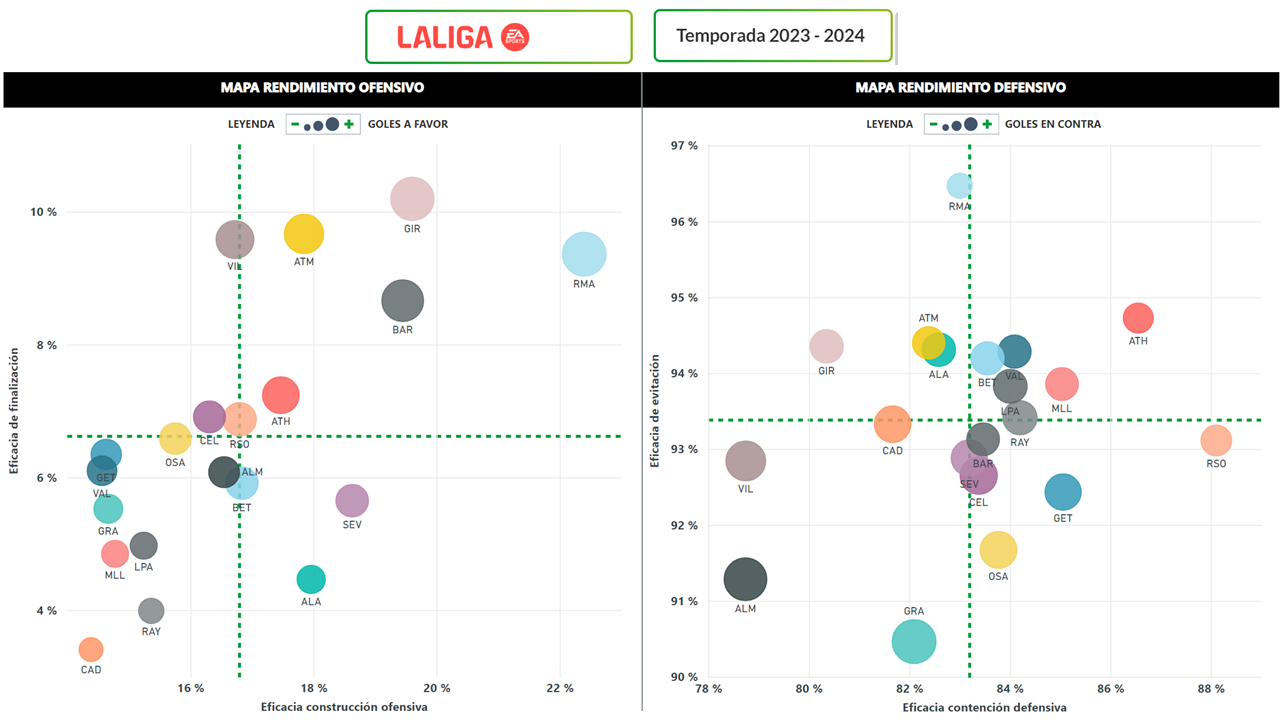
- Offensive Construction Efficiency (ECO)
- Finishing Efficiency (EF)
- Defensive Containment Efficiency (ECD)
- Avoidance Efficiency (EE)
- Accumulated Goal Differences
- Previous Wins
Each metric was analyzed to determine its individual and combined predictive power regarding match outcomes. We utilized statistical methods to calculate the accuracy of predictions based on these metrics and identified key patterns and anomalies.
Results
Accumulated Efficiencies
We first examined the predictive power of accumulated efficiencies. The Finishing Efficiency (EF) emerged as the most reliable individual predictor, accurately forecasting the winner in 60.54% of matches. However, when considering all four efficiencies together, the predictive accuracy dropped to 45.14%. This suggests that while individual metrics can be insightful, their combined use does not significantly enhance predictive power.
Accumulated Goal Differences
The analysis of accumulated goal differences revealed a higher predictive accuracy, with correct predictions in 61.89% of matches. This metric proved to be a more reliable indicator of future success compared to the combined efficiencies.
Previous Wins
The metric of accumulated wins before a match showed a predictive accuracy of 57.57%. While better than chance, it falls short of being a definitive predictor, indicating that past victories alone do not guarantee future wins.
Notable Team Performances
Our analysis highlighted several teams that frequently defied statistical predictions:
- Real Madrid demonstrated the highest predictability with a 78.38% accuracy based on accumulated goal differences.
- Villarreal CF repeatedly overcame negative predictions, winning 16 matches despite having lower accumulated efficiencies.
- FC Barcelona and Girona FC also showcased resilience, frequently winning against statistical expectations.
Discussion
The findings of this study suggest that while historical performance metrics provide valuable insights, they are not absolute predictors of future match outcomes. The relatively moderate predictive accuracies underscore the inherent unpredictability of football. Factors such as team morale, tactical decisions, player fitness, and even luck play significant roles in determining match results, often overriding statistical expectations.
Conclusion
This research highlights the complexity of predicting football match outcomes based on past performances. While metrics like accumulated goal differences and finishing efficiency offer some predictive power, they are not foolproof. Teams such as Villarreal CF and FC Barcelona illustrate that resilience and adaptability can lead to victories even when historical data suggests otherwise.
In conclusion, while historical metrics are useful tools for performance analysis, they should be considered alongside qualitative factors to develop a more comprehensive understanding of potential match outcomes. Future research could focus on integrating advanced metrics and machine learning models to enhance predictive accuracy in football.