


10 Sep Are Substitution Patterns a Coaching Style — or a Reaction to the Scoreline?
LALIGA EA SPORTS 2025/26 shows that most coaches change earlier when losing, but the way they use the bench goes far beyond the timing of the first substitution.
Coaches are often described in simple terms: he changes too late, he uses the bench a lot, he reacts quickly when the match is going badly.
These statements are common in football, but they usually mix several different behaviours into one idea.
A coach who makes his first substitution in the 60th minute may look “late”. But was his team winning, drawing or losing at that moment? Does he then make four more changes quickly? Or does he barely use the bench at all?
To explore this, we analysed substitution behaviour across LALIGA EA SPORTS 2025/26, treating each team × coach period as a separate unit.
The first result is intuitive — but its magnitude is revealing:
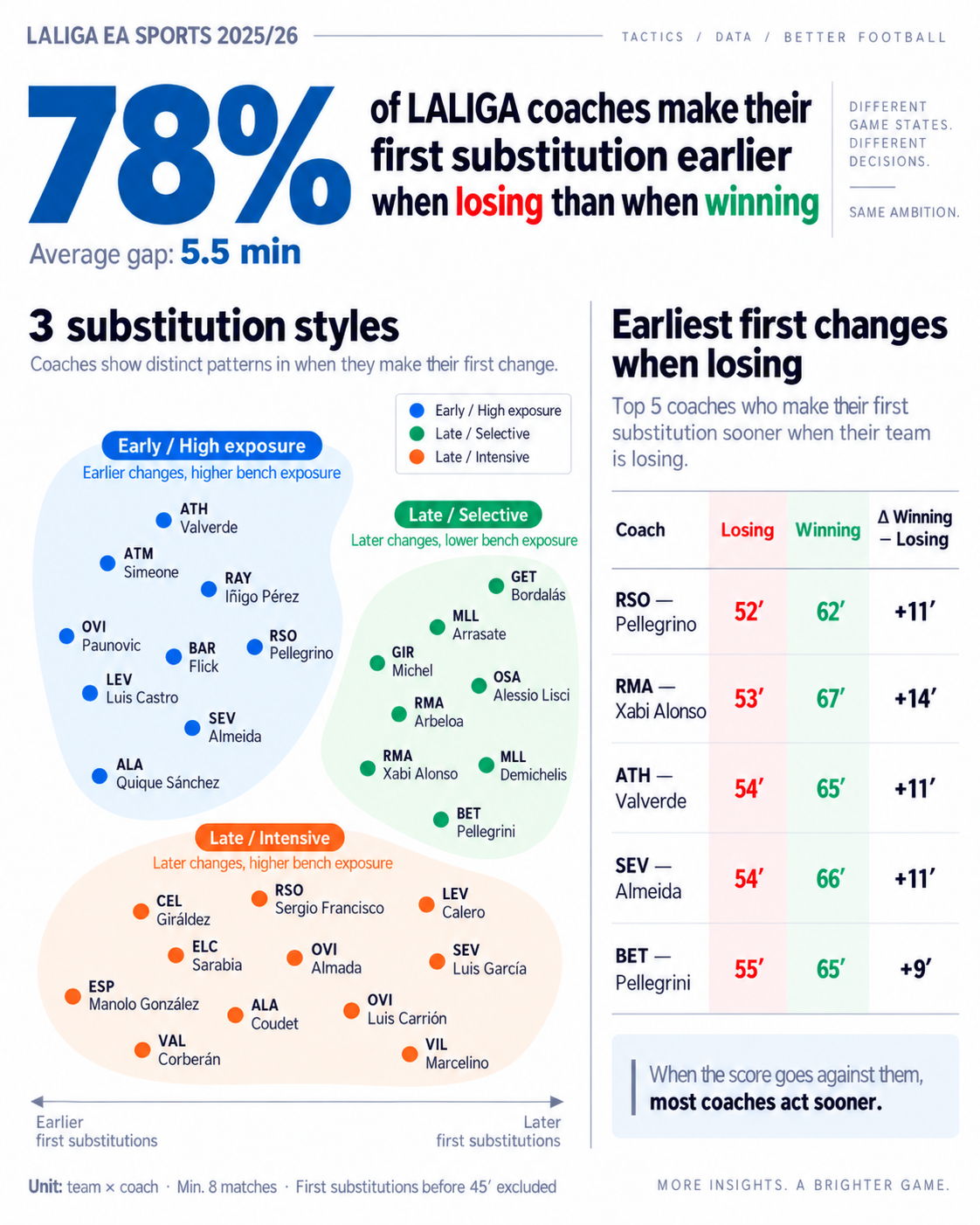
21 of 27 coach-team units (78%) made their first substitution earlier when losing than when winning.
On average, the first substitution came 5.5 minutes earlier when the team was behind.
But that league-wide number is only the beginning of the story.
Some coaches changed their timing dramatically depending on the scoreline. Others barely changed it at all.
And once the full use of the bench is considered, three broad substitution profiles emerge.
Why the team is not the right unit
Substitution behaviour is strongly linked to the coach.
For that reason, analysing a whole season only at team level can hide meaningful changes when a club changes manager.
If two coaches manage the same team during the season, averaging their substitutions into a single team value assumes that both follow the same approach. That is precisely what we wanted to avoid.
The unit of analysis was therefore:
team × coach
Coach-team periods with at least 8 LALIGA matches were included.
This resulted in 28 coach-team profiles across the 20 clubs.
For clubs with only one coach throughout the relevant sample, the club contributes one profile. Clubs that changed coach can contribute two or more.
This distinction becomes particularly important later, because several clubs moved from one substitution profile to another after changing coach.
Reconstructing the score before the first substitution
For every match, the sequence of goals was reconstructed so that the scoreline immediately before the first substitution could be identified.
Each first substitution was therefore classified according to whether the team was:
- Losing
- Drawing
- Winning
This allows us to avoid one of the main problems in simple substitution rankings.
A coach who frequently makes his first change in the 55th minute may not necessarily have an inherently aggressive substitution style. He may simply have spent more matches in a losing position at that point.
The game state has to be considered before interpreting timing.
Why substitutions before the 45th minute were excluded from the main timing analysis
Very early substitutions can be highly informative, but their cause cannot be identified from these data.
A substitution in the 20th or 30th minute may be tactical, but it may also follow an injury, physical discomfort or another exceptional match event.
Rather than assume a cause, all first substitutions before the 45th minute were excluded from the main tactical timing analysis.
Changes made at the 45th minute were retained, because half-time is clearly a normal tactical intervention point.
The early substitutions remain part of the original dataset; they are simply excluded from this specific timing analysis.
The scoreline clearly affects when coaches intervene
Across comparable coach-team units, the first substitution tended to come earlier when the team was losing.
78% showed that direction.
The mean difference between the first substitution when winning and losing was:
+5.5 minutes
In other words, coaches generally waited longer when the score was favourable.
That result is not surprising in itself. A losing team has a stronger incentive to modify the game.
What is much more interesting is how different that response is between coaches.

First substitution when losing vs winning
The table below is ordered by the average minute of the first substitution when losing.
| Team — Coach | Losing | Winning | Δ Winning − Losing |
|---|---|---|---|
| Real Sociedad — Pellegrino | 52′ | 62′ | +11′ |
| Real Madrid — Xabi Alonso | 53′ | 67′ | +14′ |
| Athletic Club — Valverde | 54′ | 65′ | +11′ |
| Sevilla — Almeida | 54′ | 66′ | +11′ |
| Betis — Pellegrini | 55′ | 65′ | +9′ |
| Espanyol — Manolo González | 56′ | 64′ | +9′ |
| Oviedo — Almada | 56′ | 66′ | +10′ |
| Levante — Luis Castro | 56′ | 64′ | +8′ |
| Getafe — Bordalás | 57′ | 74′ | +17′ |
| Rayo Vallecano — Iñigo Pérez | 57′ | 66′ | +9′ |
| Oviedo — Luis Carrión | 57′ | 52′ | −5′ |
| Atlético de Madrid — Simeone | 59′ | 57′ | −2′ |
| Celta — Giráldez | 59′ | 60′ | +1′ |
| Alavés — Quique Sánchez | 59′ | 63′ | +4′ |
| Girona — Míchel | 60′ | 66′ | +7′ |
| Elche — Sarabia | 60′ | 67′ | +7′ |
| Mallorca — Demichelis | 60′ | 59′ | −1′ |
| Mallorca — Arrasate | 60′ | 67′ | +7′ |
| Villarreal — Marcelino | 60′ | 66′ | +5′ |
| Barcelona — Flick | 61′ | 59′ | −2′ |
| Alavés — Coudet | 61′ | 65′ | +4′ |
| Real Sociedad — Sergio Francisco | 61′ | 58′ | −3′ |
| Sevilla — Luis García | 61′ | 74′ | +13′ |
| Valencia — Corberán | 63′ | 64′ | +1′ |
| Levante — Calero | 64′ | 65′ | +1′ |
| Osasuna — Alessio Lisci | 64′ | 63′ | −1′ |
| Real Madrid — Arbeloa | 66′ | 68′ | +2′ |
Oviedo–Paunovic is not included in this comparison because there were no qualifying matches in which the first substitution was made while winning.
The same league trend hides very different coaching behaviours
The contrast between coaches is considerable.
Bordalás: strong score-state dependence
Getafe made its first substitution under José Bordalás at approximately:
57′ when losing
74′ when winning
That is a 17-minute difference.
Calling Bordalás simply a “late substituter” would therefore be incomplete.
His timing changes substantially depending on whether the match is going in Getafe’s favour.
Xabi Alonso: another highly reactive profile
At Real Madrid:
53′ when losing
67′ when winning
A difference of approximately 14 minutes.
Again, the scoreline is strongly associated with when the first intervention arrives.
Giráldez: remarkably stable timing
Celta under Claudio Giráldez showed almost no difference:
59′ when losing
60′ when winning
The coach changes at a very similar point regardless of whether the team is ahead or behind.
This is an important distinction.
Two coaches can have a similar overall average substitution minute and still behave very differently once game state is considered.
A simple “early vs late” ranking is not enough
The minute of the first substitution captures only one part of bench management.
Imagine two coaches who both make their first substitution in the 60th minute.
The first may make only two or three changes and keep most of the starting XI on the pitch.
The second may make four additional substitutions within the following 15 minutes.
Their first-change timing is identical.
Their use of the bench is not.
To characterise substitution behaviour more completely, four dimensions were considered:
Timing
When the coach starts making changes, adjusted for the game state.
Substitution volume
How many substitutions are made.
Bench exposure
The proportion of total player-minutes accumulated by substitutes.
Temporal distribution
How widely the substitutions are distributed between the first and final change.
Together, these dimensions describe substitution behaviour much better than the first-change minute alone.
Three broad substitution profiles emerge
A clustering analysis based on these dimensions produced three broad groups.
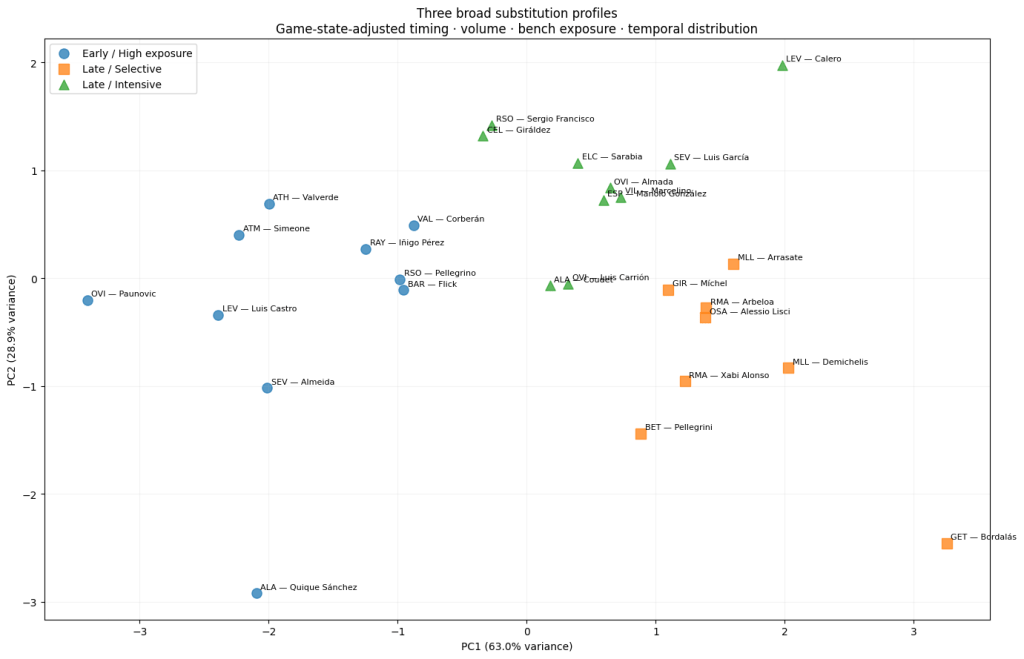
They should not be interpreted as rigid categories. The coaches exist on a continuum, and some sit close to the boundaries between profiles.
But the groups provide a useful descriptive framework.
1. Early / High Exposure
Valverde — Athletic Club
Simeone — Atlético de Madrid
Quique Sánchez — Alavés
Flick — Barcelona
Luis Castro — Levante
Iñigo Pérez — Rayo Vallecano
Paunovic — Oviedo
Pellegrino — Real Sociedad
Almeida — Sevilla
These coach-team profiles tend to begin the substitution process earlier after accounting for game state and also give relatively high playing-time exposure to substitutes.
The defining feature is not simply an early first change.
It is the combination of earlier intervention and substantial bench involvement.
2. Late / Selective
Alessio Lisci — Osasuna
Bordalás — Getafe
Míchel — Girona
Arrasate — Mallorca
Demichelis — Mallorca
Pellegrini — Betis
Arbeloa — Real Madrid
Xabi Alonso — Real Madrid
These coaches tend to start changing later and make comparatively more selective use of the bench.
Their substitutes accumulate less playing time than in the other profiles.
This is the closest profile to the traditional idea of preserving the starting XI for longer.
3. Late / Intensive
Coudet — Alavés
Sarabia — Elche
Calero — Levante
Giráldez — Celta
Manolo González — Espanyol
Almada — Oviedo
Luis Carrión — Oviedo
Sergio Francisco — Real Sociedad
Luis García — Sevilla
Corberán — Valencia
Marcelino — Villarreal
This group is particularly interesting.
These coaches also tend to begin changing relatively late, but once the substitution process starts they make more extensive use of the bench.
This leads to one of the clearest findings of the analysis:
Changing late does not necessarily mean using the bench less.
“Late” describes timing.
It does not describe volume or exposure.
The coach can change while the club remains the same
One of the most informative parts of the analysis comes from clubs that changed coach during the season.
The club context is not perfectly controlled — squad availability, fixtures, injuries and many other factors can also change — but these comparisons reduce some of the differences that exist when comparing completely different teams.
Several clubs changed substitution profile after changing coach.

Alavés
Quique Sánchez → Early / High Exposure
Coudet → Late / Intensive
The difference was already visible in the first-change timing.
Quique Sánchez tended to intervene much earlier, while Coudet generally delayed the first change but still used the bench extensively afterwards.
Real Sociedad
Pellegrino → Early / High Exposure
Sergio Francisco → Late / Intensive
Again, the same club appears in two different substitution profiles under different coaches.
Sevilla
Almeida → Early / High Exposure
Luis García → Late / Intensive
Levante
Luis Castro → Early / High Exposure
Calero → Late / Intensive
Oviedo
Three different coach-team periods also produced different positions within the substitution-style space, with Paunovic classified as Early / High Exposure and Almada and Luis Carrión closer to the Late / Intensive profile.
Mallorca
Demichelis → Late / Selective
Arrasate → Late / Intensive
Here the distinction is not mainly about starting early or late, but about what happens after the first substitution.
Real Madrid
Xabi Alonso → Late / Selective
Arbeloa → Late / Selective
This is equally useful.
A managerial change does not automatically produce a different style. Both Real Madrid periods remained within the same broad profile.
Taken together, these within-club comparisons strengthen the idea that substitution behaviour contains a coach-specific component, while also showing that it is not independent of club and match context.
Does one substitution style produce better results?
There is an obvious temptation to interpret these profiles as better or worse approaches.
The data do not support that conclusion.
At team level, the relationships between overall substitution style and season performance were extremely weak.
The timing of the first substitution, overall substitution timing, number of changes and bench exposure showed essentially no meaningful relationship with total points.
That is important.
There is no obvious “best” substitution style in these data.
Substitutions are decisions made within very different competitive contexts.
A coach managing a deep squad, a team protecting leads, a club fighting relegation or a side playing several competitions may face very different constraints.
The clustering describes behaviour, not quality.
What the analysis suggests
Three conclusions stand out.
First, game state matters.
Most coaches intervene earlier when losing than when winning, and the average difference is meaningful.
Second, coaches differ substantially in how sensitive their timing is to the scoreline.
Bordalás and Xabi Alonso show large winning-versus-losing gaps. Giráldez, Corberán and others remain much more stable.
Third, substitution strategy cannot be reduced to timing.
Two coaches who begin making changes at the same minute may differ considerably in the number of substitutions they make, the minutes accumulated by substitutes and the way changes are distributed through the rest of the match.
That is why the distinction between Late / Selective and Late / Intensive is particularly useful.
What we should not conclude
This analysis is descriptive.
It does not establish that making substitutions earlier improves results, or that delaying them is beneficial.
It also does not identify why a specific substitution was made.
Changes before the 45th minute were excluded from the primary timing analysis precisely because the available data cannot reliably distinguish tactical decisions from injuries, physical problems or other exceptional circumstances.
The coach-team units also differ in sample size. The minimum was eight matches, which is sufficient to identify an emerging tendency but should not be interpreted with the same confidence as a full 38-match season.
Finally, the clusters should be seen as broad behavioural profiles within a continuous space, rather than fixed coaching categories.
From “when does he change?” to “how does he manage substitutions?”
The usual discussion around substitutions often starts and ends with the minute of the first change.
The data suggest a more useful framework.
Instead of asking only:
When does the coach make his first substitution?
we can ask:
When does he change depending on the score?
How extensively does he use the bench?
How are those substitutions distributed through the match?
And how stable is that behaviour when the competitive context changes?
The first substitution remains important.
But on its own, it tells only part of the story.
Substitution strategy may be better understood as a behavioural profile shaped by both coaching preferences and the evolving state of the match.
And that may be a much more informative way to describe coaching behaviour than simply saying that a coach “changes early” or “changes late.”