


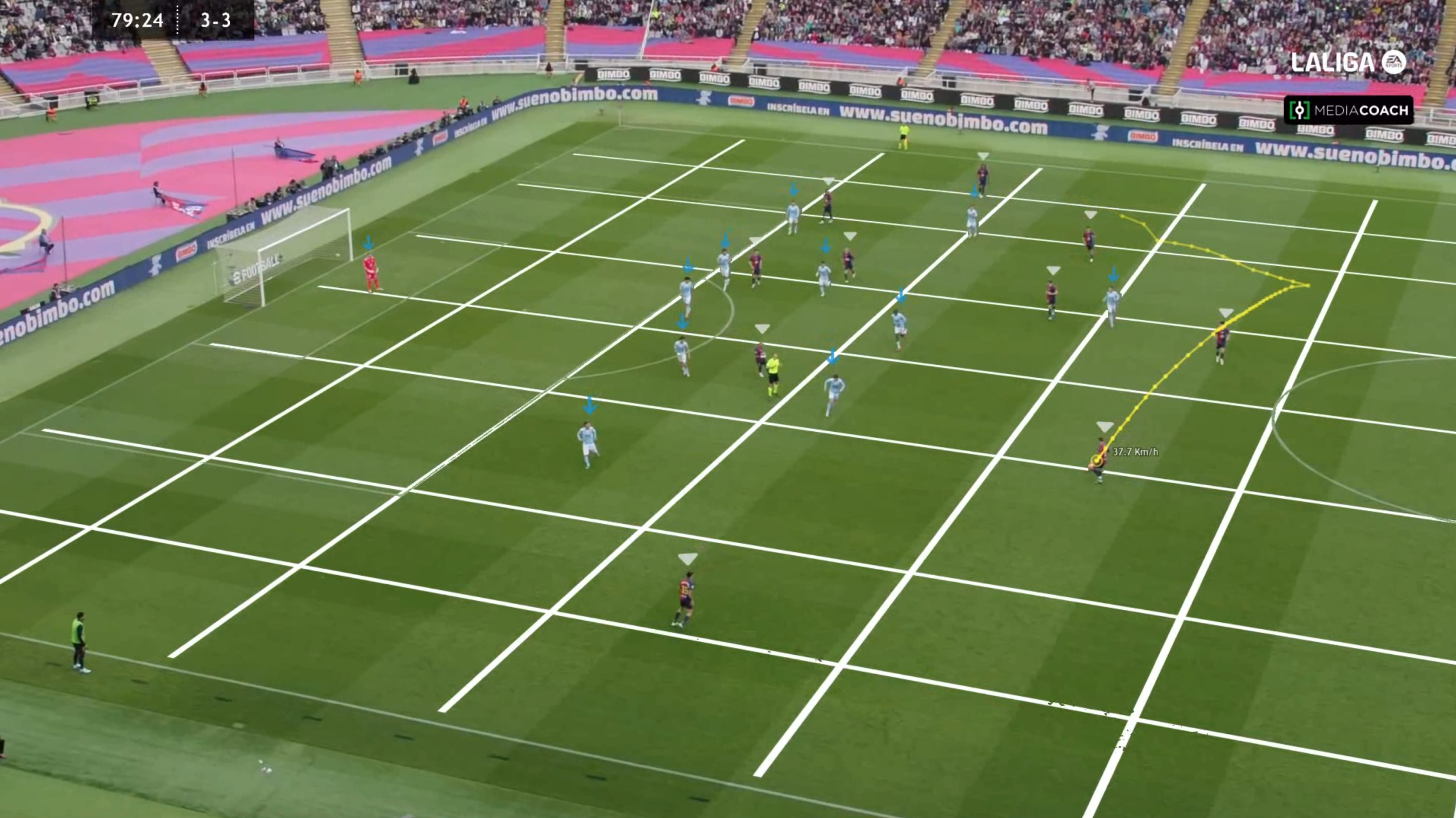
06 Ago “Your Game or Theirs?”
How Football Teams Can Measure—and Defend—their Tactical Identity
Pre-match pressure
You’re heading into an away fixture. The opponent is tactically disciplined, and their pressing system forces most teams to abandon their structure.
You’ve prepared your plan, rehearsed your pressing traps, and set your build-up routines. But one crucial question remains:
“Will we play our game—or be dragged into theirs?”
What if we could measure this?
What if we could objectively track whether your team maintains its style over time—or bends to the opponent?
Tactical identity, measured through data
Playing style is more than a philosophy. It’s a structure of decisions—on and off the ball—that can be recognized, repeated and resisted.
For years, coaches, analysts and researchers have tried to describe playing styles using formations, positional heatmaps or technical stats. But most of these approaches miss a key element:
Consistency and uniqueness over time.
Our research team at the Football Intelligence & Performance Department of LALIGA developed a method to evaluate both.
It combines match event data with network science to answer two powerful questions:
- How consistent is a team’s passing behaviour across the season?
- How unique is that behaviour compared to other teams?
Method: From passes to networks
Instead of looking at players or formations, we treated teams as dynamic systems—and analyzed how they move the ball through space.
Here’s how we did it:
- We divided the pitch into multiple grids (from coarse 3×3 to fine 10×10).
- Every completed pass during the 2018/19 LALIGA season was mapped by origin and destination.
- These were transformed into pitch-passing networks, where zones (not players) were the nodes, and passes the links.
- Each match produced an adjacency matrix, capturing how the team connected the pitch.
We then used graph correlation methods to calculate:
- Consistency: How similar a team’s networks are across matches.
- Identifiability: How different a team’s network is from those of other teams.
Results that matter on the pitch
Consistency: Same plan, game after game
- Teams like Real Madrid and FC Barcelona showed high internal consistency—meaning their ball movement patterns remained stable across the season.
- Rayo Vallecano, on the other hand, showed very low consistency—adjusting (or struggling) from match to match.
Identifiability: Your style leaves a trace
- FC Barcelona ranked top in identifiability—its passing patterns were not only consistent, but unlike any other team.
- Interestingly, this wasn’t just due to talent: Real Sociedad and Eibar also showed moderate identifiability through clear stylistic choices.
Coaches often ask: “Is our style recognisable?”
With this method, we can answer with data.
Home vs Away: The role of context
- Most teams were more consistent at home—a likely sign of tactical confidence and environmental comfort.
- Identifiability, however, varied. Some teams actually played more recognisably when away—possibly due to fixed build-up routines or pressing schemes.
📏 The sweet spot: 50 zones
We found that dividing the pitch into around 50 zones provided the optimal spatial resolution to capture team identity.
Too few, and key details are lost. Too many, and the signal gets diluted.
How can coaches and analysts use this?
1. Scout your next opponent with tactical depth
Does your next rival change their patterns often—or stick to a recognisable blueprint? Knowing this affects how much you adapt or impose.
2. Monitor your own playing identity
Track if your team’s passing patterns are drifting week to week—or becoming sharper and more consistent.
3. Contextualize team performance
Sometimes, you play your game and lose. Other times, you win by abandoning it. The match identifiability index shows which team imposed its style—independently of the scoreline.
Building on solid science
This study adds to a growing body of football research aiming to move beyond generic stats:
- Buldú et al. (2020) introduced defensive and ball-flow networks from tracking data—suggesting team dynamics can be mapped without relying on players alone.
- Kandaswamy (2020) showed how tactical pressure from opponents alters possession structures—highlighting the need to analyze interactions, not just isolated teams.
- Bialkowski et al. (2014) used entropy-based formation descriptors to identify teams based on role occupancy—pointing to the value of spatial signatures.
What our study adds: a scalable, match-level framework that measures identity using passes as structure, not just technical events.
Limitations to consider
- We used only passes. Dribbles, pressures, recoveries or defensive actions weren’t included—though they’re vital in defining some styles.
- The method requires multiple matches per team to compute reliable identifiability and consistency.
- Contextual variables (scoreline, substitutions, weather) were not yet integrated—but could enhance future models.
Dive deeper in the podcast
Want to hear how these findings can be applied to real match analysis?
Read the full scientific paper
DOI: https://doi.org/10.1038/s41598-020-76835-3
Final reflection
Style is not just what you intend—it’s what you repeat. And in high-performance football, being recognisable can be your greatest strength—or your biggest vulnerability.
So next time your team steps onto the pitch, ask yourself:
“Is our identity strong enough to impose—no matter the opponent?”