


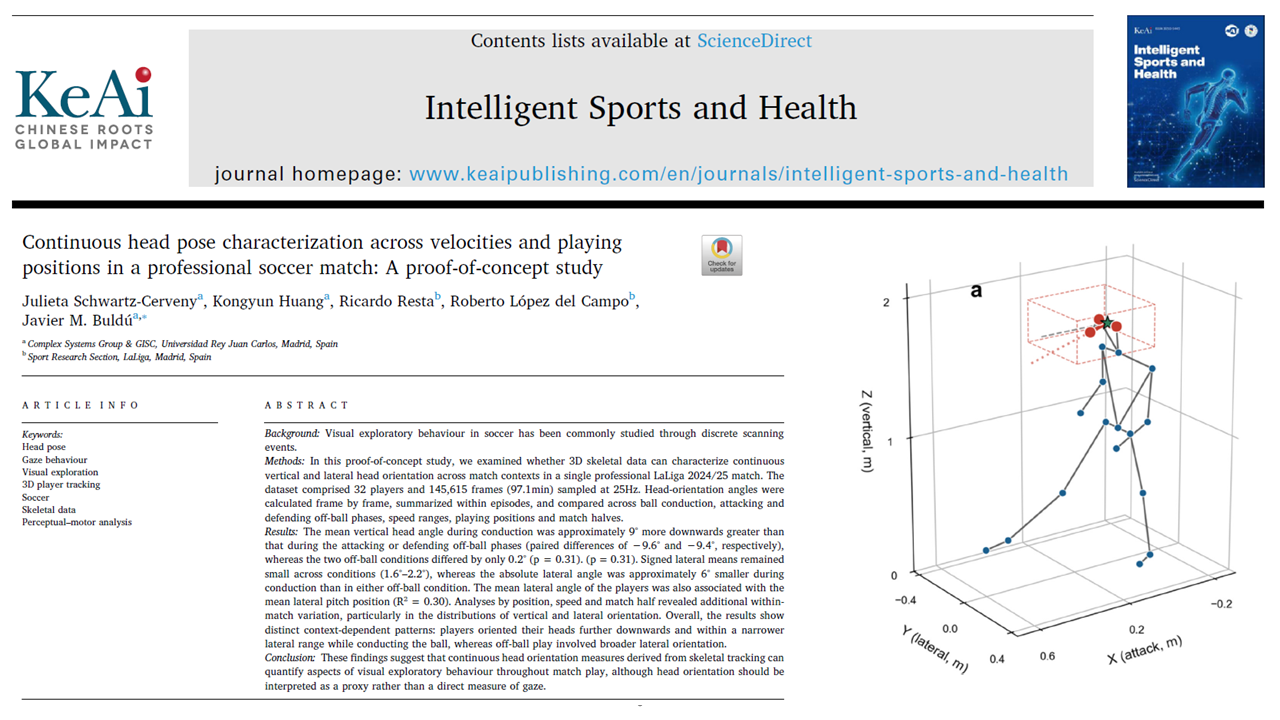
26 Sep #97. Continuous head pose characterization across velocities and playing positions in a professional soccer match: A proof-of-concept study
What happens to a footballer’s head orientation when they receive and carry the ball? And can tracking technology help us understand how players visually explore the game?
Coaches frequently encourage players to scan their surroundings before receiving the ball. Knowing where teammates, opponents and available spaces are located is essential for making decisions. However, measuring this behaviour during real matches remains challenging.
This study explored a new possibility: using 3D skeletal tracking data to measure players’ head orientation continuously throughout a professional football match, rather than relying exclusively on individual head-turning events.
The researchers analysed 32 players from one LALIGA 2024/25 match, using more than 145,000 tracking frames recorded at 25 Hz. They examined how head orientation changed when players were carrying the ball, attacking without it or defending, while also considering running speed and playing position.
What the study found
The clearest finding was that players oriented their heads approximately 9° further downwards when carrying the ball than when playing without it.
During ball-carrying situations, the average vertical head angle was −19.6°, compared with approximately −10° when attacking or defending without the ball.
This difference is consistent with the greater need to monitor the ball during close control. However, head orientation does not reveal exactly where a player is looking, so the study cannot confirm that players were directing their gaze towards the ball.
The second finding concerned lateral head orientation. When carrying the ball, players showed approximately 6° less lateral head movement relative to their body orientation than during off-ball situations.
This suggests that ball-carrying situations involve a more restricted range of head orientation, whereas playing without the ball allows or requires broader lateral orientation.
Interestingly, average head orientation was very similar when attacking and defending without possession. This does not mean that visual demands are identical in both situations, but it suggests that the clearest distinction in this match was associated with carrying the ball rather than the team’s possession phase.
The researchers also observed differences across playing positions and running speeds. Forwards tended to show more downward head orientation during ball-carrying situations, while players positioned closer to the touchlines generally oriented their heads more towards the centre of the pitch.
These positional patterns remain exploratory and require confirmation across more matches.
What this means for coaches
The study introduces a potentially valuable way to examine behaviours that are difficult to quantify through conventional match analysis.
Consider a midfielder preparing to receive under pressure. Their ability to identify available passing options depends partly on the information gathered before receiving the ball. Once in possession, the demands of controlling and protecting the ball may change how they orient their head.
Continuous head-orientation data could help analysts identify these changes and locate specific situations for video review.
For example, coaches could examine how a player’s head orientation changes before receiving, while carrying the ball and when releasing a pass. Combining these measurements with video could provide additional context for discussing individual actions and decision-making.
However, head orientation is not the same as visual scanning or awareness. Players can move their eyes without turning their heads, and a particular head angle does not demonstrate what information they perceived.
The study therefore does not establish that certain head positions produce better decisions or that players should adopt a particular orientation.
Practical takeaways
For coaches and performance analysts, the main opportunity lies in combining skeletal tracking, tactical context and video analysis.
Continuous head-orientation measurements could help identify moments when players change their orientation, compare their behaviour across similar game situations and support more detailed individual feedback.
This approach may eventually complement traditional scanning analysis, particularly when examining ball reception, ball carrying and movements without possession.
However, the research represents an initial proof of concept based on a single match. The accuracy of the specific head-angle measurements has not yet been independently validated, and further studies are needed before using these indicators to assess perceptual skills or establish training targets.
The most important contribution is therefore methodological: 3D tracking opens the possibility of studying aspects of players’ head behaviour continuously, without requiring wearable sensors or manual observation of every action.
Understanding how players orient their heads during competition may become another useful piece of information for coaches, provided it is always interpreted alongside what actually happens on the pitch.
Reference
Schwartz-Cerveny, J., Huang, K., Resta, R., López del Campo, R., & Buldú, J. M. (2026). Continuous head pose characterization across velocities and playing positions in a professional soccer match: A proof-of-concept study. Intelligent Sports and Health, 2, 265–276.
Full paper: https://doi.org/10.1016/j.ish.2026.09.003