


16 Jul Football players do not run because they can. They run because the game demands it.
Why physical performance in football cannot be understood without tactical context
For years, football has interpreted running metrics primarily as indicators of physical capacity.
Total distance, high-speed running, sprint distance and maximum speed are routinely used to describe performance. These variables are valuable, but they can create a misleading assumption: that a player runs more because they are fitter, faster or more willing to make an effort.
Match running performance also reflects something else: tactical exposure.
A player accelerates because a space opens, an opponent threatens the defensive line, possession is lost, a teammate progresses with the ball or the structure of the team requires a recovery run.
The player does not run simply because they can.
They run because the game creates a reason to run.
This is the central idea behind our recently published study:
Context-dependent velocity distributions in professional soccer: Players, referees, and ball conduction
https://doi.org/10.1016/j.ish.2026.03.005
Looking beyond isolated running metrics
Most studies of football’s physical demands focus on selected variables or predefined thresholds: total distance, metres above 21 km/h, sprint distance or accelerations.
Our study takes a different approach.
Using optical tracking data from 100 professional LALIGA matches, we analysed the complete distribution of instantaneous velocities of players, goalkeepers, referees and assistant referees.
The objective was not simply to determine how much players ran at particular intensities. It was to understand how their entire locomotor behaviour was organised and how that organisation changed according to the match context.
The distributions of outfield players showed two dominant locomotor regimes: walking and jogging. More importantly, those distributions were not stable.
They changed according to:
- the first or second half;
- the attacking or defending phase;
- the player’s position;
- direct interaction with the ball.
Context did not merely modify one physical variable. It changed how players distributed their movement across different speeds.
That is the main contribution of the paper.
Players do not simply run less in the second half
The study showed a clear shift during the second half: players increased their probability of walking and reduced their probability of jogging. Average walking and jogging speeds also decreased.
The most immediate explanation would be fatigue. As the match progresses, players become tired and reduce their physical output.
But this interpretation is incomplete.
In a previous study, we analysed 4,249 individual match observations and compared physical performance between halves while accounting for effective playing time—the period during which the ball is actually in play.
When interruptions were excluded, high-speed running and sprint distance per effective minute did not decrease globally in the second half. The response differed by position, but the supposed general decline in high-intensity performance was substantially reduced.
The two findings are compatible.
Players may maintain the high-intensity actions that the game requires by reorganising what happens at lower and moderate speeds. They walk more, jog less and continue to accelerate when the situation demands it.
This should not be interpreted as proof of a conscious energy-saving strategy. The study is descriptive and does not establish the physiological or tactical cause of the change.
It does, however, challenge the idea that fatigue produces a uniform decline across all movement intensities.
For a coach, that distinction matters.
A player who walks more is not necessarily disengaging from the match. Walking may provide recovery while the player maintains tactical organisation and prepares for the next demanding action.
The relevant question is therefore not simply:
Why is the player walking?
It is:
Is the player walking in the right place, at the right moment, and still able to accelerate when the game changes?
The ball reorganises movement
The clearest contextual change in the new study appeared when players were conducting the ball.
Across every positional group, ball conduction was associated with higher speeds, less walking and more jogging. In methodological terms, conduction was estimated through a proximity-based rule: the attacking player closest to the ball was considered to be conducting it when the distance was no greater than 1.5 metres.
The result supports a broader idea developed in another of our studies: the ball continuously reorganises the movement of the players around it.
We previously analysed how player speed and running direction changed according to distance from the ball, game phase, position and pitch location.
As a general pattern, players increased their speed as they moved closer to the ball, although their speed declined slightly at very short distances, when the movement had to be adjusted to interact with it. Running direction also changed markedly between attacking and defending phases.
A defender accelerates because an opponent threatens the space behind. A midfielder moves to create a passing line. A full-back overlaps because the winger moves inside. A forward changes speed because the ball carrier becomes able to play forward.
The physical action cannot be separated from the tactical event that generates it.
Position is a starting point, not a complete explanation
Playing position clearly influences physical demands, but a positional label cannot fully describe what a player experiences during a match.
In another recent study, we analysed 4,254 individual performances from LALIGA according to seven positions, effective playing time and time spent in and out of possession.
The results showed that physical demands depended simultaneously on position, intensity and game phase.
At high speeds, offensive roles such as wingers and forwards accumulated more distance when their team had possession. Defensive positions accumulated more high-speed distance without possession. The duration of the phases also influenced distance per minute, but not equally across positions.
There is therefore no single, stable demand associated with being a full-back, midfielder or forward.
A full-back may repeatedly overlap, move inside during build-up, remain behind the ball to protect transitions or defend long spaces against a deep-running winger. Each role creates different reasons to accelerate.
Positional averages remain useful as reference values. The problem begins when they are treated as prescriptions.
Same team, same match, different demands
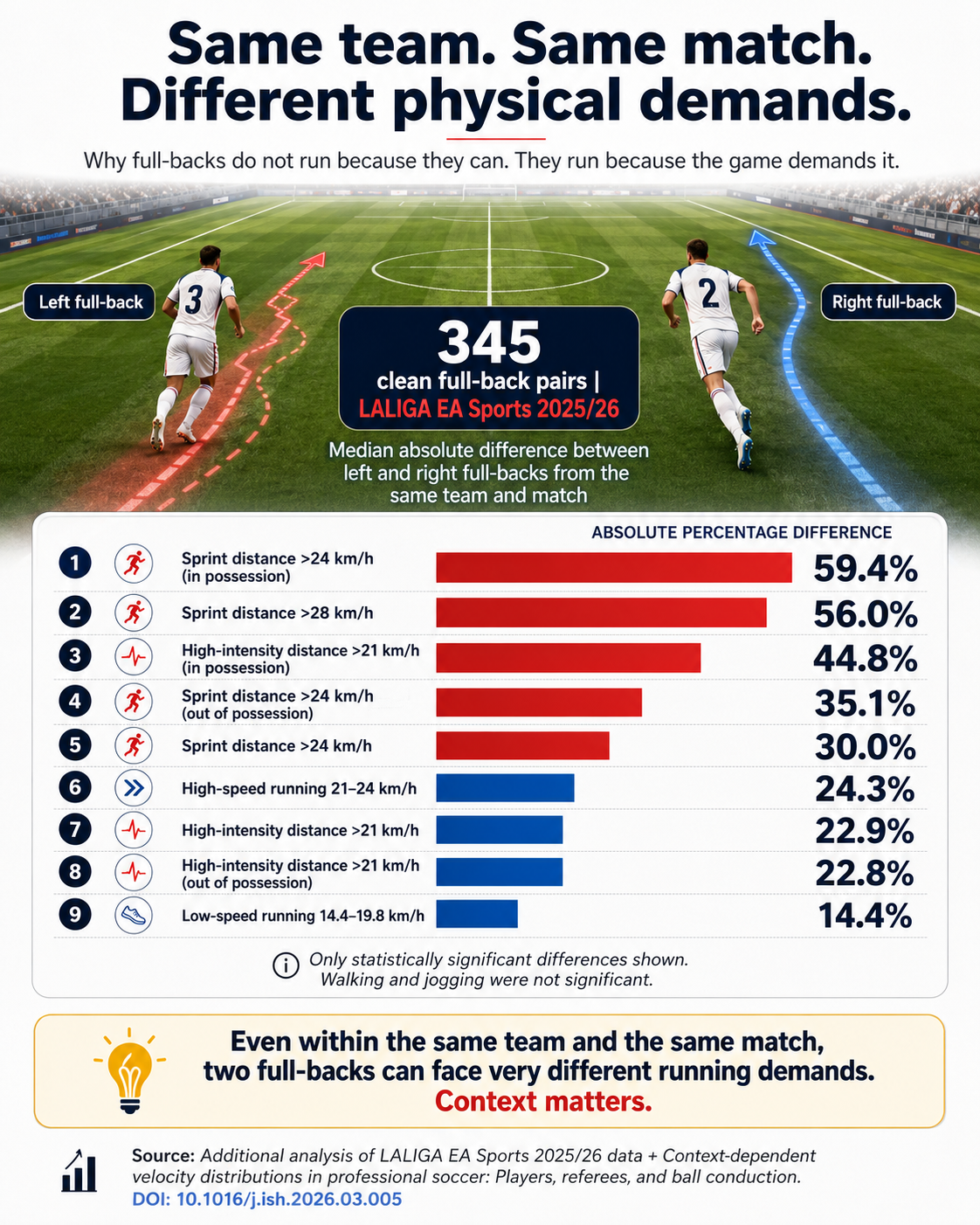
We recently explored this principle through an additional analysis of the complete 2025/26 LALIGA EA Sports season.
We compared 345 carefully selected pairs consisting of one right and one left full-back from the same team and match. Wing-backs and cases involving more than one player on either side were excluded, and all variables were expressed per minute.
Despite sharing the same opponent, coach, result and general game plan, the two full-backs frequently experienced very different high-intensity demands.
The median relative difference between sides was approximately:
- 23% for distance above 21 km/h;
- 45% for distance above 21 km/h in possession;
- 59% for sprint distance above 24 km/h in possession.
In 77% of the pairs, the difference in distance above 21 km/h during possession exceeded 20%.
The left full-back also recorded higher average high-intensity values across the season. This directional pattern is interesting, but it cannot be explained from physical data alone. It may be related to offensive orientation, player laterality, winger profiles, defensive match-ups or the distribution of the ball.
The most useful conclusion is not that one side necessarily runs more.
It is that two players from the same team and with nominally equivalent positions can be exposed to substantially different physical demands.
Position describes where a player starts conceptually. Context determines much of what they actually have to do.
What does this mean for coaches?
Do not evaluate effort without evaluating opportunity
A player cannot accumulate high-speed distance if the game does not generate high-speed situations.
A low sprint value may indicate limited involvement, but it may also reflect the role assigned to the player, the opponent’s behaviour, the location of the ball or the evolution of the score.
Before interpreting a physical metric, it is necessary to ask what opportunities the match created for that action.
Train the situation, not only the distance
Competition averages can help establish reference demands, but reproducing a number of metres does not necessarily reproduce the game.
A sprint after losing possession is not equivalent to an overlap, a defensive recovery, an attacking transition or a movement into depth. The speed may be similar, but the perception, decision and tactical purpose are different.
Training should recreate the situations that generate running, not merely its final volume.
Separate physical capacity from match expression
A sprint test measures what a player can do under controlled conditions.
Match tracking reflects what the player did in response to a particular game.
The two are related, but they are not interchangeable.
Low match output does not automatically indicate limited physical capacity. High output does not automatically indicate superior fitness. It may reflect greater exposure to a tactical demand.
Do not treat walking as the absence of performance
Football is an intermittent sport. Players constantly alternate between periods of low activity and short actions of very high intensity.
Walking can be part of effective regulation if the player maintains tactical connection, uses the period to recover and remains able to respond when the situation changes.
A player who jogs continuously may cover more distance without necessarily contributing more than one who alternates walking with decisive accelerations.
Integrate physical and tactical analysis
Knowing that a player completed 700 metres of high-speed running is not enough.
The useful questions are:
- Did those metres occur in or out of possession?
- Where on the pitch did they occur?
- How close was the player to the ball?
- Were they associated with overlaps, transitions, pressing or recovery runs?
- Did the action solve the tactical problem that generated it?
Physical data become more informative when they help explain the game rather than being presented as a separate layer of performance.
From physical output to tactical exposure
The accumulated evidence points in a consistent direction.
Effective playing time changes how we interpret second-half decline. Possession modifies running demands. Position changes the meaning of high-intensity activity. Distance and orientation to the ball shape speed and movement. Even two full-backs from the same team and match can experience very different physical loads.
Our new paper adds an important piece to this line of research.
Context does not only change isolated metrics.
It reorganises the complete distribution of locomotor behaviour.
Football is not athletics performed inside a tactical game. Physical performance emerges from the tactical game itself.
Players walk, adjust, accelerate, decelerate and sprint according to the opportunities and problems created around them.
They do not run continuously at the highest speed they can sustain.
They run when the game demands it.
The most useful question may therefore no longer be simply how much a player ran.
It may be why the game required that player to run—and why it required something different from the player beside them.