


20 May The Hidden Bias in Football Scouting
Introducing LALIGA’s Team Context Adjustment Model (TCAM)
With only one matchday remaining in the 2025/26 LALIGA EA SPORTS season, recruitment departments across professional football are already immersed in one of the most decisive moments of the year:
building next season’s squad.
Every summer, clubs compare hundreds of players across different teams, systems and tactical environments.
But there is a fundamental problem hidden inside most scouting processes:
not all player statistics are generated under the same tactical conditions.
And that creates one of the biggest biases in modern football recruitment.
The Problem With Traditional Scouting Comparisons
Imagine comparing two attacking players:
| Player | Team Shots | Player Shots |
|---|---|---|
| Player A | 600 | 90 |
| Player B | 350 | 55 |
Traditional analysis would usually conclude:
“Player A is more productive.”
But football is not played in neutral conditions.
Some teams:
- dominate possession,
- spend more time in the opponent’s half,
- generate more attacking sequences,
- create more entries into dangerous zones,
- and accumulate significantly more offensive opportunities.
Others operate inside completely different realities:
- lower possession,
- fewer passes,
- greater defensive exposure,
- fewer attacking possessions,
- and more transition-based football.
So the real question is not simply:
“Who produced more?”
But rather:
“What kind of ecosystem allowed those numbers to exist?”
Introducing the Team Context Adjustment Model (TCAM)
To address this problem, the Football Intelligence & Performance Area at LALIGA developed a new contextual framework:
Team Context Adjustment Model (TCAM)
The objective of TCAM is simple:
normalize player comparisons based on the tactical ecosystem where those statistics were produced.
Instead of analysing isolated player numbers, TCAM first evaluates the collective environment surrounding every action.
The model was developed using aggregated data from all 20 LALIGA EA SPORTS teams during the 2025/26 season (with one matchday remaining).
How The Model Works
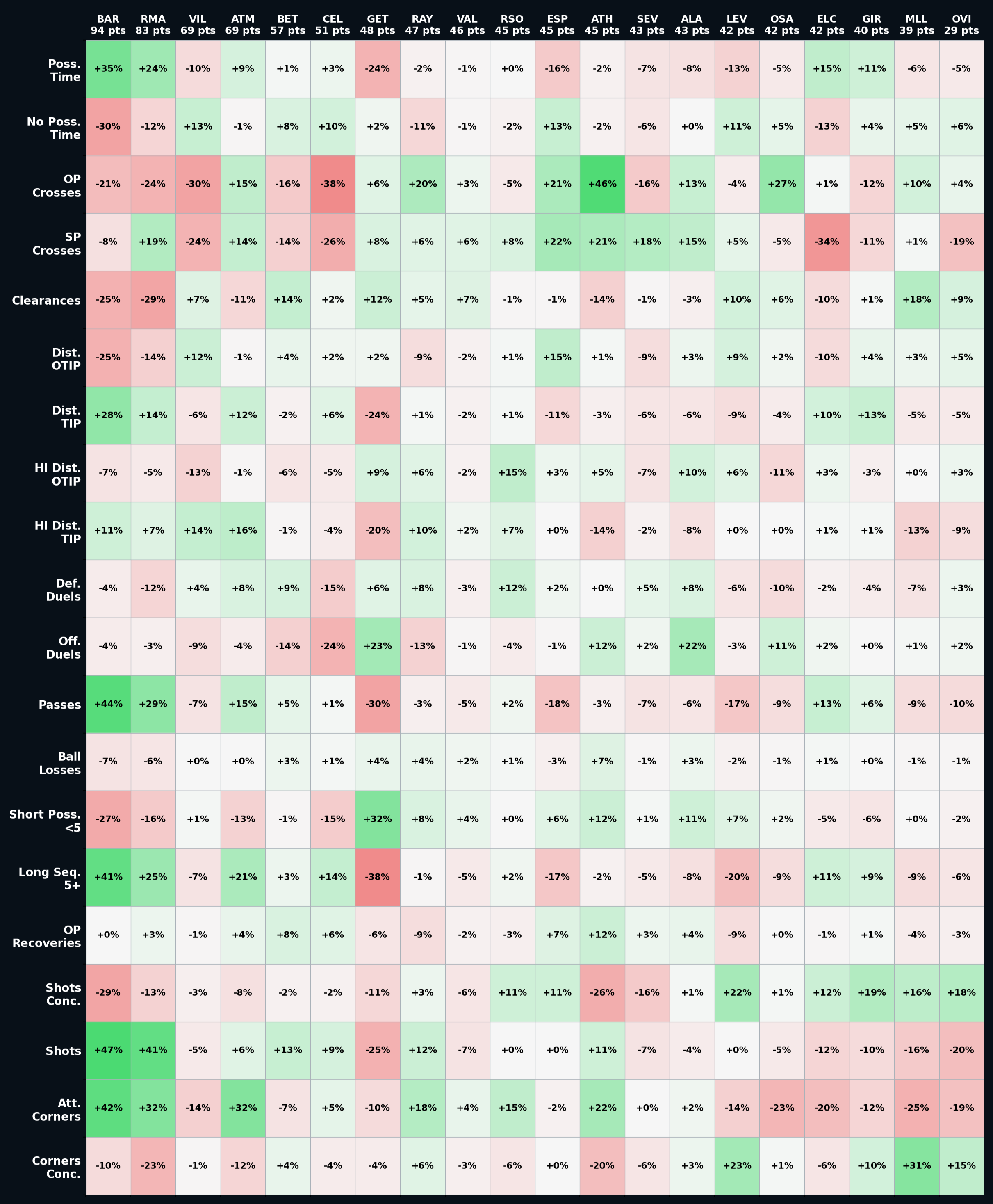
TCAM transforms collective team metrics into:
percentage deviation versus league average.
This allows us to objectively quantify:
- offensive opportunity environments,
- defensive exposure,
- possession structures,
- sequence profiles,
- and physical demands.
The matrix includes 20 collective contextual variables related to:
- possession time,
- passing volume,
- shots,
- possession sequences,
- recoveries,
- duels,
- clearances,
- crossing behaviour,
- and physical performance with and without possession.
The result is not simply a statistical table.
It is:
a tactical ecosystem map of the league.
Measuring Contextual Distance
One of the key outputs of TCAM is the ability to measure how far each team operates from the league’s tactical average.
In other words:
how “extreme” the ecosystem surrounding player production really is.
Teams Furthest From League Average
| Rank | Team | Average Contextual Deviation |
|---|---|---|
| 1 | FC Barcelona | 22.3% |
| 2 | Real Madrid | 17.6% |
| 3 | Getafe CF | 14.8% |
| 4 | Athletic Club | 11.8% |
| 5 | Atlético de Madrid | 10.2% |
This result is extremely revealing.
Because these teams represent radically different tactical identities:
- dominant possession football,
- direct-play structures,
- transition-heavy systems,
- and highly specialized collective behaviours.
In other words:
being far from average does not necessarily mean playing better or worse football.
It means operating inside a highly differentiated ecosystem.
And that directly shapes individual player statistics.
FC Barcelona: The Most Extreme Offensive Ecosystem
Barcelona emerged as the team furthest from league average.
The matrix reveals:
- massive positive deviations in possession,
- passing volume,
- shots,
- attacking corners,
- and long possession sequences.
At the same time:
- fewer clearances,
- fewer shots conceded,
- and lower defensive exposure.
This environment naturally amplifies offensive production.
A midfielder inside this ecosystem:
- participates in more passes,
- receives more touches,
- and spends more time inside organized attacking phases.
A striker:
- receives more attacking possessions,
- more box entries,
- and more shooting opportunities.
Which raises a fundamental scouting question:
how much of the production belongs to the player… and how much belongs to the ecosystem?
Getafe CF: A Completely Different Tactical Reality
Getafe also appears among the teams furthest from league average — but for completely different reasons.
The matrix shows:
- lower passing volume,
- fewer long possession sequences,
- lower attacking volume,
- and significantly higher defensive exposure.
This creates a completely different opportunity landscape for players.
And it highlights why direct statistical comparisons between players from radically different tactical environments can become deeply misleading.
Because the same number can mean completely different things depending on the ecosystem where it was produced.
Why TCAM Matters For Recruitment Departments
This is where contextual normalization becomes especially valuable for:
- scouting departments,
- recruitment analysts,
- sporting directors,
- and squad planning.
Because recruitment is not only about:
- what a player has done,
- but what a player could do inside YOUR ecosystem.
A winger moving from:
- a dominant possession team,
to: - a reactive transition-based team,
may experience a dramatic reduction in:
- touches,
- carries,
- final-third actions,
- and offensive involvement.
Meanwhile, a striker from a low-volume attacking team may significantly increase his production inside a dominant collective structure.
This is exactly what TCAM attempts to quantify.
Beyond Player Analysis: Environment-Adjusted Scouting
For years, football analytics focused mainly on:
- describing player actions.
But perhaps the next evolution is:
understanding the environments where those actions occur.
Not all players are exposed to the same:
- tactical demands,
- attacking opportunities,
- defensive workloads,
- possession structures,
- or physical contexts.
And until those environments are normalized objectively…
we risk confusing:
- ecosystem production,
with: - individual performance.
The Future of Recruitment?
Maybe the future of scouting is not simply identifying better players.
Maybe it is identifying:
which performances are sustainable once the ecosystem changes.
Because in football, context changes everything.